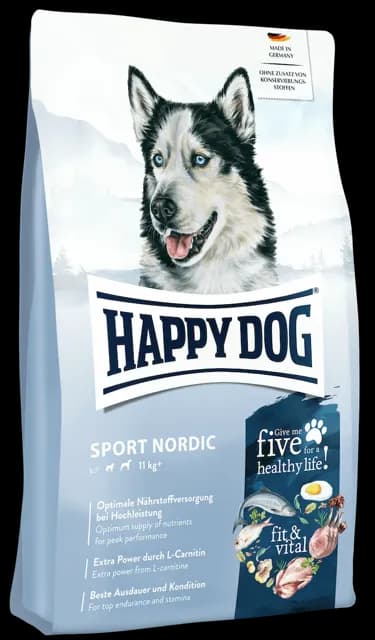



Happy Dog
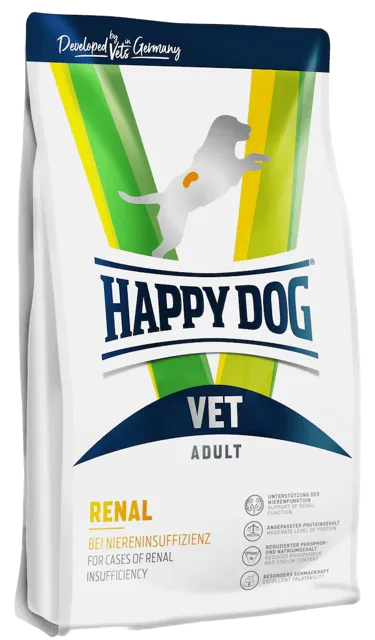
Happy Dog Vet Diet: Renal review
We don't put a score on this food. It is a veterinary diet, formulated for a diagnosed condition and meant to be fed on a vet's advice. Your vet has seen your dog and we have not, so a number from us could only pull you towards their advice or away from it, and neither of those is ours to do. What follows is what the label declares, what the analysis works out at, and where to buy it, with no judgement attached to any of it.
Happy Dog sells these seven kibbles through its VET Diet line, each named for the condition the maker aims it at. The list runs from Adipositas and Hepatic through Intestinal, Renal and Struvite to Urinary Low Purine, for dogs already working to a vet's plan.
Flavour
The Details
Dog fit
Dry
Adult
Toy, Small, Medium, Large, Giant
Salmon
What's in it
Ingredients, as declared: Maize, rice flour, potato flakes, poultry fat, meat meal (8 %), salmon meal (4 %), dried whole egg (2 %), carrots*, hydrolysed liver, sunflower oil, potassium chloride, canola oil, calcium carbonate, yeasts*, sodium chloride, seaweed*, linseed (0.15 %), mussel meat* (0.04 %), milk thistle, yeasts* (extract), artichoke, dandelion (0.015 %), ginger, birch leaves (0.015 %), stinging nettle, camomile, coriander, rosemary, sage, liquorice root, thyme (total dried products from the processing of herbs: 0.16%); * dried
Named ingredients
Nutritional additives
Vitamin A (3a672a) 12000 IU, vitamin D3 (E671) 1000 IU, vitamin E (all rac-alpha-tocopheryl acetate 3a700) 75 mg, vitamin B1 (thiamine mononitrate 3a821) 4 mg, vitamin B2 (riboflavin) 6 mg , Vitamin B6 (pyridoxine hydrochloride 3a831) 4 mg, biotin (D (+) - biotin 3a880) 575 mcg, pantothenic acid (calcium D-pantothenate 3a841) 10 mg, niacin (3a314) 40 mg, vitamin B12 70 mcg, choline chloride (3a890 ) 45 mg, antioxidants, tocopherol extracts from vegetable oils 1b306 (i). Trace elements / kg: iron (E1, iron (II) sulfate, monohydrate) 150 mg, copper (E4, copper (II) sulfate, pentahydrate) 15 mg, zinc (zinc oxide 3b603 130 mg, amino acid zinc chelate, hydrate 3b606 20 mg) 150 mg, manganese (E5, manganese (II) oxide) 25 mg, iodine (calcium iodate, anhydrous 3b202) 2.0 mg, selenium (E8, sodium selenite) 0.2 mg
What's on the label
Six of the seven follow one house pattern. A cereal or potato base sits at the front, poultry fat is the added fat, dried carrots, potassium chloride and sodium chloride cover the mineral side, and a fine tail of botanicals closes it. Urinary Low Purine sits apart from that pattern entirely, which the notes on that variety cover.
Hydrolysed liver is the ingredient every one of the seven shares. It is liver broken down into a coating rather than fed as an organ meat, and its job is keeping a therapeutic kibble worth eating for a dog whose appetite has gone quiet. On diets a dog has to stay on for months, that is not a small consideration.
Four of them carry the same long herb list, milk thistle, artichoke, dandelion, ginger, birch leaves, stinging nettle, camomile, coriander, rosemary, sage, liquorice root and thyme, declared together as 0.16% of dried herb products. Individual entries within it are printed as low as 0.008%. These are seasoning quantities.
Species naming varies a lot from one variety to the next. Some print chicken or salmon by name, others use poultry protein or meat meal, which leaves the animal open. If your dog is avoiding a particular bird or a particular red meat, the variety you are handed matters far more than the range as a whole does.
None of the seven declares its moisture, and the bags print no calorie figure, so the dry matter columns and the energy numbers here are both estimates. The added vitamin and trace element panels, by contrast, are itemised variety by variety. Vitamins A, D3, E and the B group sit beside iron, copper, zinc, manganese, iodine and selenium, and several varieties add L-carnitine or taurine on top.
Nothing here tells you which of the seven your dog needs. That is named at the consultation, and the vet who named the condition is the one who names the food.
How this variety differs
Renal reverses the usual order. Maize leads with rice flour and potato flakes behind it, and the meat arrives well down the list as meat meal at 8% and salmon meal at 4%, with dried whole egg at 2%. Meat meal leaves the species unnamed, which is worth flagging if your dog avoids a particular animal as well.
Protein is held to 17.4% of dry matter while fat runs to precisely the same figure, 17.4%. That is an unusual pairing, and it reflects the restriction the diet is built on, not a slip in the recipe. Energy is the highest in the line at 381 kcal per 100g, the carbohydrate estimate reads 58.7%, and calcium is the lowest of the seven at 0.43% of dry matter. Restricting protein and minerals together is what a diet of this type is for, and how far your dog needs it restricted is a clinical judgement.
Price and where to buy
The line comes in 1kg, 4kg, 12kg and 12.5kg bags depending on the variety, and four of them are also sold as multipacks. Per kilo the varieties run from £5.23 to £8.07. On an energy based estimate for a 15kg dog, that lands somewhere between about £1.15 and £2.07 a day across the range, with the vet's dosing instruction coming first.
Nutritional analysis
Declared analysis
Estimated using Modified Atwater factors*
16%
16%
2%
4%
Dry weight
17.4%
17.4%
2.2%
4.3%
58.7%
As-fed composition
Estimated breakdown of the finished product by ingredient category, from the declared ingredient list and ingoing weights. These are estimates, not measurements.
18%
70%
3.8%
6.4%
1.9%
Pricing & size
- Pack size
- 1kg, 4kg, 12.5kg, 12.5kg x 2
- Retailer pricing
- Coming soon
Live retailer pricing is not yet available for this food. Prices, cost per day and where to buy will appear here once retailer data is live.
Ingredients and nutrition are taken from manufacturer data. Retailer pricing is not yet live for this food.
Related dog food guides
Ranked shortlists that include foods like this one.