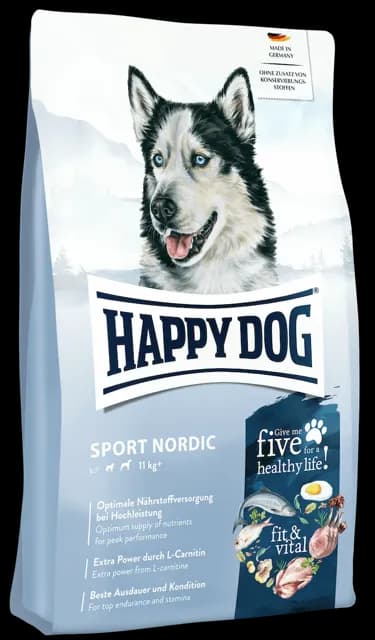




Happy Dog
Happy Dog Sensible Pure: Lamb Pure (New Zealand) review
Flavour
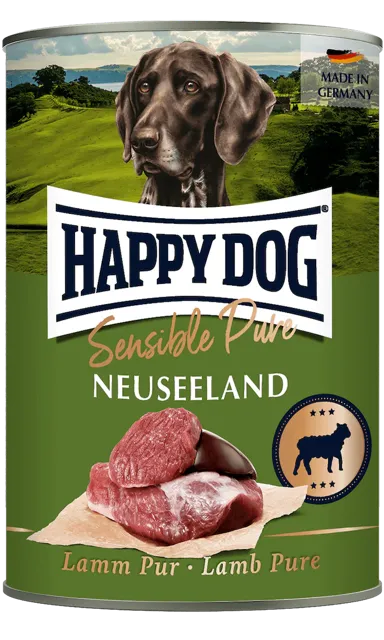
Happy Dog Sensible Pure takes the single-animal idea about as far as it goes. Eleven recipes, each built from one named animal and its own organ meats, with minerals the only other entry on the ingredient list. There is no cereal, no vegetable and no thickener, and the country on the front tells you where the animal was sourced. Four recipes land in our Outstanding band, six more in Excellent and the Sea Fish in Good.
Our view
Likely to suit
The front of the pack names the animal in your dog's bowl before you even turn it over.
- Dogs working through an elimination diet, since nine of the eleven recipes keep to one named animal and carry nothing else animal on the label
- Owners hunting an unfamiliar protein, with buffalo, horse, kangaroo, ostrich and goat each given their own recipe
- Dogs that do better without cereal or vegetable bulk, as meat and minerals are the entire ingredient list
- Owners who want the offal named, because each label spells out the hearts, livers, lungs and stomachs it uses
- Dogs that need protein high in the bowl, converting to between 47.3% and 58.4% of dry matter across the range
- Households feeding two dogs or one big one, since most recipes come in an 800g size as well as a 400g
Worth watching
Stripping a range back this far leaves a few gaps in the printing that you will want to know about.
- The Game and Sea Fish recipes each carry more than one animal, wild boar with deer in the first and whitefish with salmon in the second, so neither can hold a strict single-animal plan
- Moisture is left off five of the labels, so the dry matter figures on those are worked from an assumed 78% and should be read as our estimate
- Six of the eleven print no percentage at all for their animal share, where the others declare 60%, 67% or 70%
- Only the Game label prints trace elements beside its vitamins, where the rest of the range declares vitamins alone
- Declared calcium swings a long way from recipe to recipe, and a dog that has to keep calcium steady will do better on one flavour than on a rotation
Written by our editorial team. Independent guidance, not veterinary advice.
How this scores
How we scoreThe Details
Dog fit
The front of the pack names the animal in your dog's bowl before you even turn it over. Stripping a range back this far leaves a few gaps in the printing that you will want to know about.
Wet
Adult
Toy, Small, Medium, Large, Giant
Lamb
The score, in context
Four recipes reach our Outstanding band, six more sit in Excellent and the Sea Fish holds Good. What separates them is what each label chooses to print, and hardly the animal at all. The labels that declare more of themselves read higher on transparency, even though the construction underneath is the same in every pack. The middle of the wet adult shelf sits in our Excellent band too, so a Good reading in this company is still a fine tin and no straggler.
The analysis itself is exceptional for a wet food. Protein converts to between 47.3% and 58.4% of dry matter and fat to between 23.8% and 36.4%, with carbohydrate barely registering because there is nothing in the recipe to supply it. On the labels that skip moisture, the estimated carbohydrate figure is really the slack in that estimate, not anything added to the pack. Hold that in mind when you compare one recipe against another.
What's in it
Ingredients, as declared: Lamb Meat and Lamb by-products (67% - lamb lung, lamb meat, lamb liver, lamb heart), minerals ) (Recipe contains 32.8% drinking water)
Named ingredients
Nutritional additives
Vitamins/kg: Vitamin D3 (3a671) 200 IU, Vitamin E (all rac-alpha-tocopheryl acetate 3a700) 20 mg NB - When calculating Calcium Content, please use this formula to calculate calcium as a percentage on a dry matter basis: 1) 100% – % Moisture = % Dry Matter 2) [(As Fed Calcium %)/(% Dry Matter)] X 100%
Ingredient notes
The construction never changes. One animal, its muscle meat and its organs, and added minerals. Hearts, livers, lungs, stomachs, tripe and larynx are named individually on the labels that use them, which is unusually candid: most makers fold organ meat into a category term and leave you guessing. Few foods carry as much nutrition as liver, and on these labels you can see which animal supplied it.
Five labels put a figure on their animal share: 70% for the Beef, Game and Horse, 67% for the Lamb and 60% for the Sea Fish. Three of those also declare their drinking water, at 29.8% or 32.8%. The other six describe their contents in words without weighing them, which is the single biggest difference between the recipes that scored well here and the ones that did not.
With no grain, no vegetable and no gum in the recipe, everything in the analysis comes from the animal. That is why protein sits so high and why fat follows it, running from a lean 23.8% of dry matter on the Horse to 36.4% on the Lamb. Dogs that put on weight easily suit the leaner recipes, and the labels print enough for you to choose.
The declared additive panels vary more than the food does. Some labels list only vitamin D3 and vitamin E, most add vitamin A and vitamin B1, and only the Game prints zinc, manganese and iodine alongside them. Minerals appear in the ingredient list on every recipe, so the difference is in what gets declared rather than necessarily in what goes in.
Calcium is printed on eight of the labels and the spread is wide, running from 0.75% of dry matter on the Buffalo to 3.64% on the Lamb. For a healthy adult dog on a mixed feeding routine, that variation is not something to lose sleep over. If calcium is being managed for a reason, it is a good argument for picking one recipe and staying with it.
How this variety differs
Lamb lung, meat, liver and heart at 67%, with 32.8% drinking water declared. It is the richest recipe here, fat converting to 36.4% of dry matter, and nutritional balance reads Outstanding on our pillars. Calcium is the highest declared in the range at 3.64% of dry matter, worth knowing if that is something you are watching.
Price and value
£11.22 a kilo on the Beef, Duck, Game, Lamb and Turkey recipes and £7.91 on the Goat. The other five had no per-kilo figure when we checked. Sold in 400g and 800g sizes, with the Goat, Kangaroo and Ostrich in 400g only.
The basis is a 15kg adult dog in moderate condition on about 840 kcal a day (110 × bodyweight^0.75, the standard maintenance estimate). On the recipes we have a figure for, feeding comes to between £5.79 and £9.17 a day. Across the whole range that corresponds to roughly 732 to 1004 grams a day. The label's own guide for a dog of 10 to 25 kg runs from 500 to 1000 grams.
Nutritional analysis
Declared analysis
Estimated using Modified Atwater factors*
11%
8%
0.4%
2.5%
Dry weight
50%
36.4%
1.8%
11.4%
0.4%
As-fed composition
Estimated breakdown of the finished product by ingredient category, from the declared ingredient list and ingoing weights. These are estimates, not measurements.
66.9%
13%
20.1%
Pricing & size
- Pack size
- 400g, 800g, 6 x 400g, 12 x 400g, 6 x 800g
- Retailer pricing
- Coming soon
Live retailer pricing is not yet available for this food. Prices, cost per day and where to buy will appear here once retailer data is live.
Ingredients and nutrition are taken from manufacturer data. Retailer pricing is not yet live for this food.
Related dog food guides
Ranked shortlists that include foods like this one.