


Happy Dog
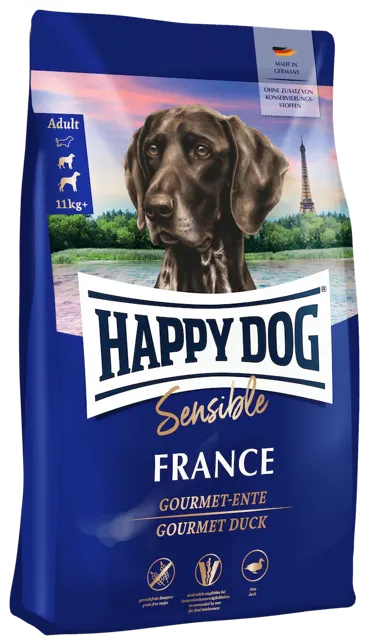
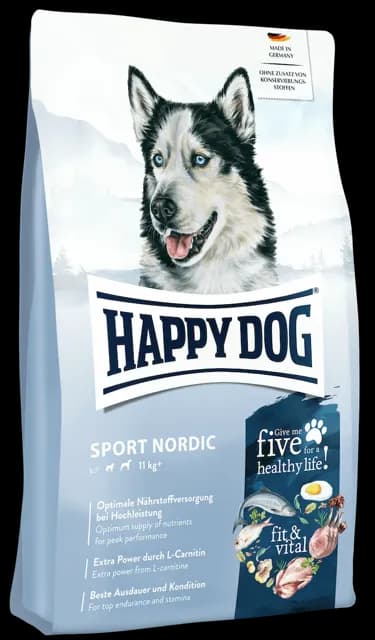
Happy Dog Sensible: Duck Grain-Free (France) review
Flavour
Happy Dog Sensible is the country range: twelve recipes, each named after a place and built around one animal, from duck and lamb through to horse, ostrich, rabbit and sea fish. The plainest of them run to eight or nine entries in total, which is the whole idea, because fewer ingredients mean fewer things for a sensitive dog to react to. The range sits in our Average band bar the Canada rabbit and lamb, which reaches our Good band. They run close enough together that the real question is which protein your dog needs, not which bag reads highest.
Our view
Likely to suit
A short ingredients list beats a long one when the job is working out what your dog cannot eat.
- Dogs on an exclusion diet, with the Montana, Africa and Karibik recipes each built on one animal and a handful of plant entries
- Owners hunting for a protein their dog has never met, since horse, ostrich and rabbit are all on this shelf
- Dogs kept off grain, with the France, Montana and Africa recipes built on potato instead
- Medium and larger breed households, the sizes this range is written for
- Dogs that need the calories eased back, with the Toscana recipe declaring fat at 7.5%
- Vegetarian households, with the India recipe built on rice and pea protein and no meat on the list
Worth watching
The range is carefully put together, and there are still a few label details you will want to know.
- The oils and fats, the hydrolysed protein and the hydrolysed liver all go unnamed, which matters when you are ruling a species in or out
- The Greece recipe carries the grain free name on the bag while rice heads its ingredients list, and it also holds shrimps and calamari at 1% each
- The India recipe is vegetarian rather than vegan, with dried whole egg and a milk derived hydrolysed protein on the list
- Fish runs through several recipes, including Canada and Ireland, which both lead on salmon meal
Written by our editorial team. Independent guidance, not veterinary advice.
How this scores
How we scoreThe Details
Dog fit
A short ingredients list beats a long one when the job is working out what your dog cannot eat. The range is carefully put together, and there are still a few label details you will want to know.
Dry
Adult
Medium, Giant
Duck
The score, in context
There is not much daylight between these twelve. Eleven of them finish in our Average band, with the Canada recipe alone reaching the Good band where the typical adult dry food lands. The middle of the range is tightly packed; the Karibik sea fish and the India vegetarian come out furthest back, with protein and processing the pillar that holds them there. Rabbit & Lamb from Canada comes out highest of the range.
Across the shelf protein and processing reads Average on almost every bag, and that is the honest summary. These are simple, well made exclusion diets with moderate meat shares and a starch load on the high side, carbohydrate estimating between 45.1% and 56.5% of dry matter against the 46.2% typical. Keeping the animal list short means leaning on the plant side. A short, readable list is exactly the thing you are buying here, and no general nutrition measure has a column for it.
Not one of these twelve labels prints a moisture figure. The dry matter conversions here take the 8% a kibble usually carries, and several of the calorie figures are our estimates.
What's in it
Ingredients, as declared: Potato*, duck protein* (23 %), oils and fats, beet pulp* (desugared), hydrolysed protein, apple pomace*, sodium chloride, yeasts* (extract). *dried.
Named ingredients
Nutritional additives
Vitamins / kg: vitamin A (3a672a) 15000 IU, vitamin D3 (3a671) 900IU, Trace elements / kg: iron (iron(II) sulphate, monohydrate 3b103) 70 mg, copper(copper(II) sulphate pentahydrate 3b405) 13 mg, zinc (zinc oxide 3b603) 85 mg, manganese(manganese(II) oxide 3b502) 16 mg, iodine (calcium iodate, anhydrous 3b202) 1.6mg, selenium (sodium selenite 3b801) 0.25 mg. Amino acids / kg: DL-methionine (3c301) 3500 mg.
Ingredient notes
The recipes come in two shapes. The simplest, France, Montana, Africa and Karibik, run to between eight and ten entries: a starch, the named animal, a fat, beet pulp with apple pomace, a little salt and a yeast extract. The rest build the familiar Happy Dog tail of seaweed, linseed, mussel meat and herbs on top of the same idea.
Potato does the carrying on the grain free recipes, often with potato protein behind it to lift the protein figure without introducing a second animal, which is a neat move on a limited ingredient food. Rice does the same job on the others, and Italian sweet chestnut flour at 26% is the genuinely unusual one, standing in for cereal on the Piemonte duck recipe.
Where these labels name one animal they largely mean it, up to a point. The named meat is the only species declared, but oils and fats, hydrolysed protein and hydrolysed liver all appear without a source, and any of those can carry material from another animal. For a dog with a mild sensitivity that will rarely matter. If a vet is running a formal elimination trial, bring it up with them before the trial starts.
Horse at 15%, ostrich at 15% and rabbit are the truly novel entries here, and they are much of the reason this range exists. A protein a dog has never eaten cannot be the one causing the trouble, which makes these recipes genuinely useful once the usual suspects have been ruled out.
DL-methionine is dosed at 3500 mg per kilo on the France and Karibik recipes, an amino acid that also acidifies the urine. Taurine is added to India, where there is no meat to supply it. Calcium, where the label gives enough to work it out, runs from 1.25% of dry matter on India up to 2.07% on Montana.
The vegetable and herb tails vary by country and are a pleasant touch at these doses. Andalucia brings peppers, tomatoes, olive leaves and courgettes to 0.5% in total, Greece runs a similar Mediterranean mix, and Toscana finishes with elderflowers, lavender and fennel among its 0.26% of dried herbs.
How this variety differs
Duck protein at 23% on a potato base, eight entries in total and duck the only species named on the list. DL-methionine is dosed at 3500 mg per kilo and calcium works out at 1.36% of dry matter.
Price and value
Per kilo, the range runs from £4.24 on the Lamb & Rice, Low Fat and Salmon & Rabbit recipes up to £6.06 on Montana. Bags go from 1kg for a trial up to 12.5kg for the main size, with a 2.8kg on India and a 4kg on Africa, and twin packs on several of the larger sizes.
Take a 15kg adult dog in moderate condition, needing about 840 kcal a day on the standard maintenance estimate of 110 × bodyweight^0.75. Daily portions land between 227 and 258 grams, according to which recipe you pick, at £0.99 to £1.54 a day. Portion by your dog's condition, not by the scoop.
Nutritional analysis
Declared analysis
Estimated using Modified Atwater factors*
20%
10%
3%
7%
Dry weight
21.7%
10.9%
3.3%
7.6%
56.5%
As-fed composition
Estimated breakdown of the finished product by ingredient category, from the declared ingredient list and ingoing weights. These are estimates, not measurements.
23%
52.5%
4%
12%
8.6%
Pricing & size
- Pack size
- 1kg, 11kg, 11kg x 2
- Retailer pricing
- Coming soon
Live retailer pricing is not yet available for this food. Prices, cost per day and where to buy will appear here once retailer data is live.
Ingredients and nutrition are taken from manufacturer data. Retailer pricing is not yet live for this food.
Related dog food guides
Ranked shortlists that include foods like this one.