
Skip to content
Off the Leash
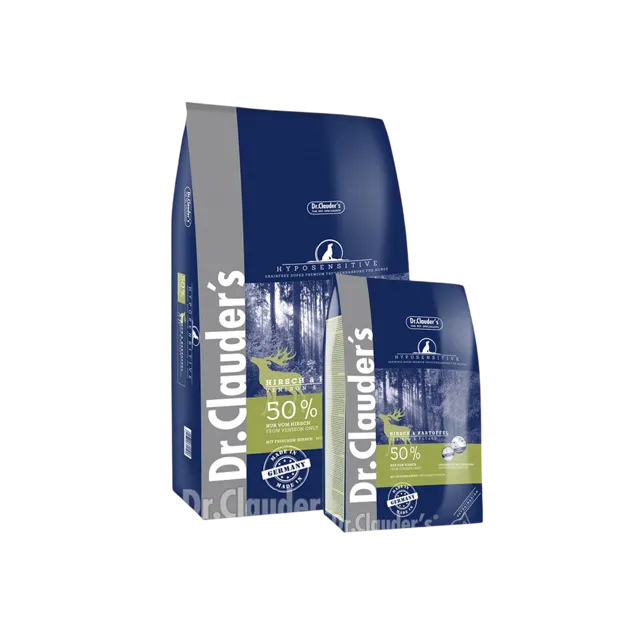
Dr Clauders Hyposensitive – Venison & Potato

Dr Clauders

Dr Clauders Hyposensitive: Venison & Potato review

46.8/100Average
DryAdultSenior

Dr Clauders Hyposensitive is a five-recipe line built the way exclusion diets are built: one named animal, one starch, and as little else as the recipe can manage. Potato leads every label, the animal follows it, and most of the range carries a Pro Digest blend of papaya, pineapple, cranberry and yeast glucans for the gut. The mini duck and the herring sit in our Good band with the other three just below them in our Average band, which is where a potato-led kibble tends to land in a general reading.

Where to buy: coming soon
Live retailer pricing is coming soon. Once we have prices from UK retailers, the best price, cost per day and where to buy will appear here.

Our view

Likely to suit

This line keeps the list of suspects short while you work out what your dog reacts to.

  • Dogs mid exclusion diet, with one headline animal named in each recipe and a short list behind it
  • Owners hunting for less common proteins, with venison and herring sitting alongside the duck and the salmon
  • Dogs that struggle with cereal, as potato does all of the starch work in every recipe here
  • Households wanting a gut-focused kibble, with chicory inulin on every label and a Pro Digest blend on most
  • Owners of small dogs, since the duck recipe also comes as a mini kibble made for little mouths

Worth watching

There is one detail on this range worth reading carefully, and a few smaller ones behind it.

  • Only the herring recipe keeps all of its animal content to fish, and even there salmon oil sits alongside the herring
  • Poultry fat, chicken fat or fish oil sits behind the headline meat in the other four, which matters for a strict trial rather than for general sensitivity
  • Across the range carbohydrate converts to between 52.4% and 57.0% of dry matter, a load carried mostly by potato
  • None of the five prints a calorie figure, so what is shown here is our estimate from each analysis

Written by our editorial team. Independent guidance, not veterinary advice.

How this scores

How we score
46.8/100Average
Protein and processingAverage
Nutritional balancePoor
TransparencyOutstanding
ValueAverage

The Details

Dog fit

This line keeps the list of suspects short while you work out what your dog reacts to. There is one detail on this range worth reading carefully, and a few smaller ones behind it.

Food type

Dry

Life stage

Adult, Senior

Breed size

Toy, Small, Medium, Large, Giant

Main protein

Venison

The score, in context

Two of these five land in our Good band, the same band the typical adult dry food occupies, with the other three a little below in our Average band. One pattern explains all of it. An exclusion diet buys its short ingredient list by leaning hard on a single starch, and potato at or near half the recipe leaves less room for meat than a general-purpose kibble carries. Judged as a tool for working out what your dog can eat, and not as a meat-first food, the range does the job it was made for. The herring is the one that manages both at once.

What's in it

Ingredients, as declared: Potato flour 47%, deer protein (dried) 15%, potato protein, beet pulp, deer meat 5%, chicken fat, linseed, vegetarian protein hydrolysate, monocalcium phosphate, potato starch, fish oil, drClauder´s Pro Digest 5 Complex 0.75% (yeast, papaya powder, pineapple powder, cranberry powder, yeast beta glucans, inulin (FOS), spirulina powder, hemp flour), chicory powder 0.73%, yeast, (dried, incl. 0.05% glucans), calcium carbonate, sodium chloride, thistle oil.

Named ingredients

Potato flour 47%, deer protein (dried) 15%, potato protein, beet pulp, deer meat 5%, chicken fat, linseed, vegetarian protein hydrolysate, monocalcium phosphate, potato starch, fish oil, drClauder´s Pro Digest 5 Complex 0.75% (yeast, papaya powder, pineapple powder, cranberry powder, yeast beta glucans, inulin (FOS), spirulina powder, hemp flour), chicory powder 0.73%, yeast, (dried, incl. 0.05% glucans), calcium carbonate, sodium chloride, thistle oil.

Nutritional additives

Vitamin a 12000 Ie, D3 1200 Ie, E 70mg, B1 7mg, B2 7mg, B6 5mg, B12 50mcg, C 90mg, Biotin 400mcg, Folate 2mg, Nicotinic Acid 30mg, Pantothenic Acid 18mg, Choline Chloride 1.450mg, Copper (as Cupric Sulphate) 10mg, Zinc (as Zinc Sulphate Monohydrate) 30mg, Iodine (as Calcium Iodide, Anhydrous) 2mg, Selenium (as Sodium Selenite) 0.2mg.

Ingredient notes

The construction repeats itself every time: potato first, one named animal second, beet pulp for fibre, then a small tail of oils and gut ingredients. That shape is entirely deliberate. The fewer things in the bowl, the fewer suspects there are when something disagrees with your dog.

The catch is in the fats. Poultry fat appears in the duck, the mini and the salmon, chicken fat in the venison, and fish oil in most of them. That leaves the herring as the only recipe whose animal content stays within one family. For everyday sensitivity that is rarely a problem, but if a vet has you running a strict trial, those are the lines to read twice.

Pro Digest is the range's own gut blend of papaya and pineapple powders, cranberry, yeast beta glucans, hemp and spirulina, with inulin in some versions. Only the mini goes without it, which leaves it on four labels of the five. At below 1% it is there for support and not as treatment.

Potato protein, and in the herring dried peas, do some quiet topping up of the protein figure behind the meat. Plant proteins do not match meat for amino acid quality, so they are better read as making up numbers than as the reason a protein declaration looks the way it does.

Every label in this range declares its vitamins and trace minerals in full, dose by dose. Plenty of kibbles at any level fail to manage that. Chicory powder runs throughout as a source of inulin for the gut bacteria.

How this variety differs

Deer is the draw, with dried deer protein at 15% and deer meat at 5% over potato flour at 47%. It is the one label in the line that adds seniors to the adult recommendation. Chicken fat and fish oil sit behind the venison, so it is a novel-protein recipe and not a venison-only one. Protein converts to 23.1% of dry matter with the lowest carbohydrate of the five at 52.4%, and thistle oil closes the list.

Price and value

Per kilo, the salmon and the venison are £5.71, the duck £5.94, the herring £6.77 and the mini duck £11.60. The four full sized recipes come in 3.5 kg and 11.5 kg bags, the mini in a 2 kg bag.

As a guide, a 15kg adult dog in moderate condition wants about 840 kcal a day (110 × bodyweight^0.75, the standard maintenance estimate). That works out at £1.42 a day on the salmon, £1.44 on the venison, £1.49 on the duck, £1.67 on the herring and £2.87 on the mini duck. Those calorie figures are estimates from each analysis, since none of these labels prints one.

Nutritional analysis

Declared analysis

Energy
334 kcal/100g

Estimated using Modified Atwater factors*

Protein

21%

Fat

11%

Fibre

3%

Ash

8.3%

Moisture

9%

Dry weight

Protein

23.1%

Fat

12.1%

Fibre

3.3%

Ash

9.1%

Carbs

52.4%

As-fed composition

Estimated breakdown of the finished product by ingredient category, from the declared ingredient list and ingoing weights. These are estimates, not measurements.

Meat

20.8%

Carbs

70.8%

Veg

0.7%

Oils

3.3%

Other

4.4%

Pricing & size
Pack size
3.5 kg, 11.5 kg
Retailer pricing
Coming soon

Live retailer pricing is not yet available for this food. Prices, cost per day and where to buy will appear here once retailer data is live.

Ingredients and nutrition are taken from manufacturer data. Retailer pricing is not yet live for this food.

Related dog food guides

Ranked shortlists that include foods like this one.
All reviews

Featured feeding accessories

All feeding accessories

Brackenwood

Slow Feeder Maze Bowl

Slows fast eaters and eases gulping at mealtimes.

From £12.99· 4 retailers
View

Tarn & Co

Raised Double Diner

Height-set stand for easier, tidier eating.

From £28.99· 3 retailers
View

Reviewed by Off the Leash Editorial

Last updated 28 August 2026