



Dachshund Superfood
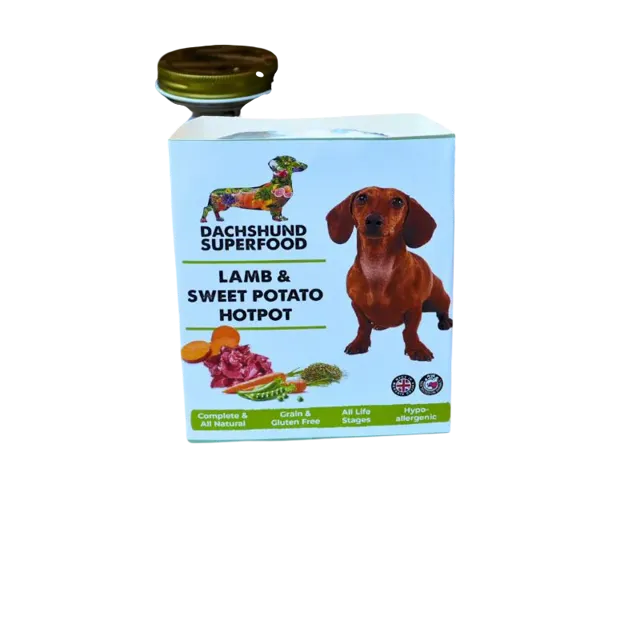
Dachshund Superfood Pate Private label: Lamb & Sweet Potato Hotpot review
Flavour
Dachshund Superfood's pate trays are aimed at small dogs and lead hard with meat. Three of the four recipes declare their named animal at 60% or more. The plant side stays to sweet potato, carrot and a few vegetables in single figures, and the same joint and prebiotic extras run through every label. All four trays land in our Excellent band, with a chicken and brown rice recipe for puppies sitting alongside the adult three.
Our view
Likely to suit
Turn one of these trays over and you will find a recipe that is easy to follow.
- Small adult dogs, the size the maker names for every tray in the range
- Dogs kept to one animal, since the chicken casserole names chicken and nothing else from the animal kingdom
- Owners reading for the meat percentage, since the casserole prints chicken at 65% and the hotpot lamb at 60%
- Puppies in the household, because the range carries a chicken and brown rice recipe made for them
- Dogs with stiffening joints, as glucosamine and chondroitin appear on all four labels
Worth watching
A few of these labels carry more than the front of the tray lets on.
- The lamb hotpot and the puppy bake both carry fish oil, so neither can anchor a strict single-animal trial
- The puppy recipe uses brown rice at 6%, worth knowing if you keep the household off grain
- The hotpot is the richest tray of the four, with fat converting to 40.0% of dry matter
Written by our editorial team. Independent guidance, not veterinary advice.
How this scores
How we scoreThe Details
Dog fit
Turn one of these trays over and you will find a recipe that is easy to follow. A few of these labels carry more than the front of the tray lets on.
Wet
Adult
Small
Lamb
The score, in context
All four trays finish in our Excellent band, level with the typical adult wet food, which is a strong field to be keeping pace with. The meat percentages do most of the lifting, because a label that prints its animal at 60% or 65% gives our reading something solid to work with. Two things put the salmon behind the chicken. A 26% share of the tray is described only as ocean fish, and its estimated carbohydrate converts to 22.2% of dry matter where the typical adult wet food runs at 15.8%. Nutritional balance and transparency read Excellent or better on every tray, protein and processing matches them on all but the lamb, and value reads Excellent across the four.
What's in it
Ingredients, as declared: Lamb (60%), Dried Sweet Potato (1.3% equivalent to 4% Sweet Potato), Dried Peas (1.3% equivalent to 4% Peas), Dried Carrots (1.3% equivalent to 10% Carrots), Dried Basil, Dried Parsley, Dried Sage, Dried Mint, Dried Rosemary, Fish Oil, Vegetable Oil, Fructo-oligosaccharies (Prebiotic FOS; 0.1%), Yeast (as a source of Prebiotic MOS; 0.1%), Minerals, High Nucleotide Yeast Extract (0.015%), Seaweed Meal, Glucosamine (0.004%), Chondroitin Sulphate (0.002%), Cranberry (0.002%), Yucca Schidigera (0.002%)
Named ingredients
Ingredient notes
Meat opens every label and does so with a figure beside it. Chicken is at 65% on the casserole, lamb at 60% on the hotpot, chicken at 60% again on the puppy bake, and the salmon tray combines salmon at 40% with ocean fish at 26%. Protein converts to between 32.0% and 48.0% of dry matter across the range, with the puppy recipe at the top of that spread, which is where a growing dog wants it.
The plant side is a small supporting cast. The casserole has sweet potato and carrot at 4% each with peas and broccoli at 1%, the hotpot sweet potato and peas, and the puppy bake brown rice at 6%. The hotpot goes a step further than most labels manage by printing both the dried weight and its fresh equivalent, so 1.3% dried carrots is declared as the equivalent of 10% carrots. That is a genuinely useful piece of honesty and it is rarer than it should be.
The extras are consistent across the range even though the labels express them in two different ways. The casserole and the salmon give mannan oligosaccharides at 111mg/kg, seaweed at 55.6mg/kg, glucosamine at 38.9mg/kg and chondroitin at 22.2mg/kg. The hotpot and the puppy bake print the same sort of amounts as percentages, glucosamine at 0.004% and chondroitin at 0.002%. Either way the levels are small and supportive. Yucca, cranberry and yeast extract sit alongside them at the same scale.
Two entries stay general. Mixed herbs appears on the casserole and the salmon without being broken down, and both of those labels close with vegetables and with vitamins and minerals, none of it itemised. No separate vitamin and trace element table is published for the puppy recipe either, its supplements being folded into the composition instead. For most buyers that is a small thing next to a meat percentage this clearly stated. It is still the one part you cannot check.
The oils differ recipe by recipe and they are worth a glance. Sunflower oil at 0.1% appears on the casserole and the salmon, a light source of vitamin E; the hotpot carries fish oil alongside an unnamed vegetable oil; and the puppy bake uses fish oil. Fish oil is a good thing for skin and coat. It is also why the hotpot and the puppy bake cannot be treated as single-animal recipes.
How this variety differs
Lamb at 60% makes this the red meat option. If your dog has had enough of poultry, this is a sensible change. It is the fattiest tray in the range at 40.0% of dry matter, and its dried vegetables are printed with their fresh equivalents, 1.3% dried peas being declared as the equivalent of 4% peas. Fish oil and an unnamed vegetable oil both appear here.
Price and value
£7.57 a kilo across the range, in 395 g trays, with the lamb hotpot in a 380 g tray.
As a guide, feeding a 15kg adult dog in moderate condition works out at £4.86 a day on the chicken casserole, £5.08 on the lamb hotpot and £5.20 on the salmon. Those come to roughly 642, 671 and 687 grams a day respectively. The working is a maintenance need of about 840 kcal a day (110 × bodyweight^0.75, the standard estimate) and our estimated energy figures for each recipe.
The puppy bake is fed to a growth guide rather than a maintenance one, so the feeding table printed on that tray is the one to work from.
Nutritional analysis
Declared analysis
Estimated using Modified Atwater factors*
8%
10%
1%
2.5%
75%
Dry weight
32%
40%
4%
10%
14%
As-fed composition
Estimated breakdown of the finished product by ingredient category, from the declared ingredient list and ingoing weights. These are estimates, not measurements.
60%
24%
12.3%
1.7%
0.1%
2%
Pricing & size
- Pack size
- 380 g tray
- Retailer pricing
- Coming soon
Live retailer pricing is not yet available for this food. Prices, cost per day and where to buy will appear here once retailer data is live.
Ingredients and nutrition are taken from manufacturer data. Retailer pricing is not yet live for this food.
Related dog food guides
Ranked shortlists that include foods like this one.