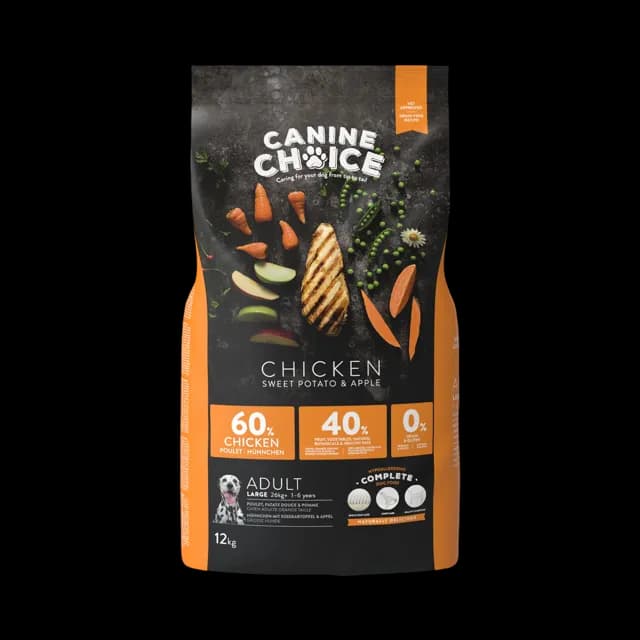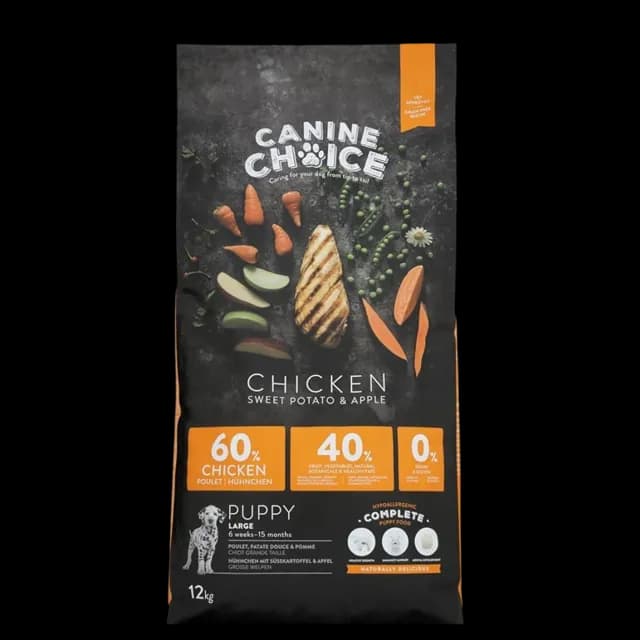




Canine Choice
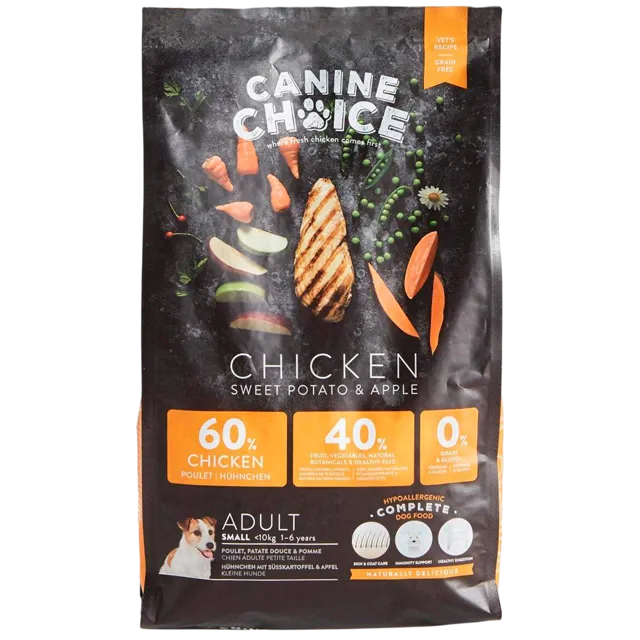
Canine Choice Adult Small: Chicken review
Canine Choice Adult Small takes the brand's grain-free formula and tunes it for little dogs, packing more protein and fat into each mouthful and selling it in a 7kg bag sized for smaller appetites. Chicken, lamb and salmon versions share one construction, each majoring on its named meat with a joint pair and prebiotics in support, and every one of them earns a place in our Excellent band.
Our view
Likely to suit
Your small dog burns through energy quickly, and this recipe was written around that arithmetic.
- Small breed dogs, fed from a denser kibble with protein at 30% in the chicken version
- Busy little dogs that need their calories in a small bowl, at 400 kcal per 100g
- Dogs that struggle with grain, since sweet potato, peas and pea protein stand in for cereal
- Owners who want joint cover started early, with glucosamine and chondroitin dosed on every label
Worth watching
Before you order the first bag, give these points a moment of thought.
- All three flavours carry chicken fat and fish, so a dog that must avoid chicken or fish outright needs a different range
- Energy is packed tight in these recipes, so a small dog with a quiet routine will want its portions kept honest
- The label declares no moisture figure, so the dry matter numbers here use our standard 8% assumption
Written by our editorial team. Independent guidance, not veterinary advice.
How this scores
How we scoreThe Details
Dog fit
Your small dog burns through energy quickly, and this recipe was written around that arithmetic. Before you order the first bag, give these points a moment of thought.
Dry
Adult
Small
Chicken
The score, in context
All three flavours finish in our Excellent band. For context, the typical adult dry food comes in a band lower, in Good, and the spread across this trio is small enough that flavour preference can safely decide it.
What's in it
Ingredients, as declared: Fresh chicken (36%), dehydrated chicken (19.5%), sweet potato (18%), peas (7%), hydrolyzed chicken liver (5%), apple pulp (4%), dehydrated carrot (0.32% equivalent to 3% of carrots), dehydrated cranberries (0.08% equivalent to 0.75% cranberries), chicken fat, brewer's yeast, fish oil, minerals, chicory (source of fos), mannan-oligosaccharides (mos), camomile, parsley, rosehips, sea algae, rosemary, cloves, cartilage (a source of chondroitin 200 mg/kg), glucosamine (300 mg/kg), yucca schidigera.
Named ingredients
Nutritional additives
- **Nutritional Additives (per kg):** Vitamin A: 19,000 IU, Vitamin D3: 1,800 IU, Vitamin E: 550mg/kg, Vitamin C: 275mg/kg, Zinc (Zinc Oxide): 108mg/kg, Iron (Ferrous Sulphate, Monohydrate): 68mg/kg, Copper (Cupric Sulphate, Pentahydrate): 9mg/kg, Manganese (Manganous Sulphate, Monohydrate): 7mg/kg, Iodine (Potassium Iodide): 3.2mg/kg, Selenium (Sodium Selenite): 0,11mg/kg. - **Zootechnical Additives:** Bacillus Subtilis C-3102 (Dsm 15544): 1 X 1,000,000,000 Cfu/kg (Probiotic). - **Technological Additives:** Antioxidants - Tocopherol Extracts Of Vegetable Oils: (135 mg/kg).
Ingredient notes
The chicken version opens with 36% fresh chicken and 19.5% dehydrated, and the lamb and salmon follow the same fresh-plus-dehydrated pattern. Cooking drives the water out of fresh meat, so dehydrated meat is the quiet workhorse of a kibble. Here it is present in a share big enough to matter. Protein converts to between 31.5% and 32.6% of dry matter across the trio.
Carbohydrate is estimated at 35.0% to 36.9% of dry matter, usefully below the 46.2% typical of adult dry food, with sweet potato and peas supplying it grain free. One oddity: the lamb recipe lists sweet potato at just 1%, leaning on peas and pea protein instead.
Joint support is printed rather than implied, glucosamine at 300 mg/kg with chondroitin at 200 mg/kg from cartilage, and chicory FOS plus MOS look after the gut. In each recipe the natural palatant is a hydrolysed entry from the lead meat.
Chicken fat provides the cooking fat throughout and fish oil the omegas in the chicken and lamb, so the named meat leads but never travels alone. That is a quality-of-life detail for most dogs and a dealbreaker only for strict avoiders.
The botanical tail from camomile to yucca is a garnish, present at trace level. What you are paying attention to on this label is the meat structure, and it holds up.
How this variety differs
The chicken pairs 36% fresh with 19.5% dehydrated and gives sweet potato its biggest role in the trio at 18%. Its label also lists a Bacillus subtilis probiotic among the additives.
Price and value
All three flavours are £5.71 a kilo, each sold in a single 7kg bag size.
A 15kg adult dog in moderate condition would get through around 210 grams a day, about £1.20, taking the standard maintenance estimate of 840 kcal a day (110 × bodyweight^0.75) as the basis. Genuinely small dogs need far less: the chicken label's own guide runs from 14 grams a day for a 0.5kg dog up to 135 grams at 10kg.
Nutritional analysis
Declared analysis
30%
19%
3.75%
7%
Dry weight
32.6%
20.7%
4.1%
7.6%
35%
As-fed composition
Estimated breakdown of the finished product by ingredient category, from the declared ingredient list and ingoing weights. These are estimates, not measurements.
60.5%
25%
8.5%
2.1%
3.9%
Pricing & size
- Pack size
- 7kg
- Retailer pricing
- Coming soon
Live retailer pricing is not yet available for this food. Prices, cost per day and where to buy will appear here once retailer data is live.
Ingredients and nutrition are taken from manufacturer data. Retailer pricing is not yet live for this food.
Related dog food guides
Ranked shortlists that include foods like this one.