



Buddy
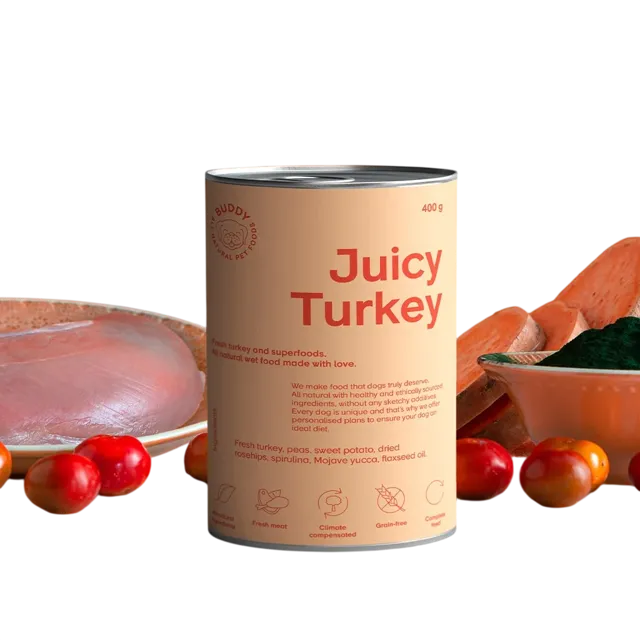
Buddy Wet Canned Pâté: Juicy Turkey review
Buddy Wet Canned Pâté is a Nordic pâté range built on meat and offal and very little else. Five of the six labels open with 65% meat and animal derivatives, then do something that phrase rarely allows. The bracket after it names every part inside the figure, muscle meat with heart, gizzard, intestine or trachea, each carrying its own percentage. The Salmon & Chicken tin splits the same animal total between 39% meat and 26% fish. Pea flour at 2% is the only meaningful plant entry, and all six tins share our Average band.
Our view
Likely to suit
Let your dog's preferences lead here, because the range runs from red meat through poultry to fish without changing its shape.
- Dogs that thrive on organ meat, since heart, gizzard, intestine and trachea are named and quantified inside the animal figure
- Owners who want to know what sits behind a category heading, because the bracket that follows accounts for all of it
- Dogs kept to one animal, as the lamb, duck, turkey and beef tins fill the whole 65% with parts of a single species
- Grain-avoiding households, with pea flour and a little lignocellulose the only plant matter on any label
- Fussy drinkers, since the tins run to 78% moisture and the water goes down with dinner
- Rotation feeders, since the six recipes keep the same build and swap the animal
Worth watching
These labels tell you more than most, and a few of the details are worth having in mind first.
- Meat and animal derivatives is the heading the animal content arrives under, so an elimination diet needs the maker to confirm the parts in writing
- Lignocellulose supplies the fibre, a purified plant fibre rather than fibre from whole fruit or vegetables
- The Turkey & Rabbit tin declares less calcium than the rest, at 0.68% of dry matter where the others sit at 0.91%
- Only the 400g tin is made, so a toy breed will be working through one over two or three meals
Written by our editorial team. Independent guidance, not veterinary advice.
How this scores
How we scoreThe Details
Dog fit
Let your dog's preferences lead here, because the range runs from red meat through poultry to fish without changing its shape. These labels tell you more than most, and a few of the details are worth having in mind first.
Wet
Adult
Toy, Small, Medium, Large, Giant
Turkey
The score, in context
An Average placing needs its context. Wet food scores strongly as a category and its midpoint falls in our Excellent band, so a tin can be genuinely meaty and honest and still finish below that middle mark. Two things account for the distance here. The first is that heading: however fully the bracket explains it, a term that could legally cover any warm blooded animal counts for less on our reading than a species printed up front.
The second is the estimated carbohydrate, which runs from 5.8% of dry matter on the duck tin up to 26.3% on the lamb, against 15.8% for the typical adult wet food. That figure is worked out by difference and not measured, so on labels that declare protein and fat as minimums it reads high. With only 2% pea flour and 0.7% lignocellulose listed, there is very little starch in the tin for it to describe. Transparency reads Outstanding on every recipe, protein and processing reads Average across the six, and nutritional balance reads Outstanding on four of them with the lamb and the turkey and rabbit in Excellent.
What's in it
Ingredients, as declared: 65% meat and animal derivatives (30% turkey meat, 25% turkey heart, 10% turkey gizzard), 2% pea flour, 0.7% lignocellulose, 0.3% calcium carbonate, 0.1% dried kelp, 0.01% dried cranberries, 0.01% dried blueberries.
Named ingredients
Nutritional additives
A-vitamin (3a672a) 800 IU, D3-vitamin (3a671) 250 IU, E-vitamin (3a700) 125 mg, B1-vitamin (3a821) 1 mg, biotin (3a880) 0.4 mg, zink (3b606) 10 mg, jern (3b106) 8 mg, mangan (3b504) 2.4 mg, kaliumiodid (3b201) 0.6 mg.
Ingredient notes
Category terms usually mean a recipe is asking to be taken on trust. Not this one. The bracket after the 65% accounts for the full amount. The lamb tin reads 35% lamb meat, 20% lamb intestine and 10% lamb heart, and the beef tin 25% beef with 20% trachea and 20% heart. You are told which animal, which parts and how much of each, which is far more than the phrase normally delivers.
Those organ entries are the ones doing the work, and they are not filler. A carcass keeps much of its iron, its B vitamins and its taurine in the organs, and heart in particular behaves more like muscle meat than like anything the word derivatives brings to mind. A dog on this range eats a nose to tail bowl by design.
The plant list is almost an afterthought, which is the point of a pâté like this. Pea flour at 2% binds, lignocellulose at 0.7% adds bulk without calories, calcium carbonate at 0.3% tops up the calcium and dried kelp at 0.1% brings iodine and trace minerals. Cranberries and blueberries appear at 0.01% each, a garnish on the label.
No oil is added anywhere in the range, so every gram of fat arrives inside the meat. That shows in the analysis. Fat converts to 25.0% of dry matter on four of the tins and 36.4% on the duck, the richest of the six, while protein lands between 36.4% and 43.2% of dry matter. For a wet food those are strong numbers, and they come from the animal content itself.
The added panel is short and every entry carries a figure, running through vitamins A, D3, E and B1, biotin, zinc, iron, manganese and potassium iodide. Turkey & Rabbit is the outlier, printing no vitamin A, twice the zinc at 20 mg per kilo and a higher dose of B1 than any of the others. That is worth noticing if you are comparing the tins line by line. The panel also reads as a translation from Scandinavian labelling, with international units written as IE on most tins and IU on the rest.
How this variety differs
Turkey meat at 30% with heart at 25% and gizzard at 10%, the most organ forward recipe of the six and a sensible pick for a dog that likes strong flavours. Protein converts to 40.9% of dry matter at an estimated 95 kcal per 100g, and the additive panel prints its units as IU, not the IE used on most of the range.
Price and value
£9.07 a kilo, in one 400g tin sold singly and in packs of 6.
As a guide, feeding a 15kg adult dog in moderate condition works out at between £7.20 and £8.08 a day depending on the tin. That comes to roughly 794 to 891 grams, assuming about 840 kcal a day (110 × bodyweight^0.75, the standard maintenance estimate).
Nutritional analysis
Declared analysis
Estimated using Modified Atwater factors*
9%
5.5%
0.7%
2%
78%
Dry weight
40.9%
25%
3.2%
9.1%
21.8%
As-fed composition
Estimated breakdown of the finished product by ingredient category, from the declared ingredient list and ingoing weights. These are estimates, not measurements.
77.2%
19.1%
2.4%
0.1%
1.2%
Pricing & size
- Pack size
- 400g · 6x400g
- Retailer pricing
- Coming soon
Live retailer pricing is not yet available for this food. Prices, cost per day and where to buy will appear here once retailer data is live.
Ingredients and nutrition are taken from manufacturer data. Retailer pricing is not yet live for this food.
Related dog food guides
Ranked shortlists that include foods like this one.