
Skip to content
Off the Leash
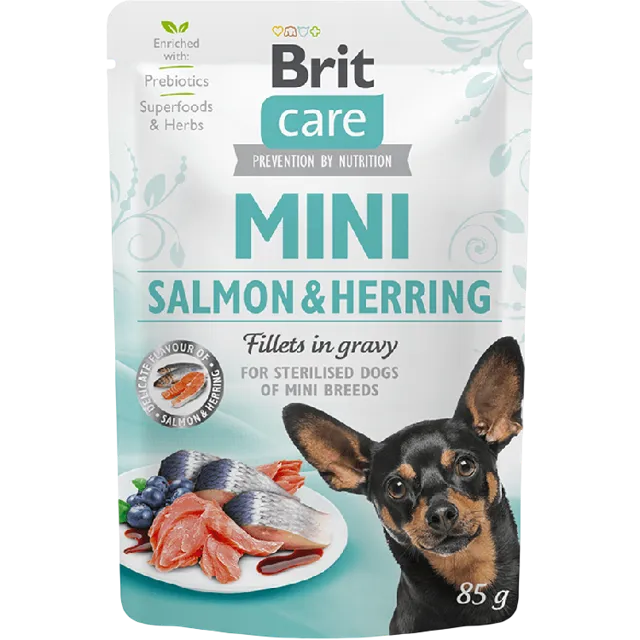
Brit Care Mini fillets in gravy – Salmon & Herring (sterilised)

Brit

Brit Care Mini fillets in gravy: Salmon & Herring (sterilised) review

51.8/100Good
WetPuppyAdult

Brit Care Mini Fillets in Gravy is a small breed range of 85 g servings, built on shredded fillets sitting in gravy and offered across six labels from chicken and tuna through to venison. The construction never changes: a large block of meat and animal derivatives with a named animal declared inside it, then pea flour, dried blueberries and a pinch of herbs and spices. The Chicken and Tuna label reaches our Excellent band, with its five siblings a step below in our Good band. What separates them is how much each label pins down, since the analysis behind them is respectable throughout.

Where to buy: coming soon
Live retailer pricing is coming soon. Once we have prices from UK retailers, the best price, cost per day and where to buy will appear here.

Our view

Likely to suit

If your dog is small and eats little, a serving that opens fresh at every meal keeps things simple.

  • Small dogs fed meal by meal, since each 85 g serving is used in one go with nothing to cover and keep back
  • Fussy eaters, because shredded fillets in gravy give a very different mouthfeel to a smooth loaf
  • Owners who like to rotate flavours, with six labels that hold one recipe and change the animal on the front
  • Households feeding across the ages, as most of these labels are written for puppies, adults and seniors alike
  • Dogs that do better on a rich bowl, with fat converting to a quarter of dry matter on most of the range

Worth watching

The way these labels are written is the thing to understand before you settle on one.

  • Most of each serving is listed as meat and animal derivatives, so none of these labels can anchor an elimination diet even where a single animal is named on the front
  • The named animal is a small share of the whole on several of them, with lamb and venison each declared at 8% inside an 85% block
  • Carbohydrate converts to an estimated 28.8% of dry matter on the Chicken and Tuna label against 15.8% for the typical adult wet food, and the rest of the range sits in the same region

Written by our editorial team. Independent guidance, not veterinary advice.

How this scores

How we score
51.8/100Good
Protein and processingAverage
Nutritional balanceOutstanding
TransparencyOutstanding
ValueGood

The Details

Dog fit

If your dog is small and eats little, a serving that opens fresh at every meal keeps things simple. The way these labels are written is the thing to understand before you settle on one.

Food type

Wet

Life stage

Puppy, Adult, Senior

Breed size

Small

The score, in context

These labels gather around the middle of the wet shelf, a strong category that sits in our Excellent band, and the spread between them is almost entirely a question of disclosure. Transparency reads Outstanding on every one of them. The bulk of each serving is still a category term that can stand for any warm blooded animal in any proportion, and it can vary between batches while the wording stays put. Nutritional balance tells a happier story and reads Outstanding right across the range, with protein and fat both landing at sensible levels for a small dog. Chicken and Tuna reaches our Excellent band because its label prints 75% chicken inside its 80% fillet block and names its tuna at 5%. Its five siblings settle a step below in our Good band. None of that is a safety verdict. It measures how much each label is prepared to show you.

What's in it

Ingredients, as declared: 77 % meat and animal derivatives in fillets, 8 % fish and fish derivatives (from this 4 % salmon, 4 % herring), 2.7 % pea flour, 1.5 % dried blueberries, 0.9 % lignocellulose, 0.4 % dried cloves, 0.4 % dried citrus, 0.4 % dried rosemary, 0.4 % dried curcuma, 0.2 % calcium carbonate.

Named ingredients

77 % meat and animal derivatives in fillets, 8 % fish and fish derivatives (from this 4 % salmon, 4 % herring), 2.7 % pea flour, 1.5 % dried blueberries, 0.9 % lignocellulose, 0.4 % dried cloves, 0.4 % dried citrus, 0.4 % dried rosemary, 0.4 % dried curcuma, 0.2 % calcium carbonate.

Nutritional additives

: vitamin A (3a672a) 300 IU, vitamin D3 (3a671) 65 IU, vitamin E (3a700) 35 mg, vitamin B1 (3a821) 0.2 mg, biotin (3a880) 0.1 mg, zinc (3b606) 3 mg, iron (3b106) 2.4 mg, manganese (3b504) 0.7 mg, iodine (3b201) 0.2 mg, copper (3b406) 1 mg, taurine (3a370) 240 mg, L-methionine (3c305) 1, 200 mg.

Ingredient notes

A block of meat and animal derivatives in fillets heads all six labels, running from 77% to 85% of the serving. That term is a legal catch all covering the fleshy parts of any warm blooded land animal, from the best cuts to the plainest offcuts. It gives no clue which animals are in the pot or in what proportion. It is not a hygiene worry, and plenty of decent foods use wording like it to keep a recipe private, but it does mean the meat has to be taken on trust.

Inside that block a named animal is declared, and the amount varies a great deal. The Chicken and Tuna label says that 75% of its block is chicken, while lamb and venison are each pinned at 8% and rabbit at 5%. Fish gets clearer treatment on two labels, with tuna at 5% and with salmon and herring at 4% each. What you get on all of them is a named animal you can point at, sitting alongside a much larger unnamed one.

The plant and botanical side barely moves between labels: pea flour at 2.7%, dried blueberries at 1.5% and lignocellulose at 0.9% on most of them. Small pinches of cloves, citrus, rosemary and curcuma follow at 0.4% each. At those levels the herbs and spices are flavour and antioxidant flourishes, well below a working dose. Pea flour is a milled pea powder bringing fibre, iron and a little plant protein, which is a fair use of it in the small amount printed here.

Every label carries taurine at 240 mg per kilo, a real dose and not a token. The vitamin and trace element panel carries a printed figure for each entry. Calcium carbonate at 0.2% tops the minerals up, taking calcium to 1.88% of dry matter on the adult labels.

How this variety differs

Salmon and Herring is written for neutered dogs whose weight needs an eye keeping on it. It is the only label naming two fish, with salmon and herring at 4% each inside an 8% fish and fish derivatives entry. Its fillet block is the smallest here at 77%, and the panel adds vitamin B1 and L-methionine, the latter a supplement used to acidify urine.

Price and value

Sold in 85 g servings.

The label's own feeding guide covers small dogs directly. It puts a 2 to 5 kg dog on 170 to 297 grams a day, and a 5 to 10 kg dog on 297 to 510 grams a day.

For a larger dog outside that guide, the same energy works out at roughly 1085 grams a day for a 15kg adult in moderate condition. That takes about 840 kcal as the daily maintenance figure (110 × bodyweight^0.75).

Nutritional analysis

Declared analysis

Energy
77.4 kcal/100g
Protein

6%

Fat

4%

Fibre

0.4%

Ash

1%

Moisture

84%

Dry weight

Protein

37.5%

Fat

25%

Fibre

2.5%

Ash

6.2%

Carbs

28.8%

As-fed composition

Estimated breakdown of the finished product by ingredient category, from the declared ingredient list and ingoing weights. These are estimates, not measurements.

Meat

88%

Added water

4.9%

Carbs

2.8%

Other

4.3%

Pricing & size
Pack size
0.085 kg
Retailer pricing
Coming soon

Live retailer pricing is not yet available for this food. Prices, cost per day and where to buy will appear here once retailer data is live.

Ingredients and nutrition are taken from manufacturer data. Retailer pricing is not yet live for this food.

Related dog food guides

Ranked shortlists that include foods like this one.
All reviews

Featured feeding accessories

All feeding accessories

Brackenwood

Slow Feeder Maze Bowl

Slows fast eaters and eases gulping at mealtimes.

From £12.99· 4 retailers
View

Tarn & Co

Raised Double Diner

Height-set stand for easier, tidier eating.

From £28.99· 3 retailers
View

Reviewed by Off the Leash Editorial

Last updated 28 August 2026