
Skip to content
Off the Leash
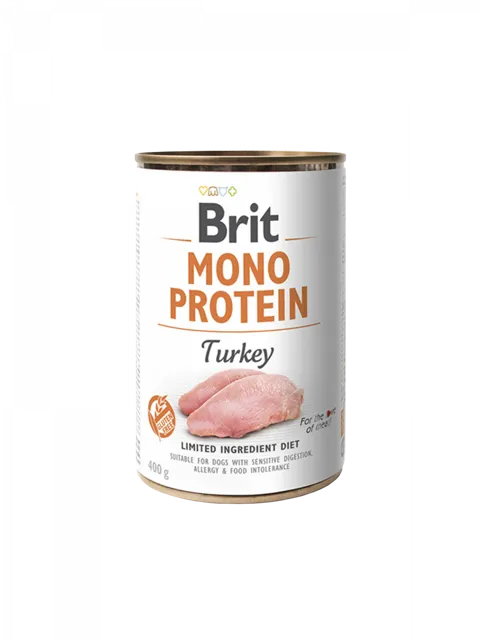
BRIT MONO PROTEIN – TURKEY – —

Brit

BRIT MONO PROTEIN – TURKEY review

77.2/100Excellent
WetAdult

Brit Mono Protein Turkey does exactly what the name promises. Turkey, meat and organs together, makes up 74% of the can, pea starch at 3% and pea fibre at 1% are the only other ingredients on the list, and no second animal appears anywhere. It sits in our Excellent band, and it is one of the most straightforward labels you will read on the wet shelf.

Where to buy: coming soon
Live retailer pricing is coming soon. Once we have prices from UK retailers, the best price, cost per day and where to buy will appear here.

Our view

Likely to suit

When you need to know every animal in the bowl, a label this short answers the question on its own.

  • Dogs on an exclusion diet, since turkey is the only animal here and there is no unnamed fat or fish oil to break the rule
  • Owners who want organ meat included, as the turkey is declared as meat and organs rather than muscle alone
  • Dogs that do poorly on starch, with carbohydrate converting to 2.2% of dry matter where the typical adult wet food runs at 15.8%
  • Active dogs and poor doers, since fat converts to 45.5% of dry matter and the energy runs high for a wet food
  • Any adult dog whatever their size, as this recipe is written for toy through to giant

Worth watching

Richness is the thing to weigh up here before you make the switch.

  • Fat converts to 45.5% of dry matter, ahead of protein at 40.9%, which is more than a steady dog prone to putting on weight will want
  • The three named ingredients account for 78% of the can, with the balance being water the label does not itemise
  • Pea starch and pea fibre are the only plant entries, so there is nowhere else for a dog that reacts to legumes to land
  • There is one can size, so a larger dog will be opening more than one of them a day

Written by our editorial team. Independent guidance, not veterinary advice.

How this scores

How we score
77.2/100Excellent
Protein and processingGood
Nutritional balanceOutstanding
TransparencyOutstanding
ValueExcellent

The Details

Dog fit

When you need to know every animal in the bowl, a label this short answers the question on its own. Richness is the thing to weigh up here before you make the switch.

Food type

Wet

Life stage

Adult

Breed size

Toy, Small, Medium, Large, Giant

Main protein

Turkey

The score, in context

This can settles in our Excellent band. The label is about as clean as wet food labels get: one animal and two plant lines, with nothing hiding behind a category term. Transparency reads Outstanding, value Excellent, and protein and processing Good. Because a well made wet food usually reads well on our scoring, the Excellent band keeps a lot of company, and this can takes its place among that company without pulling far ahead.

What's in it

Ingredients, as declared: 74 % turkey (meat and organs), 3 % pea starch, 1 % pea fiber.

Named ingredients

74 % turkey (meat and organs), 3 % pea starch, 1 % pea fiber.

Nutritional additives

vitamin D3 (3a671) 250 IU, vitamin E (3a700) 100 mg, zinc (3b606) 15 mg, iron (3b106) 10mg, manganese (3b504) 3 mg, potassium iodine (3b201) 0.75 mg, copper (3b406) 0.5 mg, biotin (3a880) 0.2 mg. Technological additives per 1 kg: Carob gum (E410) 5 000 mg.

Ingredient notes

Turkey at 74% is all of the animal content. The label declares it as meat and organs. That tells you more than the word turkey on its own would. Organ meat brings a natural density of vitamins and minerals that muscle meat does not carry, and turkey itself is easy on the digestion. Protein converts to 40.9% of dry matter, which is a genuinely meat led reading.

Fat is the figure to look at twice. It converts to 45.5% of dry matter, so this is a rich can, and at 126 kcal per 100g it carries more energy per gram than most wet food does. For a working dog, a fussy eater or one that struggles to hold condition, that is a feature worth paying attention to. For a settled adult dozing on the sofa most of the day, it simply means keeping the portions honest.

The plant side barely exists. Pea starch at 3% binds the can together and pea fibre at 1% gives it a little bulk. Between them they leave the estimated carbohydrate at 2.2% of dry matter against 15.8% for the typical adult wet food. That is an unusually low reading and a real point in this recipe's favour.

The added panel is dosed in print, covering vitamins D3 and E, zinc, iron, manganese, iodine, copper and biotin, with carob gum as the only technological addition. Calcium converts to 0.91% of dry matter, a sensible level for adult maintenance.

Price and value

£4.47 a kilo, sold in a 0.4 kg can.

As a guide, feeding a 15kg adult dog in moderate condition works out at about £2.98 a day, or roughly 667 grams, taking maintenance as about 840 kcal a day (110 × bodyweight^0.75). Because this can is energy dense for a wet food, that daily weight is smaller than most wet portions.

Nutritional analysis

Declared analysis

Energy
126 kcal/100g
Protein

9%

Fat

10%

Fibre

0.5%

Ash

2%

Moisture

78%

Dry weight

Protein

40.9%

Fat

45.5%

Fibre

2.3%

Ash

9.1%

Carbs

2.2%

As-fed composition

Estimated breakdown of the finished product by ingredient category, from the declared ingredient list and ingoing weights. These are estimates, not measurements.

Meat

82.3%

Added water

13.2%

Carbs

4.5%

Pricing & size
Pack size
0.4 kg
Retailer pricing
Coming soon

Live retailer pricing is not yet available for this food. Prices, cost per day and where to buy will appear here once retailer data is live.

Ingredients and nutrition are taken from manufacturer data. Retailer pricing is not yet live for this food.

Related dog food guides

Ranked shortlists that include foods like this one.
All reviews

Featured feeding accessories

All feeding accessories

Brackenwood

Slow Feeder Maze Bowl

Slows fast eaters and eases gulping at mealtimes.

From £12.99· 4 retailers
View

Tarn & Co

Raised Double Diner

Height-set stand for easier, tidier eating.

From £28.99· 3 retailers
View

Reviewed by Off the Leash Editorial

Last updated 28 August 2026