

Amazon
Amazon Wet Chunks in Gravy: Poultry review
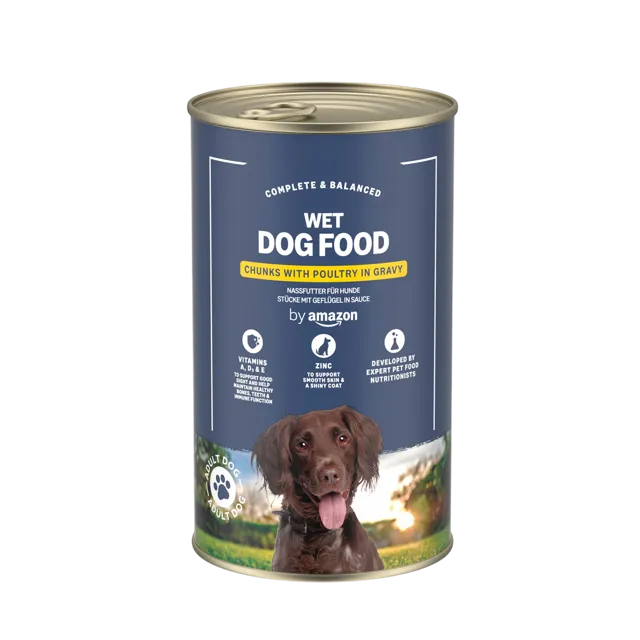
Amazon Wet Chunks in Gravy is a large own label can sold in beef and poultry, and both tell the same story on the back. Meat and animal derivatives make up 28% with 4% tied to the named animal, unnamed cereals follow, and various sugars close the list. Both cans sit in our Average band. What holds them there is how little of the animal content is pinned to a species, and nothing in the gravy is troubling.
Our view
Likely to suit
If your dog has always eaten happily from a big can of chunks in gravy, this is that dinner.
- Larger dogs, since the label's feeding guide runs all the way up to a 60 kg dog and the can holds 1.24 kg
- Dogs that eat better when there is gravy to lick up, with the chunks and gravy format doing the persuading
- Households with more than one dog to feed, as a single can covers a generous serving at a time
- Dogs that drink less water than you would like, with moisture declared at 80.0%
- Dogs that do better on a moderate bowl, as fat converts to 22.5% of dry matter
Worth watching
Before this becomes the everyday dinner, read what the label leaves out.
- Meat and animal derivatives sits at 28% with only 4% tied to the named animal, so neither tin can carry an elimination diet
- The cereals go unnamed, and carbohydrate converts to an estimated 25.5% of dry matter where the typical adult wet food runs at 15.8%
- Various sugars are declared, which is fair to know about if you would rather your dog's dinner did not include added sugar
- Poultry is a group term rather than one bird, so the poultry can names even less of its animal content than the beef one does
Written by our editorial team. Independent guidance, not veterinary advice.
How this scores
How we scoreThe Details
Dog fit
If your dog has always eaten happily from a big can of chunks in gravy, this is that dinner. Before this becomes the everyday dinner, read what the label leaves out.
Wet
Adult
Toy, Small, Medium, Large, Giant
Poultry
The score, in context
Both cans come to rest in our Average band, two steps under the Excellent band the typical adult wet food reaches. Protein and processing reads Poor on both cans, and the reasons overlap. The animal content hides behind a category term, the cereals are unnamed, and the estimated carbohydrate runs to 25.5% of dry matter where the typical adult wet food sits at 15.8%. What the analysis does show is decent enough, with protein at 37.5% of dry matter, and dogs have eaten happily from cans like these for generations. The score turns on what the tin actually names, and the animal column is where this one stays general.
What's in it
Ingredients, as declared: Meat and Animal Derivatives 28% (4% Poultry), Cereals, Vegetable Protein Extracts, Minerals, Various Sugars.
Named ingredients
Nutritional additives
- **Nutritional Additives:** Vitamin A 1100IU, Vitamin D3 140IU, Vitamin E 10mg, Zinc (Zinc sulphate monohydrate) 10mg, Manganese (Manganese(II) oxide) 2mg, Copper (Copper(II) sulphate pentahydrate) 1.8mg, Iodine (Calcium iodate, anhydrous) 0.1mg.
Ingredient notes
Five entries make up the recipe and three of them are categories. Meat and animal derivatives at 28% can be drawn from any warm blooded land animal, with only the 4% of named beef or poultry fixed in place. Cereals can be any grain, and vegetable protein extracts give no clue as to which plant the protein came from or how it was taken out. Any of those can be swapped between batches, and the label will read exactly as it does now.
The analysis reads better than the list does. Protein converts to 37.5% of dry matter and fat to 22.5%, both respectable for a wet food. The estimated carbohydrate is the figure that stands out, at 25.5% of dry matter against 15.8% for the typical adult wet food, and that is where the unnamed cereals show themselves.
Various sugars are on the list, and they are there for palatability rather than nutrition. A dog that has gone off its food will often eat more enthusiastically for them, which is exactly why a maker reaches for them. It is a plain thing to know about a can you are feeding every day.
The added panel is fully dosed, running from vitamin A, vitamin D3 and vitamin E through zinc, manganese, copper and iodine, each with a printed amount. Crude ash converts to 12.5% of dry matter, in line with what a mineral fortified wet recipe usually shows.
How this variety differs
Poultry stands in for the named species at the same 4%. Poultry covers any domestic fowl, so this can pins down slightly less of its animal content. Everything else on the label matches the beef.
Price and value
£10.48 a kilo on the beef and £1.37 a kilo on the poultry, in 1.24 kg cans sold singly and in packs of 6 and 12.
As a guide, feeding a 15kg adult dog in moderate condition works out at £10.12 a day on the beef and £1.32 a day on the poultry. The assumption is about 840 kcal a day (110 × bodyweight^0.75, the standard maintenance estimate). Either way that is roughly 966 grams a day, about four fifths of a can, and the label's own guide for a dog of 15 to 20 kg is 960 to 1190 grams.
Nutritional analysis
Declared analysis
7.5%
4.5%
0.4%
2.5%
80%
Dry weight
37.5%
22.5%
2%
12.5%
25.5%
As-fed composition
Estimated breakdown of the finished product by ingredient category, from the declared ingredient list and ingoing weights. These are estimates, not measurements.
28%
15%
51.9%
5.1%
Pricing & size
- Pack size
- 1.24 kg cans - 1-can (B0DBLKZ7GZ), 6-can (B0DBLM7J99) and 12-can (B0GZPP8ZJX) packs per the twister
- Retailer pricing
- Coming soon
Live retailer pricing is not yet available for this food. Prices, cost per day and where to buy will appear here once retailer data is live.
Ingredients and nutrition are taken from manufacturer data. Retailer pricing is not yet live for this food.
Related dog food guides
Ranked shortlists that include foods like this one.