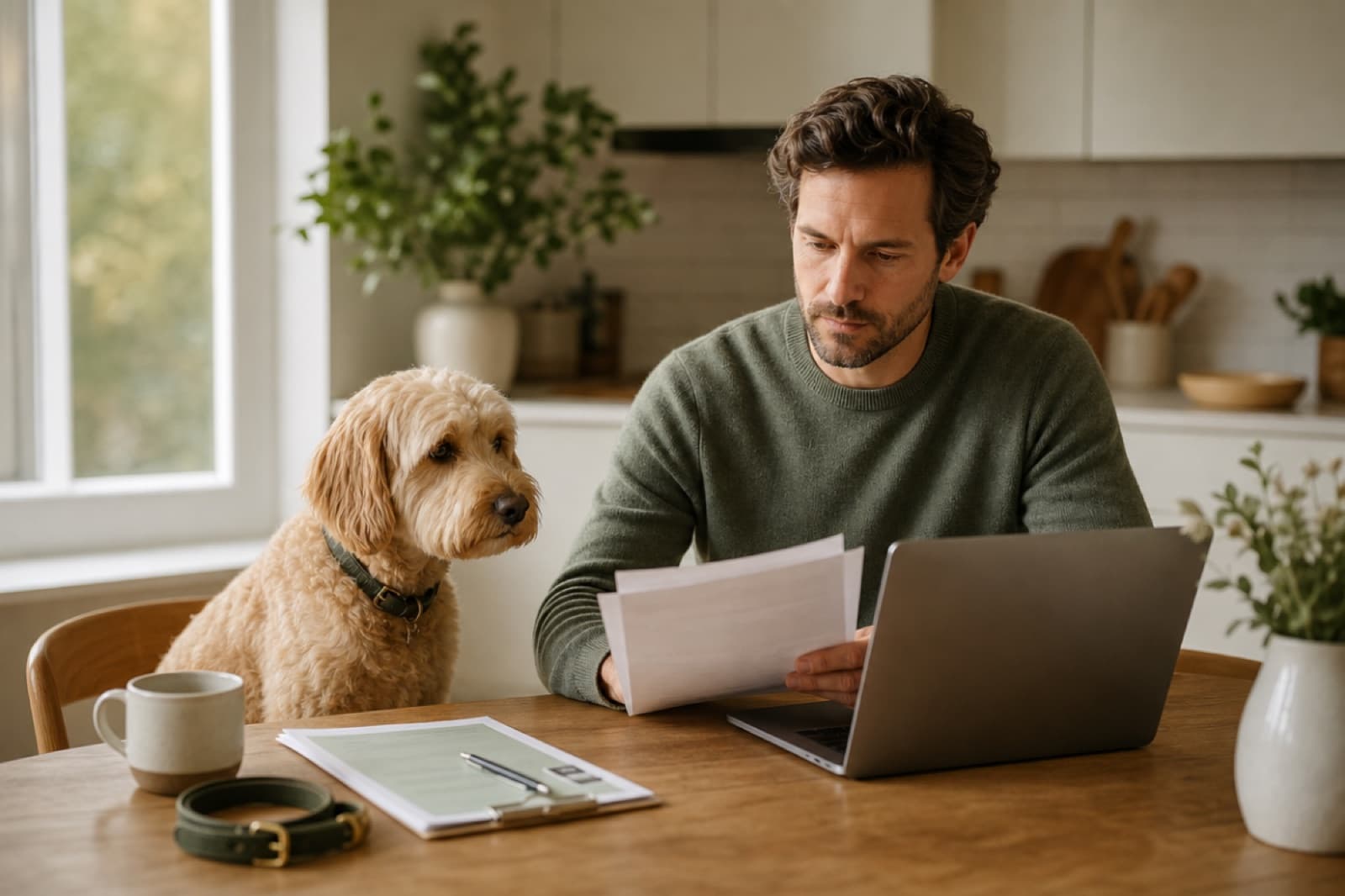


Most UK owners are already compliant without knowing it. The law expects a microchip registered to you, and a collar and tag showing your name and address in public. It expects suitable restraint in the car, a lead wherever local orders or livestock require one, and picking up after your dog. Above all, your dog must never be dangerously out of control.
The short version of what UK dog law asks of you
There is no single dog owners' act to learn and no licence to renew. UK dog law is a handful of duties scattered across different pieces of legislation, and almost every one of them describes something a careful owner already does without being told.
The rules vary slightly between the nations of the UK, and your local council can add its own layer on top. That sounds daunting until you see what the local layer covers, which is nearly always leads and mess in named places, signposted where it applies.
Read what follows as a checklist rather than a warning. If you are the sort of owner who looks up their responsibilities, the law was not written with you in mind.
Is microchipping a legal requirement?
Yes, and it is the one duty with no wriggle room. Every dog in the UK must be microchipped and registered on an approved database. The breeder carries the first part of that job for a puppy, who must be chipped and registered before going to a new home at around eight weeks old.
The chip is rarely the problem. The database is the part owners miss. A chip only works if the details attached to it are yours and current. When you take a dog on, the registration needs transferring into your name, which is not the same as your vet having your address on file. Move house or change your number and the database wants updating that week.
If you have taken on a dog whose history is patchy, your vet can scan the chip and read the number back to you, and the database will tell you whose name it sits under. It is a good job for the first few days of settling a rescue dog.
Does my dog still need a collar and tag?
Yes, and the chip did not replace it. When your dog is in a public place they should wear a collar with a tag or engraved plate showing your name and your address. A phone number is not compulsory, but it is the thing that gets a dog home in an hour, so add one.
Most owners leave the dog's own name off, on the grounds that a stranger who can call your dog by name has an easier time leading them away. If you want to be thorough, a readable tag and a chip registered to you cover the legal duty and the practical one at once.
Worth a look at your own kit, because tags wear smooth and clips fail quietly. A harness carries no details unless you attach a tag to it, so check yours. Our dog walking gear pages cover the bits that take the daily punishment.
What are the rules for dogs in cars?
The Highway Code says a dog must be suitably restrained in a vehicle so it cannot distract you while you drive or hurt anyone if you stop hard. In practice that means a crash tested harness clipped to a seat belt, a secured crate, or a proper guard behind the boot line.
The Code itself is guidance rather than an offence in its own right. Even so, an unrestrained dog can support a charge of driving without due care and attention. It can also complicate matters with your insurer after a bump. We go through what actually works in travelling with your dog by car.
Leaving a dog shut in a warm car falls under animal welfare law and not road law. It is the one area where a stranger may act before you get back to the vehicle. On warm days, take your dog with you or leave them at home.
Where does my dog have to be on a lead?
There is no national lead law covering every pavement and park. What exists is local. Councils use public spaces protection orders to set conditions for particular places. One beach may be closed to dogs over the summer while the park up the road only asks for a lead on the paths. Some orders also let an officer tell you to put your dog on a lead.
Those orders are signed at the entrance to the ground they cover, and councils publish them online. Read the sign once on each of your regular walks and you will know your own patch for good.
Two situations sit above the local rules. Certain roads are designated, which means dogs must be on a lead on them. The second is livestock, which changes everything. A dog worrying sheep is treated seriously and a farmer has real powers, so lead up around livestock however good your recall is. If cattle take an interest while you cross their field, let your dog off and let the two of them get clear of each other.
What does dangerously out of control actually mean?
This is the duty that matters most, and it has nothing to do with what your dog looks like. A dog is dangerously out of control when there are reasonable grounds to fear it will injure someone. That applies in public and in your own home and garden. It covers any dog of any size, and it includes a dog that attacks an assistance dog.
Intent is not the test. A friendly dog that barrels into a nervous stranger and puts them on the ground can still leave you answering for it. Front doors catch owners out as well, because a dog who is easy on a walk may take a different view of someone coming through the gate.
The principle underneath is simple. Know your dog, and manage the situation before it arrives. Do not test whether it will be fine. Shorten the lead, make space, say plainly that your dog would rather not be greeted. None of that is an admission that your dog is a problem. It is the ordinary work of owning one.
What else counts as your legal responsibility?
Welfare law gives you a duty of care, which is the legal way of saying your dog's needs are your job. That means somewhere suitable to live, a suitable diet, the freedom to behave like a dog, appropriate company, and protection from pain and suffering. Nobody arrives to inspect. It only comes into play when something has gone badly wrong.
Time alone sits inside that duty. No set number of hours appears in law, but a dog left so long that they are distressed turns a scheduling matter into a welfare one. If your working days are long, leaving your dog home alone is worth reading before it turns into a problem.
Fouling is the other everyday one. Failing to pick up is an offence almost anywhere you walk, and in some places you can be asked to show that you are carrying bags at all. Keep a supply in every coat and it never becomes a conversation.
The ten minute check worth doing this week
Start with the chip. Confirm on the database itself that it is registered to you, at the address and number you use now. A check at the vet is not enough. Then read your dog's tag out loud and see whether your name and address are still legible. Then look honestly at how your dog travels in the car.
After that, walk one of your usual routes and read the sign at the gate. If your dog ever goes missing, you are expected to tell your local council's dog warden. Involve the police as well if you believe your dog was taken. It is the chip and the tag that turn a found dog into a returned dog, and there is more on prevention in keeping your dog safe from theft.
One last thing that gets tangled up with the law. For an ordinary pet dog, insurance is not something you are required to buy. The part of a policy that covers damage or injury your dog causes to someone else speaks to everything in this guide. If you have never looked at how that side works, how dog insurance works explains it in plain terms.
Frequently asked questions
Is dog insurance a legal requirement in the UK?
No. For an ordinary pet dog, nothing in law obliges you to hold a policy. What the law does hold you to is control of your dog, and the consequences if someone is hurt or something is damaged. That is exactly what the third party liability part of a policy is built to answer, which is why it lines up with the duties in this guide.
My dog is microchipped, so do we still need a tag?
Yes, both. The chip is a permanent record that needs a scanner and a database lookup to be any use. The tag is what a neighbour can read in the street while your dog is standing in front of them. In a public place your dog should wear a collar showing your name and address, and adding a phone number turns a long afternoon into a short one.
Can I be in trouble if my friendly dog knocks someone over?
Potentially, yes. The test is whether there were reasonable grounds to fear injury, not whether your dog meant any harm. A large, delighted dog landing on a nervous stranger can meet that bar. It is why recall practice and a lead in crowded places are worth far more than any argument about your dog's character after the event.
Do the rules change if I move to another part of the UK?
The core duties travel with you, and the differences are mostly detail, not substance. What really changes is the local layer, and it changes street by street, never nation by nation. When you move, look up your new council's public spaces protection orders and read the signs at the gates of your new walks in the first week.