

Wolfworthy
Wolfworthy 80/20 Countryside review
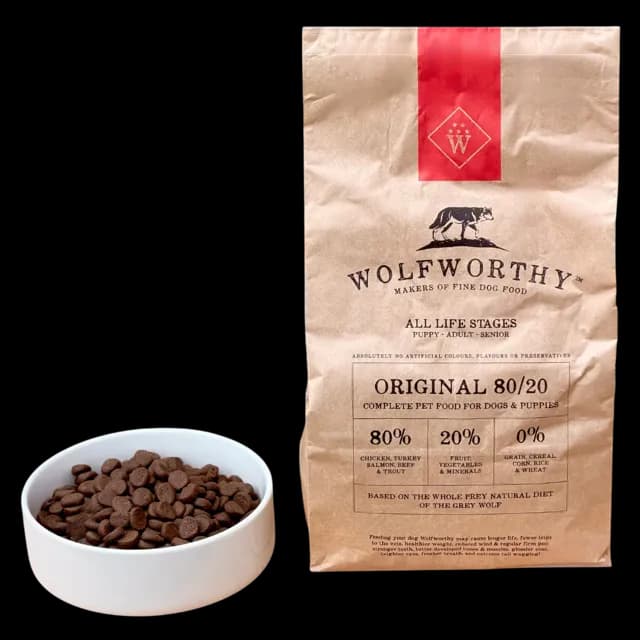
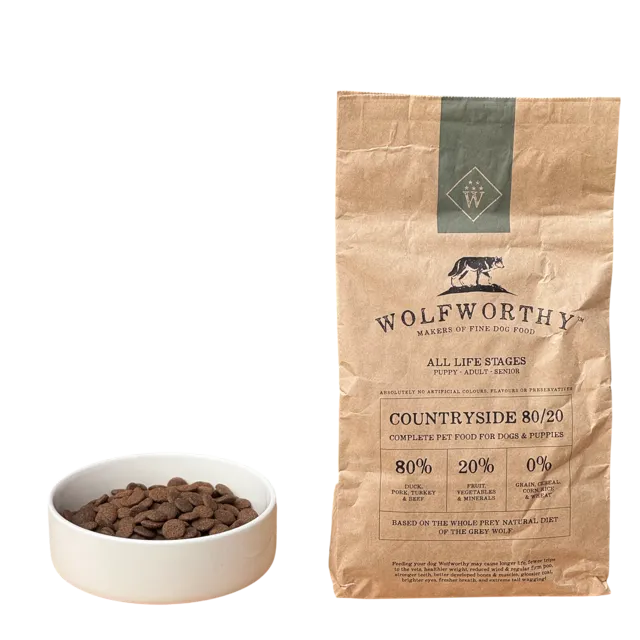
Wolfworthy 80/20 Countryside is a four-animal, grain-free kibble that does the arithmetic its name promises. Duck, pork, beef and turkey add up to the 80% on the front of the bag once the turkey gravy is counted in. Sweet potato and tapioca carry what is left, and a dosed joint set plus a long botanical tail finish the label off. It lands in our Excellent band, a rung above the Good band where the typical adult dry food settles.
Our view
Likely to suit
If your dog eats better on red meat than on chicken, this is a bowl built around exactly that preference.
- Dogs who have had enough of chicken, since the only animals here are duck, pork, beef and turkey
- Owners who want the headline meat share checkable, because the named animal entries add up to the figure on the bag
- Older dogs that have started to feel their joints, since glucosamine and MSM both carry printed doses, as does chondroitin
- Households feeding three ages from one bag, since the label covers puppy through to old age
- Dogs kept on a lighter starch load, with the carbohydrate estimate at 28.7% of dry matter
Worth watching
A few honest details about a food this meat-heavy are worth having up front.
- Four animals share this recipe, so it cannot narrow anything down for a dog you are running an exclusion trial on
- Dehydrated pork sits second at 23%, worth a thought for a dog with a urinary history since the mammal meats run higher in purines
- This is a rich bowl at 395 kcal per 100g, so a steady, sofa-fond dog needs the scoop levelled off
- A binder is what tapioca is doing midway down the list, and it brings very little with it beyond the binding
Written by our editorial team. Independent guidance, not veterinary advice.
How this scores
How we scoreThe Details
Dog fit
If your dog eats better on red meat than on chicken, this is a bowl built around exactly that preference. A few honest details about a food this meat-heavy are worth having up front.
Dry
Puppy, Adult, Senior
Toy, Small, Medium, Large, Giant
Duck
The score, in context
Our scoring places this recipe in the Excellent band, clear of the Good band that marks the middle of the adult dry category. Its protein and processing reads Excellent, with nutritional balance and transparency both reading Outstanding, and that is a fair description of the food. The meat share is large and every animal inside it is named and given a percentage. Protein converts to 40.2% of dry matter and carbohydrate to only 28.7%, a long way under the 46.2% typical for adult dry food. The label is specific nearly everywhere it counts.
What's in it
Ingredients, as declared: Freshly Prepared Duck (36%), Dehydrated Pork (23%), Freshly Prepared Beef (10%), Sweet Potato (9.5%), Freshly Prepared Turkey (9%), Tapioca, Turkey Gravy (2%), Flaxseed, Beta Vulgaris, Lentils, Minerals, Garbanzo Beans, Mannanoligosaccharides (MOS, 260 mg/kg), Fructooligosaccharides (FOS, 260 mg/kg), Glucosamine (178 mg/kg), Methylsulfonylmethane (178 mg/kg), Chondroitin Sulphate (125 mg/kg), Yucca Extract, Dried Carrot, Dried Spinach, Dried Pumpkin, Dried Apple, Dried Seaweed, Dried Calendula, Dried Cranberries, Dried Camomile, Burdock Root, Aniseed & Fenugreek, Dried Peppermint, Green Tea Extract, Dried Dandelion, Dried Bilberries, Ginseng, Thyme, Marjoram, Oregano, Parsley Sage
Named ingredients
Nutritional additives
Vitamins: Vitamin A 12,865 IU, Vitamin D3 865 IU, Vitamin E 96 IU; Trace Elements: Zinc (Zinc Sulphate Monohydrate & Zinc Chelate of Amino Acids Hydrate) 77mg, Iron (Iron (II) Sulphate Monohydrate & Iron (II) Chelate of Protein Hydrolysates) 48 mg, Manganese (Manganous Sulphate Monohydrate) 18 mg, Copper (Copper (II) Chelate of Amino Acids Hydrate) 5 mg, Iodine (Calcium Iodate Anhydrous & Potassium Iodide) 4.16 mg, Selenium (Selenised Yeast Saccharomyces Cerevisiae CNCM I-3060, inactivated) 0.17 mg; Amino Acids: Methionine 1,106 mg; Provitamins: L-Carnitine 48 mg
Ingredient notes
You can check the 80/20 claim for yourself. Not many bags let you. Duck comes freshly prepared at 36%, with dehydrated pork at 23% behind it. Freshly prepared beef at 10% follows, then freshly prepared turkey at 9% and turkey gravy at 2%. Together they take the meat half of the name to its total. In the oven, fresh entries lose most of their water. Second place on the list therefore understates what the dehydrated pork puts into the finished kibble. The analysis agrees: protein converts to 40.2% of dry matter, a genuinely meaty figure for a dry food.
Pork is the interesting choice among the four. It turns up far less often in dog food than chicken or beef, so a lot of dogs have simply never met it. A dog cannot react to a meat it has never eaten. Paired with duck at the head of the list, this is a bowl aimed squarely at dogs that have already been round the usual birds.
On the plant side, sweet potato takes 9.5%, with tapioca, lentils, beta vulgaris and garbanzo beans behind it. Tapioca is worth naming honestly: it is a starch pulled from the cassava root and it brings almost nothing but the starch, so it is there to hold the biscuit together. With carbohydrate estimated at 28.7% of dry matter, none of the plant side is being asked to carry much.
The functional additions come with numbers beside them, not as bare names on a list. That is the difference between a supplement and a suggestion. Glucosamine and methylsulfonylmethane arrive at 178 mg/kg each with chondroitin sulphate at 125 mg/kg behind them, and MOS and FOS, the prebiotic pair, are both declared at 260 mg/kg. Yucca extract sits alongside them, included in kibble for the effect it has on what the garden smells like.
The mineral panel is better than most. Selenium is here as selenised yeast, not the plain selenite, and that form is taken up more readily. Both zinc and iron are declared partly as chelates. Zinc runs to 77 mg, iron to 48 mg, manganese to 18 mg, copper to 5 mg and iodine to 4.16 mg per kilo, with methionine at 1,106 mg and L-carnitine at 48 mg alongside. Calcium is declared at 1.3% of dry matter, a sensible level and a useful figure to find in print on a bag that includes puppies.
Then comes the tail, a long one: carrot, spinach, pumpkin, apple, seaweed, cranberries, camomile, burdock root, green tea, dandelion, bilberries and ginseng, with a shelf of kitchen herbs after them. None of it is declared with a percentage and none of it needs to be. It is the label's flourish. No recipe is improved by containing marjoram. The meat is what this food stands on, and that is precisely where you want the weight to sit.
Price and value
£8.89 a kilo, sold in 1.5kg and 7.5kg bags, with a 60 g sample of the recipe available on its own.
As a guide, a 15kg adult dog in moderate condition eats about 213 grams a day, which works out at £1.89, assuming about 840 kcal a day (110 × bodyweight^0.75, the standard maintenance estimate). The label's own chart asks between 134 and 178 grams for that dog, so start inside that range and adjust as your dog responds.
Nutritional analysis
Declared analysis
37%
18%
3%
7.5%
8%
Dry weight
40.2%
19.6%
3.3%
8.2%
28.7%
As-fed composition
Estimated breakdown of the finished product by ingredient category, from the declared ingredient list and ingoing weights. These are estimates, not measurements.
80%
16.4%
3.6%
Pricing & size
- Pack size
- 1.5kg (£18.88, SKU 202151), 7.5kg (£66.66, SKU 202150) - plus a 60 g sample of this recipe sold as its own product (see the exclusions appendix). Every recipe is also offered on Subscribe & Save at 10 % off: £16.99 (1.5 kg) / £59.99 (7.5 kg).
- Retailer pricing
- Coming soon
Live retailer pricing is not yet available for this food. Prices, cost per day and where to buy will appear here once retailer data is live.
Ingredients and nutrition are taken from manufacturer data. Retailer pricing is not yet live for this food.
Related dog food guides
Ranked shortlists that include foods like this one.