


Skip to content
Off the Leash
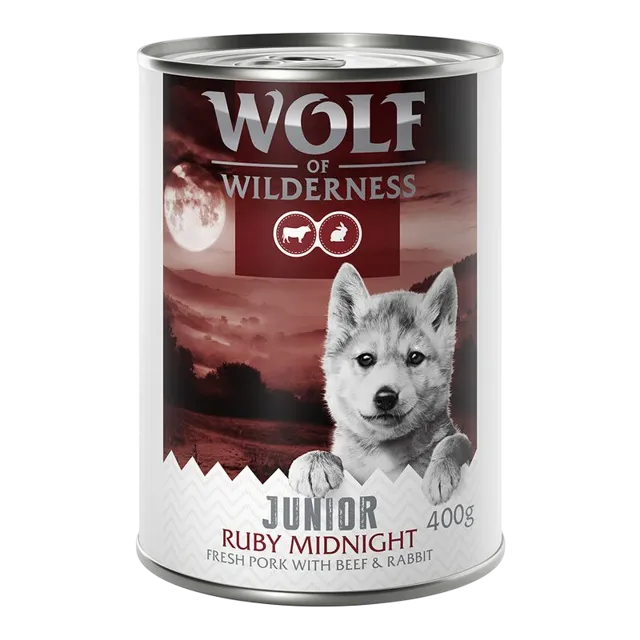
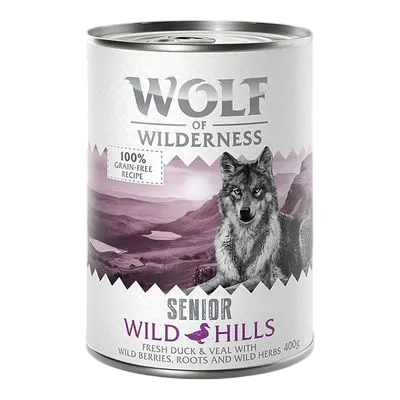
Wolf Of Wilderness Tins Senior – Wild Hills

Wolf Of Wilderness

Wolf Of Wilderness Tins Senior: Wild Hills review

79.3/100Excellent
WetPuppyAdult

Wolf Of Wilderness Tins Senior takes the tin this brand fills for younger dogs and rebalances it for an older one. Chicken and lamb share Green Fields at 40% and 25%, veal and duck share Wild Hills on the same split, and both close with salmon oil, linseed oil and a little green lipped mussel extract. Both recipes sit in our Excellent band, and every entry on either label is named and given a percentage.

Where to buy: coming soon
Live retailer pricing is coming soon. Once we have prices from UK retailers, the best price, cost per day and where to buy will appear here.

Our view

Likely to suit

When an older dog starts picking at dinner, a soft, strongly scented tin is an easy way back in.

  • Older dogs off their food, since a soft tin this meat led has a smell worth getting up for
  • Owners who want every entry named, with the two animals declared at 40% and 25% and the smallest extras printed down to 0.1%
  • Dogs already on a vet's joint supplement, since the green lipped mussel here works alongside it and does not replace it
  • Senior dogs whose water intake has dropped off, with moisture declared at 75.0% on Green Fields and 76.0% on Wild Hills
  • Households cooking around a grain sensitivity, since no cereal appears on either senior label

Worth watching

A little context on the label helps before you settle an older dog onto it.

  • Neither tin pins its 29.5% meat stock to a species, so neither recipe can carry a single animal plan
  • At 0.1% apiece, the green lipped mussel extract, the salmon oil and the linseed oil are a nod towards joints and coat, not a working dose
  • Green Fields brings chicken and lamb together while Wild Hills brings veal and duck, so both tins carry two animals apiece
  • Calcium is not declared on either label, so a dog on a calcium watch needs the figure from the maker

Written by our editorial team. Independent guidance, not veterinary advice.

How this scores

How we score
79.3/100Excellent
Protein and processingExcellent
Nutritional balanceOutstanding
TransparencyOutstanding
ValueExcellent

The Details

Dog fit

When an older dog starts picking at dinner, a soft, strongly scented tin is an easy way back in. A little context on the label helps before you settle an older dog onto it.

Food type

Wet

Life stage

Puppy, Adult, Senior

Breed size

Toy, Small, Medium, Large, Giant

Main protein

Duck

The score, in context

Our Excellent band holds both of these tins, and it holds them at almost the same height, so neither one is the compromise pick. Wet food does strongly here as a category, and the halfway mark of the wet shelf already reaches Excellent. A recipe has to declare a great deal to finish above that. These two do: two named animals with printed percentages, named cuts, named herbs, named oils, and not one entry written as a legal category.

What's in it

Ingredients, as declared: 40% veal meat, hearts, liver, 29.5% stock, 25% duck meat, liver necks, 2% raspberries, 2% bilberries, 1% minerals, 0.2 % wild herbs (dandelion root, nettle, ribwort, common yarrow) 0.1% salmon oil 0.1% linseed oil 0.1% green-lipped mussel extract

Named ingredients

40% veal meat, hearts, liver, 29.5% stock, 25% duck meat, liver necks, 2% raspberries, 2% bilberries, 1% minerals, 0.2 % wild herbs (dandelion root, nettle, ribwort, common yarrow) 0.1% salmon oil 0.1% linseed oil 0.1% green-lipped mussel extract

Nutritional additives

- **Nutritional additives:** Vitamin D3 200 IU, vitamin E as all rac-alpha-tocopheryl acetate 30mg, zinc as zinc sulphate, monohydrate 15mg, manganese as manganese (II) sulphate, monohydrate 3mg, iodine as calcium iodate 0.75mg,

Ingredient notes

Green Fields leads with chicken at 40%, listing meat, hearts, livers, gizzards and necks, then brings in lamb at 25% taking in tripe among the cuts. Wild Hills swaps in veal at 40% and duck at 25% on the same construction. Naming the cuts like this is unusual, and it is useful: tripe and liver are among the easier and denser things an older dog can digest.

Meat stock accounts for 29.5% of both tins and is the only entry that keeps its animal to itself. Everything else on the label is complete. That one gap is what stops either recipe serving as a true single animal diet.

Protein converts to 41.2% of dry matter in Green Fields and 42.9% in Wild Hills, with fat at 24.8% and 25.8%, which keeps both tins firmly on the meat side of the ledger. Neither list carries a starch ingredient. The estimated carbohydrate reads 24.4% of dry matter in Green Fields and 19.2% in Wild Hills, against 15.8% typical for adult wet food. That figure is arithmetic residue, not a cereal share you could remove.

The last entries are the senior touches. Salmon oil and linseed oil bring marine and plant omega 3 respectively, and green lipped mussel extract is the ingredient owners of stiffening dogs most often reach for. All three are declared at 0.1%, so treat them as a gesture in the right direction and keep any prescribed joint support exactly as your vet has set it.

The wild herbs at 0.2% are broken out one by one as dandelion root, nettle, ribwort and common yarrow, which is the honest way to list a herb blend even when the amount is small. Minerals at 1% and the added panel handle the micronutrition, with vitamin D3 at 200 IU, vitamin E at 30mg, zinc at 15mg, manganese at 3mg and iodine at 0.75mg, each dosed in print. Calcium itself is not among the declared figures.

How this variety differs

Veal at 40% and duck at 25%, the tin to reach for when chicken or lamb is off the menu. Just remember that veal is beef as far as an avoidance list is concerned. It runs a touch drier at 76.0% moisture, a touch higher on protein at 42.9% of dry matter and a touch denser at 111 kcal per 100g.

Price and value

£3.34 a kilo on both recipes.

As a guide, take a 15kg adult dog in moderate condition, which the standard maintenance estimate puts at about 840 kcal a day (110 × bodyweight^0.75). That is £2.57 a day on Green Fields or £2.53 a day on Wild Hills. In grams that is roughly 770 of Green Fields or 757 of Wild Hills. The labels put a 20kg dog on 823 grams of Green Fields or 810 grams of Wild Hills, which lines up closely with the energy based estimate.

Nutritional analysis

Declared analysis

Energy
110.9 kcal/100g
Protein

10.3%

Fat

6.2%

Fibre

0.5%

Ash

2.4%

Moisture

76%

Dry weight

Protein

42.9%

Fat

25.8%

Fibre

2.1%

Ash

10%

Carbs

19.2%

As-fed composition

Estimated breakdown of the finished product by ingredient category, from the declared ingredient list and ingoing weights. These are estimates, not measurements.

Meat

65.3%

Added water

29.5%

Oils

0.2%

Other

5%

Pricing & size
Retailer pricing
Coming soon

Live retailer pricing is not yet available for this food. Prices, cost per day and where to buy will appear here once retailer data is live.

Ingredients and nutrition are taken from manufacturer data. Retailer pricing is not yet live for this food.

Related dog food guides

Ranked shortlists that include foods like this one.
All reviews

Featured feeding accessories

All feeding accessories

Brackenwood

Slow Feeder Maze Bowl

Slows fast eaters and eases gulping at mealtimes.

From £12.99· 4 retailers
View

Tarn & Co

Raised Double Diner

Height-set stand for easier, tidier eating.

From £28.99· 3 retailers
View

Reviewed by Off the Leash Editorial

Last updated 28 August 2026