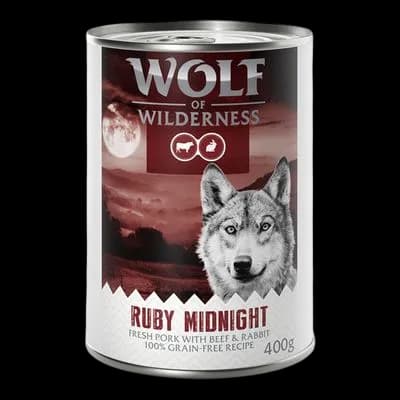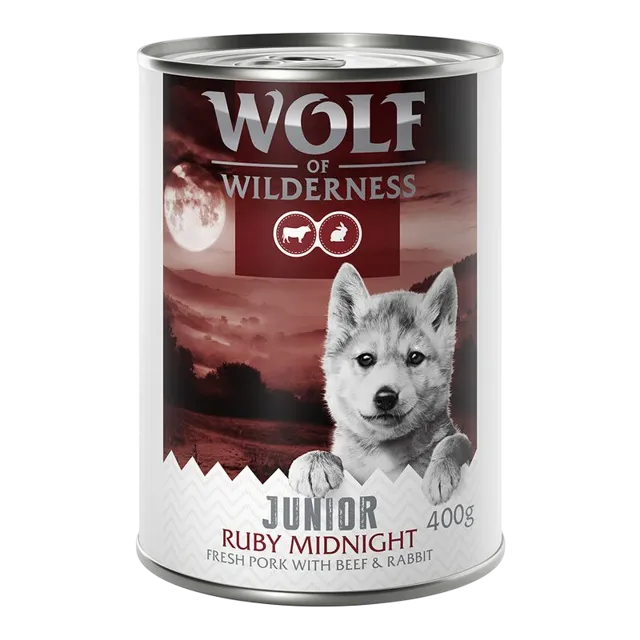



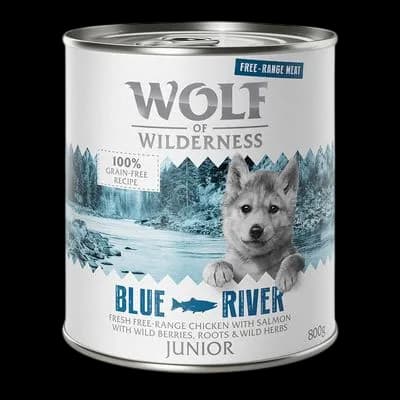
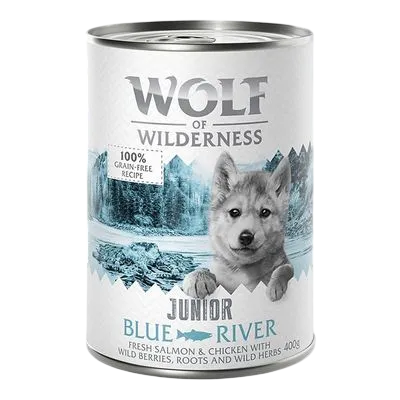

Wolf Of Wilderness
Wolf Of Wilderness Tins Puppy: Blue River review
Flavour
Wolf Of Wilderness Tins Puppy is a two recipe range built the way this brand builds everything. A named animal takes 46%, a second animal 20%, and a meat stock takes up most of what is left. Blue River pairs chicken with salmon, Wild Hills pairs veal with duck, and both finish with berries, named wild herbs and a pinch of eggshell powder. Blue River sits in our Excellent band with Wild Hills a step up in Outstanding, and either one can be fed from puppyhood right through adult life.
Our view
Likely to suit
A growing dog's dinner should be legible, and every entry on this label can be read.
- Puppies headed for a big adult frame, since calcium converts to 1.12% of dry matter, a level that carries a large breed pup as comfortably as a small one
- Owners who like the animal share spelled out, since both tins print 46% for the lead animal and 20% for its partner
- Households with a puppy and a grown dog to feed, because both recipes are cleared for either age
- Dogs that keep away from cereal, as neither tin carries a grain of any kind
- Dogs that ignore the water bowl, since moisture is declared at 75.0% on both labels
Worth watching
Read the small print on both tins before you choose between them.
- Neither tin can anchor a strict elimination diet, because the meat stock, 28.8% in Blue River and 28.5% in Wild Hills, names no animal
- Each recipe carries two animals, chicken with salmon in Blue River and veal with duck in Wild Hills
- Eggshell powder puts egg on both ingredient lists, worth knowing if you are keeping egg off the menu
- The two tins declare very different energy for near identical analyses, so the portion moves when you swap between them
Written by our editorial team. Independent guidance, not veterinary advice.
How this scores
How we scoreThe Details
Dog fit
A growing dog's dinner should be legible, and every entry on this label can be read. Read the small print on both tins before you choose between them.
Wet
Puppy, Adult
Toy, Small, Medium, Large, Giant
Chicken
The score, in context
The two tins land a whisker apart, Blue River in our Excellent band and Wild Hills just over the line into Outstanding. That makes the choice a question of which animals your dog prefers, not of which recipe is stronger. Wet food does well on our scoring generally, and the middle of the wet shelf reaches Excellent on its own account. Holding that ground takes a label built like this one: a named animal at the front, a percentage beside nearly every entry and nothing vague doing the heavy lifting.
What's in it
Ingredients, as declared: Chicken (46%, comprising heart, meat, liver, lung), meat stock (28.8%), salmon (20%), cranberries (2%), currants (2%), minerals (1%), sunflower oil (0.2%), wild herbs (0.2%, dandelion root, nettle, ribwort plantain, yarrow), eggshell powder (0.1%). 46 % chicken hearts, meat, lungs, 28.8% meat stock, 20% salmon, 2% cranberries, 2% blackcurrants, 1% minerals, 0.2% sunflower oil, 0.2% wild herbs (dandelion root, nettle, ribwort, common yarrow), 0.1% powdered egg shell.
Named ingredients
Nutritional additives
- **Nutritional additives:** Vitamin D3 (200 IU), vitamin E [as all rac-alpha-tocopheryl acetate] (30mg), zinc [as zinc sulphate monohydrate] (15mg), manganese [as manganous(II)-sulphate monohydrate] (3mg), iodine [as calcium iodate] (0.75mg).
Ingredient notes
The two labels open identically: headline animal at 46%, second animal at 20%. In both cases what went into that percentage is spelled out. Blue River lists heart, meat, liver and lung for its chicken. Wild Hills does the same for its veal and then names heart and liver for the duck behind it. Organ meat has a reputation it does not deserve. For nutrient density, little else a dog eats comes close to liver.
Meat stock accounts for 28.8% of Blue River and 28.5% of Wild Hills. Of every entry on either label, it is the only one that leaves its animal unnamed. In a range this specific about everything else, that reads as an oversight and not a habit. It is still the reason neither tin can be called a one animal recipe.
Protein converts to 44.8% of dry matter in Blue River and 46.0% in Wild Hills, with fat at 25.6% and 26.0%. For a wet food, the analysis is genuinely meat led. The estimated carbohydrate sits at 19.6% and 18.0% of dry matter against the 15.8% typical for adult wet food. Neither list carries a starch ingredient at all, so that figure is simply what the arithmetic leaves once protein, fat, fibre, ash and moisture are accounted for.
Berries and named herbs close both lists. Cranberries and currants sit at 2% each on Blue River, raspberries and bilberries at 2% each on Wild Hills. On both tins the wild herbs at 0.2% are named one by one: dandelion root, nettle, ribwort plantain and yarrow. You would not buy these tins for the herbs, but naming them is the more honest way to do it.
Eggshell powder at 0.1% and minerals at 1% carry the calcium, which converts to 1.12% of dry matter. The added panel is short and fully dosed: vitamin D3 at 200 IU, vitamin E at 30mg, zinc at 15mg, manganese at 3mg and iodine at 0.75mg. The only added fat is sunflower oil at 0.2%, a modest amount. A recipe two thirds animal has plenty of fat of its own to work with.
How this variety differs
Chicken at 46%, taking in heart, meat, liver and lung, with salmon at 20% behind it and cranberries and currants for the fruit. It declares the lower energy of the pair at 97 kcal per 100g, so bowls are fuller here, and its protein converts to 44.8% of dry matter. This is the recipe to choose if you want oily fish in the mix.
Price and value
£3.34 a kilo, the same figure on both recipes.
Take a 15kg adult dog in moderate condition and the usual maintenance estimate of about 840 kcal a day (110 × bodyweight^0.75). Feeding works out at £2.89 a day on Blue River or £2.21 a day on Wild Hills. That comes to roughly 866 grams of Blue River or 661 grams of Wild Hills, the difference being the energy each tin declares.
Nutritional analysis
Declared analysis
11.2%
6.4%
0.4%
2.1%
75%
Dry weight
44.8%
25.6%
1.6%
8.4%
19.6%
As-fed composition
Estimated breakdown of the finished product by ingredient category, from the declared ingredient list and ingoing weights. These are estimates, not measurements.
65.9%
28.7%
0.2%
5.2%
Pricing & size
- Retailer pricing
- Coming soon
Live retailer pricing is not yet available for this food. Prices, cost per day and where to buy will appear here once retailer data is live.
Ingredients and nutrition are taken from manufacturer data. Retailer pricing is not yet live for this food.
Related dog food guides
Ranked shortlists that include foods like this one.