



Wolf Of Wilderness
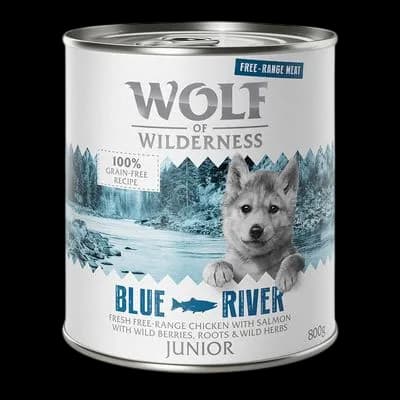
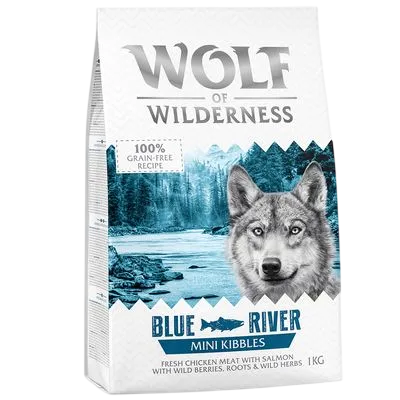
Wolf Of Wilderness Dry Adult Mini: Blue River review
Flavour
Wolf Of Wilderness Dry Adult Mini shrinks the brand's wild-country idea down to a bag written for smaller dogs. Chicken heads both recipes, the starch comes from potato flakes with no cereal involved, and each label signs off with a scatter of wild berries and hedgerow herbs. Blue River and Wild Hills both land in our Good band, where most of the adult dry shelf lands too.
Our view
Likely to suit
If your dog is small, keen and fond of chicken, this range was written at their scale.
- Owners of small dogs, since the range is built for them and the label's feeding table starts at a 1kg dog
- Dogs kept off cereal, with potato flakes and dried beet pulp taking the starch work here
- Households that like to alternate flavours, as both recipes are constructed the same way and change only the second animal
- Small dogs with a delicate digestion, with yeast cell walls at 0.2% and chicory inulin printed on both labels as prebiotic support
Worth watching
A few differences between these bags are worth knowing before you choose.
- Salmon appears in both recipes, so neither one counts as fish free for a dog being steered away from fish
- Poultry fat gives a family name where an owner hunting one species needs the bird itself
- These are dense little kibbles, so a small dog that takes life gently needs the scoop measured, not heaped
Written by our editorial team. Independent guidance, not veterinary advice.
How this scores
How we scoreThe Details
Dog fit
If your dog is small, keen and fond of chicken, this range was written at their scale. A few differences between these bags are worth knowing before you choose.
Dry
Adult
Chicken
The score, in context
Both recipes come out in our Good band. Most of the adult dry category settles there as well. What holds them there is straightforward. Named chicken heads each list, and the mineral panel is printed in full with its doses. Carbohydrate works out at 42.3% and 43.6% of dry matter, against the 46.2% typical for adult dry food. They do not climb further because the fresh meat headline loses its water in the oven, and because a handful of working entries, poultry fat among them, name a family instead of a bird.
What's in it
Ingredients, as declared: Fresh chicken (25%), potato flakes, chicken protein (16.9%), pea protein, poultry fat, salmon protein (4%), dried beet pulp, linseed, apple pomace (2.1%), sodium chloride, dried wild berries (total 0.3%: cranberries, blackcurrants, elderberries, raspberries), monocalcium phosphate, yeast cell walls (0.2%, a source of beta-glucans and mannan-oligosaccharides), salmon oil, chicory inulin (0.1%), sunflower oil, dried wild herbs (0.03% yarrow, 0.03% dandelion, 0.03% dandelion root, 0.03% camomile, 0.03% nettle, 0.03% ribwort leaves, 0.03% St. John's wort).
Named ingredients
Nutritional additives
- **Nutritional additives:** Vitamin A (12,000 IU), vitamin D3 (1500 IU), vitamin E (250 IU), vitamin C (100mg), vitamin B1 (12mg), vitamin B2 (12mg), vitamin B 6 (8mg), vitamin B12 (0.18mg), niacinamide (35mg), calcium-D-pantothenate (35mg), biotin (0.3mg), folic acid (1.2mg), choline chloride (2000mg), copper [cupric(II)-protein-hydrolysate chelate] (12.5mg), zinc [protein hydrolysate zinc chelate] (100mg), manganese [protein hydrolysate manganous chelate] (30mg), iron [ferrous(II)-protein-hydrolysate chelate] (200mg), iodine [potassium iodide] (2.3mg).
Ingredient notes
Fresh chicken leads both labels, at 25% on Blue River and 41% on Wild Hills. Read fresh carefully, because the oven bakes that water away. What survives into the finished kibble is the dried backup, and both recipes have one, chicken protein at 16.9% on Blue River, dried duck protein at 10% with poultry protein at 9% on Wild Hills. The analysis lands where that construction suggests, with protein converting to 29.3% and 28.3% of dry matter.
Potato flakes do the binding in both, with dried beet pulp behind them carrying the fibre. Neither label carries a cereal. Blue River also lists pea protein, a plant protein that helps the headline figure along without adding meat to the bowl, so notice it and do not count it.
Salmon runs through the range as the omega source, as oil in both recipes and as dried salmon protein at 4% in Blue River on top of that. It is a sensible way to bring marine omega 3s into a chicken bowl, and it does mean neither variety can be called fish free.
The gut thinking is printed on the label. Yeast cell walls at 0.2% supply beta-glucans and mannan-oligosaccharides, the prebiotic fraction that feeds the friendly end of the gut flora, with chicory inulin just behind them doing similar work.
The wild berries at 0.3% and the seven herbs at 0.03% apiece are the range's signature flourish rather than its substance. Cranberry and elderberry are pleasant things to find on a label and nettle does no harm, but nothing at that level changes a bowl. The chicken and the mineral panel are what this food stands on.
Blue River doses its trace minerals as protein hydrolysate chelates, the form usually picked when absorption is the priority. Zinc is at 100 mg, iron at 200 mg, manganese at 30 mg, copper at 12.5 mg and iodine at 2.3 mg per kilo. Wild Hills prints those same headline amounts as sulphates and adds a further 50 mg of chelated zinc alongside.
How this variety differs
Chicken at 25% fresh with dried chicken protein at 16.9% behind it, plus dried salmon protein at 4%. Its animal list is the shorter of the pair, the tidier label for a dog you are watching. Pea protein appears here and not on Wild Hills.
Price and value
Blue River is £6.00 a kilo and Wild Hills £5.50 a kilo.
As a guide, a 15kg adult dog in moderate condition eats about 228 grams of Blue River a day, or about 218 grams of Wild Hills. That works out at £1.37 a day on Blue River and £1.20 on Wild Hills, assuming around 840 kcal a day (110 × bodyweight^0.75, the standard maintenance estimate). The label's own table asks 145 grams for a 10kg dog on Blue River and 140 grams on Wild Hills, so if the two guides disagree, go by how the dog looks after a fortnight.
Nutritional analysis
Declared analysis
27%
16%
2.5%
7.6%
Dry weight
29.3%
17.4%
2.7%
8.3%
42.3%
As-fed composition
Estimated breakdown of the finished product by ingredient category, from the declared ingredient list and ingoing weights. These are estimates, not measurements.
45.9%
41.8%
2.2%
5.2%
4.9%
Pricing & size
- Retailer pricing
- Coming soon
Live retailer pricing is not yet available for this food. Prices, cost per day and where to buy will appear here once retailer data is live.
Ingredients and nutrition are taken from manufacturer data. Retailer pricing is not yet live for this food.
Related dog food guides
Ranked shortlists that include foods like this one.