



Walker & Drake
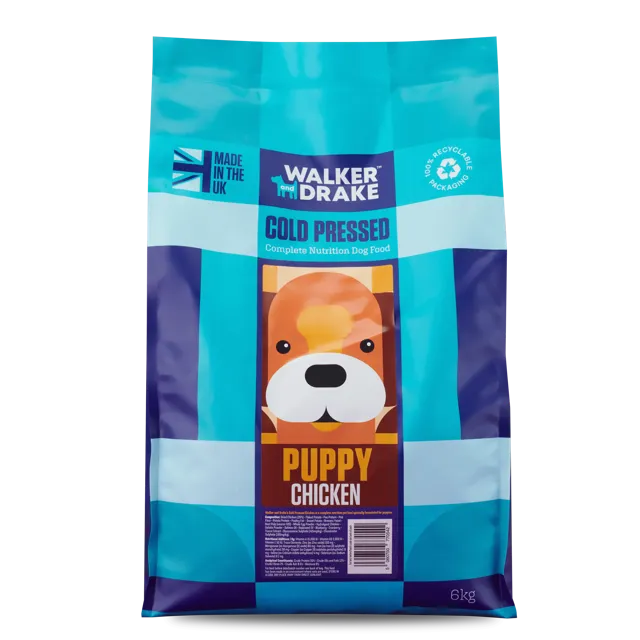
Walker & Drake Puppy Food: Chicken review
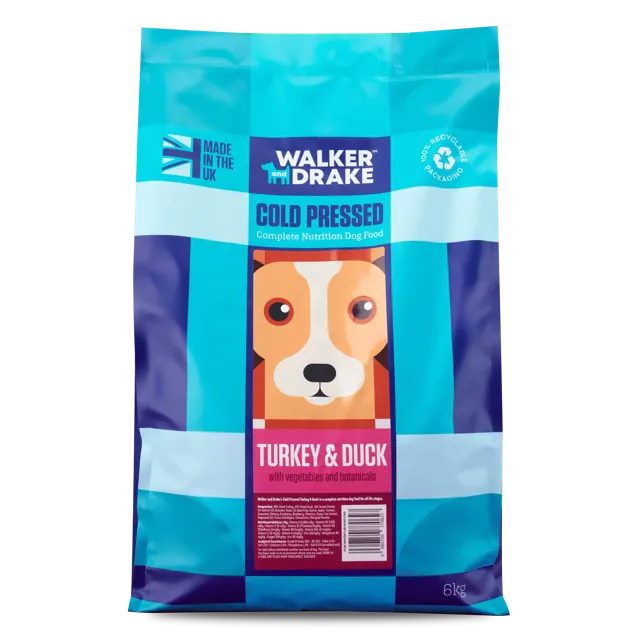
Walker & Drake Puppy Food takes the brand's cold-pressed method and builds it for growth. Dried chicken at 26% or dried duck at 34% heads the list, potato and pea sit behind, and the joint supplements are declared with their doses printed rather than implied. Both recipes share an analysis of 33.0% protein and 12.0% fat. Both are pressed at low temperature, so the pellet crumbles when it meets water instead of swelling in a puppy that has eaten too fast. The duck sits in our Excellent band alongside the typical cold-pressed puppy food, with the chicken a band below it in Good.
Our view
Likely to suit
You have enough on with a new puppy, and this bag quietly does several jobs at once.
- Puppies that gulp their meals, since the pellets soften on contact with water and do not expand afterwards
- Owners who want a puppy food without cereals, with potato, sweet potato and pea taking that role instead
- Growing joints, with glucosamine sulphate at 415mg/kg and chondroitin sulphate at 180mg/kg
- Households with a picky pup, since the chicken recipe adds hydrolysed chicken for palatability and the duck leans on duck fat
- Owners starting small, with a 1.5kg bag offered alongside the 6kg
Worth watching
Growth is the stage where the small print earns its keep, so read these before you settle in.
- Raising a large-breed puppy is worth a call to the maker, since neither label prints a calcium or phosphorus figure
- Pea protein, pea flour and potato protein sit high in the chicken recipe, so part of its protein figure arrives from plants
- Fish is in the bag either way, since salmon oil appears in both recipes
- Alongside its named chicken, the chicken recipe carries poultry fat, a term that names no particular bird
Written by our editorial team. Independent guidance, not veterinary advice.
How this scores
How we scoreThe Details
Dog fit
You have enough on with a new puppy, and this bag quietly does several jobs at once. Growth is the stage where the small print earns its keep, so read these before you settle in.
Cold pressed
Puppy
Toy, Small, Medium, Large, Giant
Chicken
The score, in context
The duck settles in our Excellent band, where the cold-pressed puppy field has its middle, and the chicken comes in a band below in Good. Named dried meat leading each list, printed joint supplement doses and a trace element declaration that names the source compound behind every mineral are what earn the placing. Two things hold them there: the plant protein sitting close to the top of the chicken recipe, and a label that never prints a calcium figure. For a puppy that is going to grow large, no number counts for as much. Protein and processing and nutritional balance both read Good, and transparency reads Outstanding on either bag.
What's in it
Ingredients, as declared: Dried Chicken 26%, Flaked Potato 25%, Pea Protein 10%, Pea Flour 10%, Potato Protein 6%, Poultry Fat 6%, Sweet Potato 5%, Brewers Yeast 2%, Beet Pulp 2% (source FOS), Whole Egg Powder 2%, Hydrolysed Chicken 2%, Salmon Oil 1%, Rapeseed Oil 1%, Blueberry 1%, Cranberry 1%, Gelatin Powder 0.1%, Yucca Extract 0.1%, Glucosamine Sulphate (415mg/kg), Chondroitin Sulphate (180mg/kg).
Named ingredients
Nutritional additives
- Vitamins (per kg): Vitamin A 15,000 IU, Vitamin D3 2,000 IU, Vitamin E 50 IU. - Trace Elements (per kg): Zinc (as Zinc oxide) 100mg, Manganese (as Manganese (II) oxide) 80mg, Iron (as Iron (II) sulphate monohydrate) 30mg, Copper (as Copper (II) sulphate pentahydrate) 15mg, Iodine (as Calcium iodate anhydrous) 4mg, Selenium (as Sodium Selenite) 0.1mg.
Ingredient notes
The two recipes are put together quite differently despite sharing an analysis. The chicken names every entry with a percentage, from dried chicken at 26% down to yucca extract at 0.1%, which is about as open as a puppy label gets. The duck names its meat at 34% and then lists the rest in order without figures, which is the ordinary approach and tells you rather less.
Meat share is where they diverge most. Dried duck at 34% is the larger inclusion, and the energy comes from duck fat and not a generic bird fat. That keeps the animal side of that label to one species, aside from the egg and the salmon oil. The chicken recipe puts dried chicken at 26% and hydrolysed chicken at 2%, then adds poultry fat, a category term covering any domestic bird, so it cannot be read as a single-species diet.
Plants do real protein work in the chicken recipe. Pea protein at 10%, pea flour at 10% and potato protein at 6% follow flaked potato at 25%. Refined plant proteins are digested less completely by a dog than the same percentage arriving from meat. Keep that in mind at the 33.0% protein on the panel, because not all of it comes from an animal.
The starch side is grain free in both, with flaked potato and sweet potato carrying it. Carbohydrate converts to 39.7% of dry matter, close to the 41.4% usual for cold-pressed puppy food, so the pellet is doing what the format normally does. Beet pulp is declared as the source of FOS, a prebiotic fibre that feeds gut bacteria. A young dog's bowl is a sensible place for it.
Joint support is properly declared here, with glucosamine sulphate at 415mg/kg and chondroitin sulphate at 180mg/kg, both figures printed. Rounding the recipes out are gelatine, whole egg powder, blueberry, cranberry and yucca extract. Whole egg is one of the most digestible proteins a growing dog can be given.
The additive panel names the source compound behind every trace element, from zinc oxide through to sodium selenite, which is more openness than most labels bother with. Only A, D3 and E appear among the vitamins, and no calcium or phosphorus figure is printed anywhere on either label. For a small or medium breed that is a minor gap. For a large-breed puppy, where the calcium level genuinely shapes how the skeleton grows, it is the number to ask Walker & Drake for directly.
How this variety differs
Dried chicken at 26% heads a list where every single entry carries a percentage: flaked potato at 25%, pea protein and pea flour at 10% each, potato protein at 6% and poultry fat at 6%. Hydrolysed chicken at 2% is there to make the pellet taste of something, and whole egg powder at 2% adds a highly digestible protein. Salmon oil and rapeseed oil at 1% each supply the finishing fats. It is the more transparent of the pair and the more plant-reliant.
Price and value
£7.00 a kilo, the same figure on both recipes. Bags come in 6kg and 1.5kg.
Nutritional analysis
Declared analysis
33%
12%
2%
8.5%
8%
Dry weight
35.9%
13%
2.2%
9.2%
39.7%
As-fed composition
Estimated breakdown of the finished product by ingredient category, from the declared ingredient list and ingoing weights. These are estimates, not measurements.
29.9%
57.9%
8%
4.2%
Pricing & size
- Pack size
- 6KG (£41.99), 1.5KG (£13.49)
- Retailer pricing
- Coming soon
Live retailer pricing is not yet available for this food. Prices, cost per day and where to buy will appear here once retailer data is live.
Ingredients and nutrition are taken from manufacturer data. Retailer pricing is not yet live for this food.
Related dog food guides
Ranked shortlists that include foods like this one.