


Skip to content
Off the Leash
The Pack Plant-Based Healthy Meals – No-Fishy Dishy

The Pack

The Pack Plant-Based Healthy Meals: No-Fishy Dishy review

53.3/100Good
WetAdult

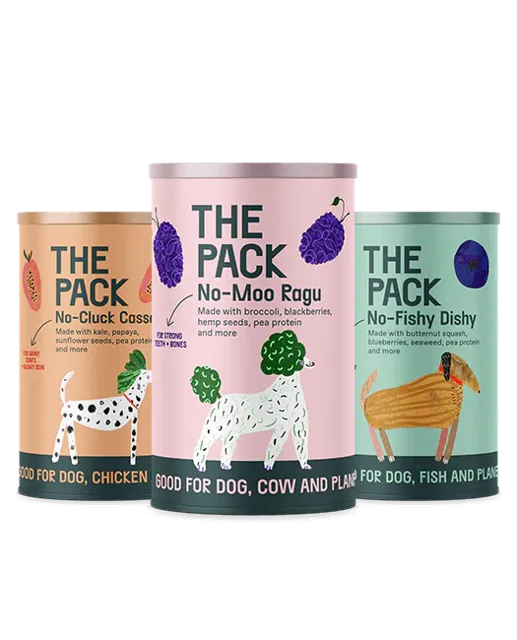
The Pack Plant-Based Healthy Meals is a vegan range of three 375g cans, each built on pea protein at 8% and lupin beans at 5.4%. Papaya, seeds and vegetables fill in behind them, with berries and a long list of herbs. Algal oil brings the long-chain omega 3 that would normally arrive with fish, and the amino acids a meat-free bowl can run short of are added and dosed rather than assumed. The three recipes share one analysis and one placing, in our Good band.

Where to buy: coming soon
Live retailer pricing is coming soon. Once we have prices from UK retailers, the best price, cost per day and where to buy will appear here.

Our view

Likely to suit

You may have ruled meat out of the bowl, or your dog may have ruled it out for you, and this is a complete range written for that decision.

  • Dogs that react to several animal proteins, since these labels name no meat, no fish and no dairy or egg
  • Households feeding a plant-based diet by conviction, with a complete recipe rather than a topper
  • Owners who want the supplement panel spelled out, with taurine at 400 mg and DL-methionine at 1000 mg per kilo printed on the can
  • Smaller dogs and dogs on a measured portion, as 118 kcal per 100g is richer than the 97 typical of adult wet food
  • Eaters who like variety, with three recipes changing the fruit and vegetables over one shared base
  • Households keeping grain out, since peas, lupin beans and squash carry the starch instead

Worth watching

A meat-free bowl raises questions a meat one does not, so here is what these labels tell you.

  • The protein is spread across pea protein, lupin beans, seeds and brewer's yeast, so this is not a one-ingredient protein source even though pea protein leads
  • Lupin beans belong to the same family as peanuts and soya, worth knowing if your dog reacts to legumes
  • Crude fibre converts to 8.0% of dry matter, higher than most wet food, so expect stools to change in the first week or two
  • Moving a dog onto a meat-free diet is a decision worth talking through with your vet first, and the printed doses of taurine and methionine, with L-carnitine alongside, are there to support that conversation
  • Estimated carbohydrate converts to 22.0% of dry matter against a 15.8% typical, which is what happens when plants carry the whole recipe

Written by our editorial team. Independent guidance, not veterinary advice.

How this scores

How we score
53.3/100Good
Protein and processingPoor
Nutritional balanceOutstanding
TransparencyOutstanding
ValueGood

The Details

Dog fit

You may have ruled meat out of the bowl, or your dog may have ruled it out for you, and this is a complete range written for that decision. A meat-free bowl raises questions a meat one does not, so here is what these labels tell you.

Food type

Wet

Life stage

Adult

Breed size

Toy, Small, Medium, Large, Giant

The score, in context

All three recipes land in our Good band and finish level with one another, since they share an analysis and differ only in fruit and vegetables. Protein and processing reads Poor, since there is no animal ingredient for our scoring to reward, while nutritional balance and transparency both read Outstanding on a label that is thoroughly declared.

The midpoint of the wet shelf reaches our Excellent band, so a step sits between this range and the typical wet food. That step is largely the meat question, not a shortfall in care. Judged on its own terms, this label does the difficult parts of plant-based feeding properly. Protein still converts to 40.0% of dry matter, and the amino acids plants supply poorly are added and printed with doses.

What's in it

Ingredients, as declared: Pea Protein (8%), Lupin Beans (5.4%), Papaya (3.5%), Blueberries (3%), Sunflower Oil (2.9%), Butternut Squash (2.3%), Red Pepper (2.3%), Peas (2.2%), Brewer's Yeast (2.1%), Botanicals & Herbs: Rosemary, Thyme, Chamomile, Dandelion, Basil, Marjoram, Coriander, Bay Laurel, Parsley, Sage, Dill, Yucca, Chicory Root (0.1%, source of inulin), Minerals, Hemp Seeds (0.67%), Pumpkin Seeds (0.67%), Sunflower Seeds (0.67%), Vegetable Broth, Seaweed (0.5%), Algal Oil (0.04%).

Named ingredients

Pea Protein (8%), Lupin Beans (5.4%), Papaya (3.5%), Blueberries (3%), Sunflower Oil (2.9%), Butternut Squash (2.3%), Red Pepper (2.3%), Peas (2.2%), Brewer's Yeast (2.1%), Botanicals & Herbs: Rosemary, Thyme, Chamomile, Dandelion, Basil, Marjoram, Coriander, Bay Laurel, Parsley, Sage, Dill, Yucca, Chicory Root (0.1%, source of inulin), Minerals, Hemp Seeds (0.67%), Pumpkin Seeds (0.67%), Sunflower Seeds (0.67%), Vegetable Broth, Seaweed (0.5%), Algal Oil (0.04%).

Nutritional additives

Vitamin A 4000IU, Vitamin D3 250IU, Vitamin E 40mg, DL-Methionine 1000mg, Taurine 400mg, Lysine 100mg, L-Carnitine 80mg, Iron (Iron (II) Sulphate Monohydrate) 50mg, Zinc (Zinc Chelate of Glycine Hydrate) 25mg, Manganese (Manganous Sulphate Monohydrate) 12mg, Copper (Copper (II) Sulphate Pentahydrate) 1mg, Iodine (Calcium Iodate Anhydrous) 0.6mg, Selenium (Selenised Yeast -Saccharomyces cerevisiae, inactivated) 0.06mg.

Ingredient notes

Pea protein at 8% leads every recipe, with lupin beans at 5.4% behind it. Pea protein is a concentrate left over from pea processing, and it is an efficient way to lift a protein figure. Set against meat, though, plant protein is the less complete and less digestible option for a dog. That is the honest starting point for any vegan recipe, and it is exactly why the rest of this label matters so much.

Protein converts to 40.0% of dry matter, which is a real figure for wet food of any kind. The supporting protein comes from lupin beans, brewer's yeast at 2.1% and hemp, pumpkin and sunflower seeds at 0.67% each. Brewer's yeast deserves a mention on its own account. Natural sources of B vitamins do not come much better, and its protein carries all nine of the essential amino acids.

The fruit and vegetable side is substantial and fully itemised, with papaya at 3.5%, berries at 3% and a pair of vegetables at 2.3% each on every recipe. Estimated carbohydrate lands at 22.0% of dry matter against 15.8% for the typical adult wet food, which is simply what a bowl with no meat in it looks like. Crude fibre at 8.0% of dry matter is high by wet food standards. Chicory root at 0.1% adds inulin, a prebiotic fibre the large intestine's own bacteria thrive on.

The fat comes from sunflower oil at 2.9% and from algal oil at 0.04%. Sunflower oil is low in saturated fat and carries vitamin E. That tiny algal figure is the clever part. Algae are the original source of long-chain omega 3, fish included, so a vegan recipe can supply the same fats without the fish.

The supplement panel is where this range earns its keep. DL-methionine at 1000 mg, taurine at 400 mg, lysine at 100 mg and L-carnitine at 80 mg per kilo cover exactly the nutrients that plant proteins deliver poorly. Each one arrives with a figure beside it. Vitamins A, D3 and E follow with figures, along with iron, zinc, manganese, copper, iodine and selenium. Calcium converts to 1.6% of dry matter, a sound level for an adult dog.

The herb list running from rosemary and thyme through to dill and yucca sits at trace level throughout. It gives the cans their character and their aroma, and rosemary in particular doubles as a natural antioxidant. You would not choose this food for the herbs, though.

How this variety differs

The sea-flavoured one, built on butternut squash and red pepper at 2.3% each with peas at 2.2% and blueberries at 3%. Seaweed at 0.5% is what gives it its character, and it brings a natural source of iodine and trace minerals with it.

Price and value

Each recipe comes in 375 g cans, sold in boxes of 6, 12, 18 and 36. We did not hold a checked figure for what this range sells for when this was written, so no per-kilo or per-day number appears here.

For portioning, a 15kg adult dog in moderate condition needs about 712 grams a day, assuming around 840 kcal a day (110 × bodyweight^0.75, the standard maintenance estimate). These cans are energy dense for wet food, so that is a smaller daily bowl than most wet feeding asks for.

Nutritional analysis

Declared analysis

Energy
118 kcal/100g
Protein

10%

Fat

5%

Fibre

2%

Ash

2.5%

Moisture

75%

Dry weight

Protein

40%

Fat

20%

Fibre

8%

Ash

10%

Carbs

22%

As-fed composition

Estimated breakdown of the finished product by ingredient category, from the declared ingredient list and ingoing weights. These are estimates, not measurements.

Added water

10.1%

Carbs

15.6%

Veg

33.2%

Oils

2.9%

Other

38.2%

Pricing & size
Pack size
6 Pack, 12 Pack, 18 Pack, 36 Pack (375 g cans)
Retailer pricing
Coming soon

Live retailer pricing is not yet available for this food. Prices, cost per day and where to buy will appear here once retailer data is live.

Ingredients and nutrition are taken from manufacturer data. Retailer pricing is not yet live for this food.

Related dog food guides

Ranked shortlists that include foods like this one.
All reviews
Canagan Petite – Beef Stew Paté
89/100Outstanding
9 varieties

Canagan

Petite

WetAll life stagesSingle protein
View review

Featured feeding accessories

All feeding accessories

Brackenwood

Slow Feeder Maze Bowl

Slows fast eaters and eases gulping at mealtimes.

From £12.99· 4 retailers
View

Tarn & Co

Raised Double Diner

Height-set stand for easier, tidier eating.

From £28.99· 3 retailers
View

Reviewed by Off the Leash Editorial

Last updated 28 August 2026