



Tesco
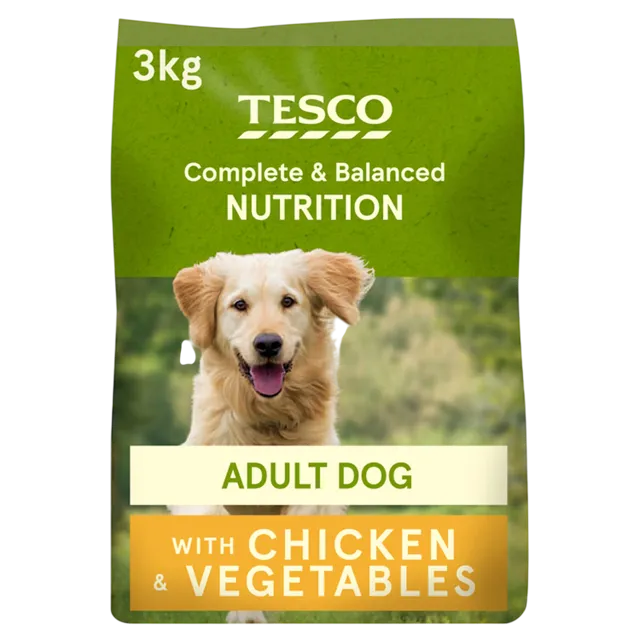
Tesco Complete & Balanced Nutrition Adult Dry: Chicken & Vegetables review
Tesco Complete & Balanced Nutrition Adult is an everyday supermarket kibble that comes as beef or chicken and is built the same way in both. Meat and animal derivatives account for 22% of each recipe, 4% of which is named as the flavour on the front. The bag mixes a shaped kibble holding that named meat with a brown barrel kibble making up the bulk. Behind it sits a complete vitamin and mineral panel with every trace element dosed in print. Both recipes land in our Average band, and that reflects how many category names the label leans on. Nothing in the food itself is troubling.
Our view
Likely to suit
You can drop this bag in the trolley and pour it without giving dinner a second thought.
- Owners feeding a healthy adult dog with no known sensitivities, since the recipe is plain, complete and consistent
- Households with two dogs on the same food, because beef and chicken are built to one recipe and swap over easily
- Dogs that like a bit of texture in the bowl, as each bag mixes two kibble shapes
- Owners who like to see a dose beside every trace mineral, zinc at 100 mg and iron at 60 mg per kilo among them
- Adult dogs in steady working condition, with fat sitting at a middling 9.0%
Worth watching
A few label facts deserve reading before this becomes your regular bag.
- The meat entry is meat and animal derivatives at 22%, and only the 4% named flavour is tied to an animal, so an elimination trial needs a different food
- Cereals covers any grain at all, and which grain it is can differ between batches
- Neither label declares moisture, so the dry matter figures on this page assume the usual 8% for a kibble
- Starch does much of the carrying, with carbohydrate estimated at 55.4% of dry matter where 46.2% is typical for adult dry food
- The preservatives and antioxidants are given as categories without names
Written by our editorial team. Independent guidance, not veterinary advice.
How this scores
How we scoreThe Details
Dog fit
You can drop this bag in the trolley and pour it without giving dinner a second thought. A few label facts deserve reading before this becomes your regular bag.
Dry
Adult
Toy, Small, Medium, Large, Giant
Chicken
The score, in context
Our scoring lands both recipes in our Average band, and it is a reading of the label more than of the bag. Nearly every entry that matters is a category name, so there is no way to tell what changed between batches, and the detail our scoring leans on simply is not printed. A typical adult dry food gets a band further, to our Good band, mostly by naming its parts.
Taken for what it actually is, a plain complete kibble with a fully dosed mineral panel behind it, this feeds an ordinary adult dog perfectly well. The two flavours read identically on the analysis, and the only gap between them is transparency, where the beef sits a band above the chicken, so otherwise it comes down to what your dog prefers.
What's in it
Ingredients, as declared: Cereals, Meat and Animal Derivatives (22% including 4% Chicken in the Bone-shaped Kibble*), Oils and Fats, Vegetables (4% Peas in the Brown Barrel-shaped Kibble), Minerals, Derivatives of Vegetable Origin (0.5% Beet Pulp in the Bone-shaped kibble*), Yeasts. *Bone-shaped Kibble: typically 20% of product, Brown Barrel-shaped Kibble: typically 60% of product
Named ingredients
Nutritional additives
_Nutritional additives per kg:_ Vitamin A 17, 000 IU, Vitamin D3 1, 500 IU, Vitamin E 70mg, Iodine (Calcium Iodate Anhydrous) 2.5mg, Selenium (Sodium Selenite) 0.1mg, Copper (Copper (II) Sulphate Pentahydrate) 8mg, Iron (Iron (II) Sulphate Monohydrate) 60mg, Manganese (Manganese (II) Oxide) 50mg, Zinc (Zinc Oxide) 100mg. _Additives:_ Preservatives, Antioxidants.
Ingredient notes
The two kibble shapes in each bag are not decoration, they are how the recipe is organised. The named meat, whether beef or chicken, lives only in the shaped kibble that the label says is typically 20% of the product, alongside the 0.5% beet pulp. The brown barrel kibble that makes up around 60% carries the 4% peas. So the named animal is concentrated in a minority of what you pour. That is worth remembering when you read 4% on the front.
Everything else is written in categories. Cereals can be any grain. Oils and fats can be any oil at all, whether it came from a plant or from an animal, and derivatives of vegetable origin is broader again. These umbrella terms turn up on good recipes and thin ones alike, often for perfectly ordinary commercial reasons, so their presence proves nothing on its own. What they do prevent is a reader working out what they are actually feeding, which is the whole difficulty for a dog with a sensitivity.
The analysis is steady rather than striking. Protein reads 21.0% and fat 9.0%, converting to 22.8% and 9.8% of dry matter, with fibre at 3.0% and ash at 8.0%. No moisture figure is declared. Those dry matter numbers therefore use the usual 8% assumed for a kibble. Carbohydrate estimates to 55.4% of dry matter, above the 46.2% typical for adult dry food. Do the sums and that is what a cereal led recipe looks like. Energy comes out at 347 kcal per 100g.
The label is at its best in the added nutrition. Zinc is dosed at 100 mg, iron at 60 mg, manganese at 50 mg, copper at 8 mg, iodine at 2.5 mg and selenium at 0.1 mg per kilo. Vitamin E sits alongside them at 70 mg. The plain forms are used here, zinc as an oxide and selenium as sodium selenite. Chelated and yeast bound versions are generally taken up a little more readily. A complete panel printed with figures is still genuinely useful, and plenty of labels never manage it.
Yeasts close the list, and a small amount of yeast is a sensible inclusion: it brings B vitamins and a little palatability. The fibre entry is beet pulp at 0.5%, the fibrous material left when sugar is taken from sugar beet, and it helps keep a gut regular.
How this variety differs
The named 4% is chicken, and it sits in the bone shaped kibble rather than the clover, again typically 20% of what is in the bag. Chicken is the lighter of the two flavours, and for a dog that has not eaten much red meat it is the more familiar start.
Price and value
£1.00 a kilo, sold in 3kg and 12kg bags.
As a guide, a 15kg adult dog in moderate condition eats about 242 grams a day, and that comes to £0.24 a day. The maths behind that assumes around 840 kcal a day (110 × bodyweight^0.75, the standard maintenance estimate). Both flavours read the same on energy, so the figure holds either way.
Nutritional analysis
Declared analysis
21%
9%
3%
8%
Dry weight
22.8%
9.8%
3.3%
8.7%
55.4%
As-fed composition
Estimated breakdown of the finished product by ingredient category, from the declared ingredient list and ingoing weights. These are estimates, not measurements.
25.8%
10%
1.5%
1.9%
60.8%
Pricing & size
- Pack size
- 3kg e · 12kg
- Retailer pricing
- Coming soon
Live retailer pricing is not yet available for this food. Prices, cost per day and where to buy will appear here once retailer data is live.
Ingredients and nutrition are taken from manufacturer data. Retailer pricing is not yet live for this food.
Related dog food guides
Ranked shortlists that include foods like this one.