



Tesco
Tesco Kingswood Dry: Adult Salmon with Spinach & Sea Buckthorn review
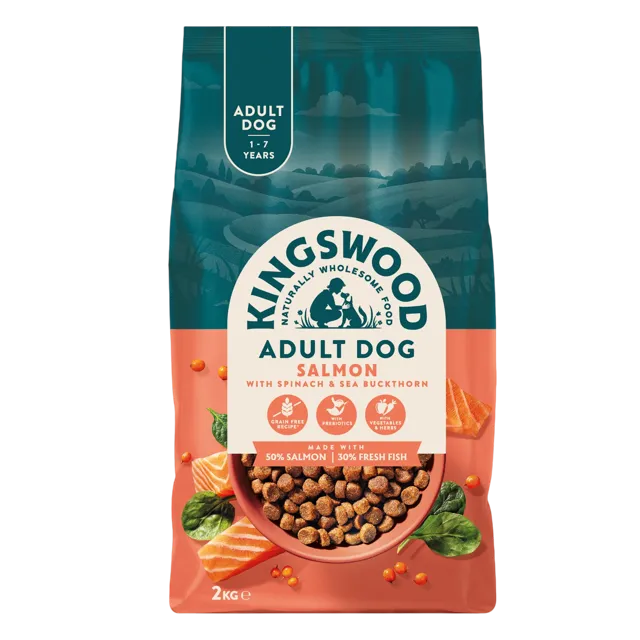
Tesco Kingswood is the supermarket's more ambitious dog food, and the front of the bag backs it up. Each recipe declares 50% of a single named animal and then splits that figure into its fresh and its dried share, which is the kind of detail most labels leave out. The adult is salmon on a grain free base of peas, sweet potato and potato starch, the puppy is chicken with rice behind it, and both carry taurine, inulin and a dosed mineral panel. Both sit in our Average band, held there by a named meat at the front and pulled back by a handful of unnamed entries further down.
Our view
Likely to suit
Half of what goes into each of these bags is named and weighted on the front, which makes the choice a simple one.
- Dogs that thrive on fish, since the adult recipe is built on 50% salmon, declared as 30% fresh and 20% dried
- Puppies growing on poultry, because the puppy bag declares 50% chicken as 28% fresh and 22% dried
- Owners who like both halves of that 50% set out, the fresh and the dried, not folded into one headline number
- Adult dogs kept away from grain, as peas, sweet potato and potato starch carry the starch in the salmon recipe
- Households that shop for the dog in the supermarket but still want a named meat leading the list
Worth watching
A few entries further down these lists are worth reading before you commit.
- Animal fat and hydrolysed proteins are both unnamed in each recipe, so neither can rule a species in or out for a food trial
- The puppy recipe carries salmon oil, so a young dog that reacts to fish cannot use this bag
- Rice is declared at 15% in the puppy food, one to note when a growing dog is being kept off grain
- No calcium figure is declared on either label, the very number you want when rearing a large breed puppy
- The published analysis reads as a flat row of 5.0% figures on both bags, which cannot be right, so there is no dependable dry matter reading to give you here
Written by our editorial team. Independent guidance, not veterinary advice.
How this scores
How we scoreThe Details
Dog fit
Half of what goes into each of these bags is named and weighted on the front, which makes the choice a simple one. A few entries further down these lists are worth reading before you commit.
Dry
Adult
Toy, Small, Medium, Large, Giant
Salmon
The score, in context
Both bags read Average on our scale, a step below the Good band that a typical adult dry food arrives at. The front of the list is doing the lifting. Half of each recipe is one named animal, and printing the fresh and dried shares separately tells you something that a single headline figure never can.
The small print is what stops them climbing further. Animal fat and hydrolysed proteins carry no species, and the published analysis for both bags is not usable as it stands. Some of the picture has to come from the ingredients alone. On what can be read, these are well put together recipes.
What's in it
Ingredients, as declared: Salmon 50% (Fresh salmon 30%, Dried salmon protein 20%). Peas, dried sweet potato, potato starch, dried beet pulp, animal fat, potato, flakes, hydrolyzed proteins, minerals, inulin (0, 7%), dried spinach (0, 45%), Yucca Schidigera (0, 2%), dried sea buckthorn (0, 1%)*, thyme*, rosemary*, parsley*, Natural Ingredients
Named ingredients
Nutritional additives
_Nutritional additives per kg:_ Vitamin A 20000IU Vitamin D3 1333 IU Vitamin E 350 mg Vitamin C 150 mg Copper ( Copper(II) sulphate pentahydrate) 11, 85 mg Iron ( Iron(II) sulphate monohydrate) 133 mg Iodine ( Calcium iodate, anhydrous) 2, 67 mg Zinc ( Zinc sulphate monohydrate) 114 mg Manganese ( Manganese (II) oxide) 13, 33 mg Selenium ( Sodium selenite) 0, 3 mg Taurine 1000 mg _Technological additives per kg:_ With antioxidants
Ingredient notes
Start with the split, because it is the most useful thing on either label. The adult declares salmon at 50%, made up of 30% fresh salmon and 20% dried salmon protein. Water makes up most of any fresh fish, and the oven takes it out again, so a fresh only headline flatters a recipe. The 20% dried salmon protein is what actually reaches the finished kibble, and that is a substantial share. The puppy does the same thing with chicken at 50%, as 28% fresh and 22% dried.
The bases part company after that. The salmon recipe leans on peas, dried sweet potato, potato starch and potato flakes, with no grain at all. If you are avoiding cereal, that is the bag to pick up. The puppy recipe puts rice at 15% behind the peas, along with dried sweet potato at 4%, a conventional and easily digested base for a growing dog.
The small print earns its place on both. Inulin is a prebiotic. The bacteria in a dog's large intestine live on it. Dried beet pulp adds the fibre a settled gut likes. Yucca schidigera has long been added to kibble for its effect on stool odour. Taurine is dosed at 1000 mg per kilo. Most dogs make this amino acid for themselves, and it is still well worth adding to a recipe leaning on plant starches. The adult also carries dried spinach and a little sea buckthorn.
The honest limitation is a pair of unnamed entries. Animal fat and hydrolysed proteins appear in both recipes without a species attached, and hydrolysed protein in particular is usually there as a palatant. Neither is a problem for a dog with no sensitivities, but together they mean that neither bag can be used to keep a dog strictly off a particular animal, whatever the headline says.
The mineral and vitamin panel is dosed in print and generous with the antioxidants. Vitamin E is at 350 mg per kilo, vitamin C at 150 mg in the adult, zinc at 114 mg and iron at 133 mg. Zinc and iron both come as sulphates and the selenium as sodium selenite, the plain forms rather than the chelated ones, but the doses are all there to read.
One thing you should treat with caution is the published analysis. Both bags show protein, fat, fibre and ash as a flat row of 5.0% figures, with the puppy's fat at 0.0%, and no recipe built on 50% meat looks like that. It reads as a capture that went wrong rather than a description of the food, so nothing on this page rests on those numbers, and the ingredient list is the better guide.
How this variety differs
The adult recipe, and the grain free one: salmon at 50% over peas, dried sweet potato and potato starch, with no cereal anywhere. Dried spinach and dried sea buckthorn give it the name on the front, and vitamin C is dosed at 150 mg per kilo alongside vitamin E at 350 mg. It reads 370 kcal per 100g, the more energy dense of the two.
Price and value
£4.95 a kilo, sold in 2kg bags.
As a guide, a 15kg adult dog in moderate condition eats about 227 grams a day of the salmon recipe, and that comes to £1.12 a day. Behind it is around 840 kcal a day (110 × bodyweight^0.75, the standard maintenance estimate). The label's own table asks 170 to 360 grams for a dog between 10kg and 25kg. Any gap between the two is settled by how your dog looks and feels. Growing puppies eat to a different curve entirely, so portion the puppy bag from its own table.
Nutritional analysis
Declared analysis
5%
5%
5%
5%
Dry weight
5.4%
5.4%
5.4%
5.4%
78.4%
As-fed composition
Estimated breakdown of the finished product by ingredient category, from the declared ingredient list and ingoing weights. These are estimates, not measurements.
50%
44.1%
0.2%
2.7%
3%
Pricing & size
- Pack size
- 2kg ℮
- Retailer pricing
- Coming soon
Live retailer pricing is not yet available for this food. Prices, cost per day and where to buy will appear here once retailer data is live.
Ingredients and nutrition are taken from manufacturer data. Retailer pricing is not yet live for this food.
Related dog food guides
Ranked shortlists that include foods like this one.