


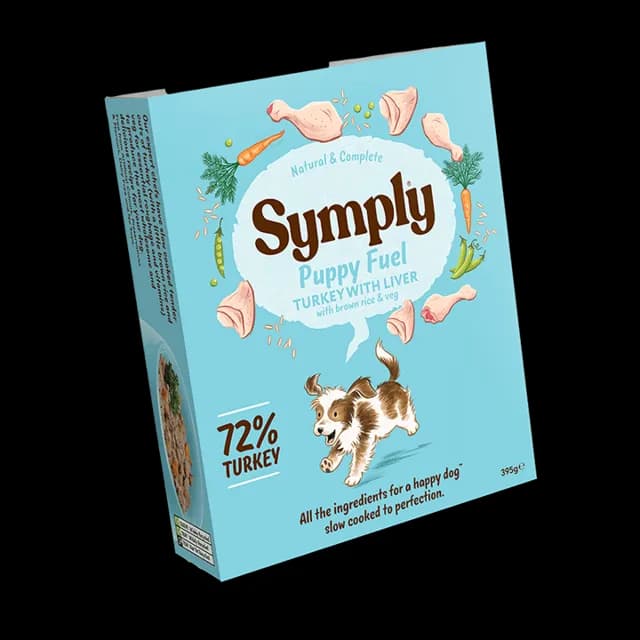
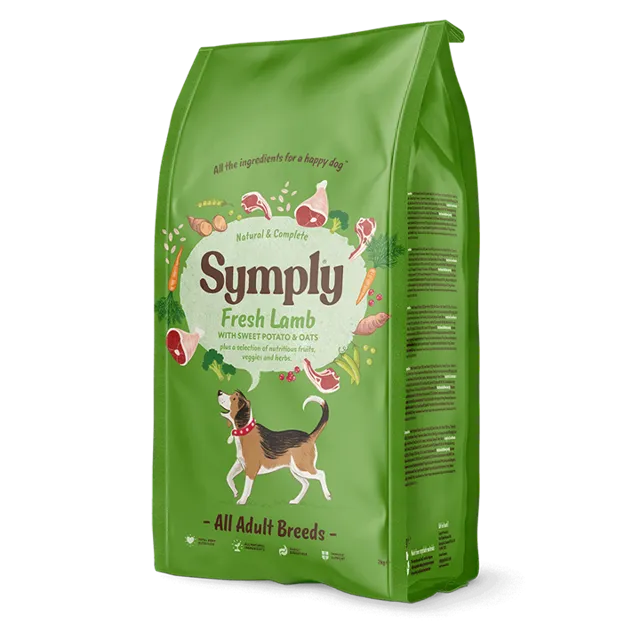

Symply
Symply Adult: Fresh Lamb review
Symply Adult builds four recipes on one honest frame, with a single named animal supplying a little over 45% of the recipe. Each part is itemised, the fresh and dried meat along with the fat and the gravy, so you can see how that headline number was put together. Sweet potato, whole oats and potato carry the starch, whole egg and a short tail of fruits, greens and marigold follow, and a prebiotic fibre closes the list. All four sit in our Good band, with the lamb a whisker behind the other three.
Our view
Likely to suit
You will find feeding one meat far easier when the bag says which animal it is and how much.
- Owners who want to see how a meat percentage is built, since the fresh and dried meat, the fat and the gravy each get their own line
- Dogs that do best on one main meat, because every recipe draws its bulk protein from a single named animal
- Rotation feeders, since four species share one construction and swap cleanly from bag to bag
- Dogs that get on with oats, which carry the grain side here in place of wheat or maize
Worth watching
The smaller print holds a few details worth taking in before you pick one of the four.
- Whole egg and salmon oil run through all four recipes, so none of them is a single protein or a fish free diet
- Whole oats make this a grain inclusive food, so it is off the list for a dog kept away from cereal
Written by our editorial team. Independent guidance, not veterinary advice.
How this scores
How we scoreThe Details
Dog fit
You will find feeding one meat far easier when the bag says which animal it is and how much. The smaller print holds a few details worth taking in before you pick one of the four.
Dry
Adult
Toy, Small, Medium, Large, Giant
Lamb
The score, in context
All four of these finish in our Good band, level with the middle of the adult dry category, and the lamb comes in just below its siblings without leaving that band. Transparency reads Outstanding across the range, which is where these recipes are strongest: the meat is named, the split behind the number is printed, and the plant side is recognisable food rather than fractions. Nutritional balance reads Average on three of the four and Poor on the lamb, because carbohydrate is still carrying a fair share. It runs from 47.4% of dry matter in the salmon up to 50.6% in the chicken, against 46.2% for the typical adult dry food. Let the animal decide it for you, since the gap between these recipes is smaller than their finishing positions suggest.
What's in it
Ingredients, as declared: 45.7% Lamb (Fresh Lamb 26%, Dried Lamb 15%, Lamb Fat 3.1%, Lamb Gravy 1.6%), Sweet Potato (15%), Whole Oats (12.9%), Potato (11.9%), Pea Starch, Peas, Alfalfa, Salmon Oil (0.8%), Whole Egg, Carrot, Apple, Broccoli, Marigold Flower, Cranberry, Bilberry, Spinach, Prebiotic - Fructooligosaccharides (0.04%), Peppermint.
Named ingredients
Nutritional additives
_(the page labels this "Nutritional Additives (per kg)")_: Vitamins: Vitamin A 15,000 iu Vitamin D3 1,200 iu Vitamin E (as alpha tocopherol) 150 mg. Trace Elements: (per kg) Zinc (Zinc Oxide) 90 mg Zinc (Zinc Chelate of Amino Acids Hydrate) 45 mg Copper (Copper (II) Sulphate Pentahydrate) 10 mg Iodine (Calcium Iodate, Anhydrous) 2 mg Selenium (Sodium Selenite) 0.2 mg
Ingredient notes
Each recipe puts one named animal at the top and then shows its working. The chicken variety declares 45.8% chicken: 26% fresh, 15.7% dried, 2.5% chicken fat and 1.6% chicken gravy. The other three follow the same pattern with their own species. That matters because a fresh meat figure is largely water weight, and the oven removes it. The dried share is what really lands in the finished kibble, and printing both halves means you are not left guessing which is which.
Sweet potato, whole oats and potato carry the starch, in that order in the chicken recipe and shuffled slightly in the others, with pea starch and whole peas filling in behind. Whole oats are a gentle, easily digested grain that brings soluble fibre along with them, and sweet potato adds fibre and vitamin A that ordinary potato does not. Carbohydrate still converts to between 47.4% and 50.6% of dry matter across the range, so the plant side is doing genuine work rather than sitting decoratively at the back.
Whole egg turns up in every recipe, a small entry with an unusually complete amino acid profile behind it, and alfalfa sits above it as a green source of fibre and minerals. The fruit and vegetable tail of cranberry, carrot, apple, broccoli, marigold flower, bilberry and spinach is real but modest. Treat it as seasoning on a recipe that already stands up without any of it.
In the chicken, lamb and turkey recipes the omega 3 source is salmon oil. In the salmon variety the fish is the meat itself, with sunflower oil alongside. Marine omega 3s are the form a dog's body puts to work most directly, on skin and coat and on the joints. That is a real advantage. The flip side is simply that nothing here is free of fish.
Fructooligosaccharides are declared at 0.04%, a prebiotic fibre that the large intestine's helpful bacteria live on. Peppermint closes the list. The trace element panel is short and specific. Zinc appears twice: 90 mg as the oxide, and another 45 mg as an amino acid chelate. That second form is the one a dog absorbs most readily. Copper comes at 10 mg, iodine at 2 mg and selenium at 0.2 mg per kilo. Iron and manganese are not declared, which is worth noticing on an otherwise open label.
How this variety differs
Lamb at 45.7%, split into 26% fresh, 15% dried, 3.1% fat and 1.6% gravy. This one carries the most fibre at 4.5% and the most ash at 9.0%, with calcium working out at 2.28% of dry matter. Protein is the lowest in the range at 21.0%, which is what leaves it a shade behind its siblings. Lamb remains one of the kindest red meats for a dog that finds poultry hard going.
Price and value
Per kilo, the chicken and the turkey are £5.67, the salmon £6.08 and the lamb £6.33. All four are sold in 2kg, 6kg and 12kg bags.
As a guide, feeding a 15kg adult dog in moderate condition works out at between £1.36 and £1.56 a day depending on the flavour. That assumes about 840 kcal a day (110 × bodyweight^0.75, the standard maintenance estimate) and the estimated energy figures on these labels. The maker's own table asks 150 grams a day for a 15kg dog, a little under that estimate, so let your dog's condition settle the difference.
Nutritional analysis
Declared analysis
Estimated using Modified Atwater factors*
21%
13%
4.5%
9%
8%
Dry weight
22.8%
14.1%
4.9%
9.8%
48.4%
As-fed composition
Estimated breakdown of the finished product by ingredient category, from the declared ingredient list and ingoing weights. These are estimates, not measurements.
45.6%
1.6%
48.9%
2.7%
0.8%
0.3%
Pricing & size
- Pack size
- 2kg (£17.49), 6kg (£40.99), 12kg (£75.99)
- Retailer pricing
- Coming soon
Live retailer pricing is not yet available for this food. Prices, cost per day and where to buy will appear here once retailer data is live.
Ingredients and nutrition are taken from manufacturer data. Retailer pricing is not yet live for this food.
Related dog food guides
Ranked shortlists that include foods like this one.