
Skip to content
Off the Leash
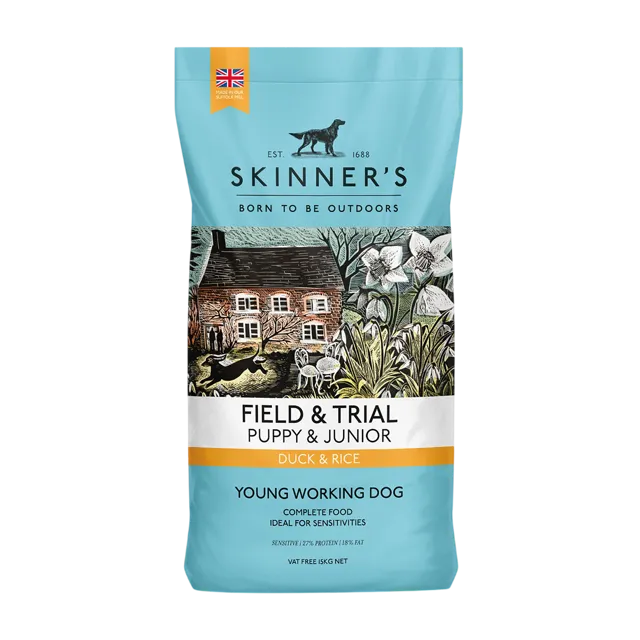
Skinner's Field & Trial Puppy & Junior – Duck & Rice

Skinner's

Skinner's Field & Trial Puppy & Junior: Duck & Rice review

60.8/100Good
DryPuppy

Skinner's Field & Trial Puppy & Junior puts a pair of recipes under one name, and they take noticeably different routes to the same job. Duck & Rice leads on duck meat meal at 28.1%, with brown rice at 28% just behind it. Rich In Lamb & Rice reverses the order, putting brown rice at 39.3% ahead of lamb meat meal at 15.5%. Both carry the same fully quantified supplement tail, from MOS at 2500mg/kg down to yucca at 100mg/kg, and both land in our Good band.

Where to buy: coming soon
Live retailer pricing is coming soon. Once we have prices from UK retailers, the best price, cost per day and where to buy will appear here.

Our view

Likely to suit

Two bags share this name, and you will want to choose between them with care.

  • Puppies working through the junior stretch, since both recipes are labelled for puppy and junior together
  • Pups whose owners prefer a meat away from chicken, with duck heading one recipe and lamb the other
  • Owners who want their extras quantified, with MOS at 2500mg/kg, FOS at 1000mg/kg, glucosamine at 250mg/kg and chondroitin sulphate at 150mg/kg printed on both bags
  • Steadier growers as well as busy ones, since the lamb recipe runs lighter at 348 kcal per 100g while the duck recipe carries 388
  • Puppies who take rice comfortably, with brown rice in the base of both and naked oats behind it

Worth watching

Both recipes share a few habits, and you will want to know them before you buy.

  • Neither label prints a calcium figure, so large breed growth cannot be planned from these packs alone
  • Neither bag can anchor a strict duck only or lamb only elimination diet, because poultry fat is in both
  • The lamb recipe puts brown rice ahead of the meat in the order, so its meat share is much the lighter of the two

Written by our editorial team. Independent guidance, not veterinary advice.

How this scores

How we score
60.8/100Good
Protein and processingAverage
Nutritional balanceGood
TransparencyOutstanding
ValueGood

The Details

Dog fit

Two bags share this name, and you will want to choose between them with care. Both recipes share a few habits, and you will want to know them before you buy.

Food type

Dry

Life stage

Puppy

Breed size

Toy, Small, Medium, Large, Giant

Main protein

Duck

The score, in context

Both recipes finish in our Good band, level with where the puppy dry field averages out. Transparency reads Outstanding on both bags and value Good, with protein and processing Average on each. Nutritional balance splits, Good for the duck and Average for the lamb.

The reason is the balance of the bags rather than any single fault. Meat shares are modest for a growth food, and the cereal base carries more of each recipe than the meat does. Neither label declares calcium, the figure a puppy owner most wants to see. What both do well, and what plenty of bags aimed at this stage of life still do not, is print a quantity beside every supplement they name.

What's in it

Ingredients, as declared: Duck meat meal 28.1%, Brown rice 28%, Naked oats, Peas, Poultry fat, Whole linseed, Beet pulp, Vitamins & minerals, Brewer's yeast, Dicalcium phosphate, Cellulose, Marine algae meal, MOS 2500mg/kg, FOS 1000mg/kg, Herb blend 750mg/kg, Glucosamine 250mg/kg, Chondroitin sulphate 150mg/kg, Seaweed 150mg/kg, Yucca 100mg/kg

Named ingredients

Duck meat meal 28.1%, Brown rice 28%, Naked oats, Peas, Poultry fat, Whole linseed, Beet pulp, Vitamins & minerals, Brewer's yeast, Dicalcium phosphate, Cellulose, Marine algae meal, MOS 2500mg/kg, FOS 1000mg/kg, Herb blend 750mg/kg, Glucosamine 250mg/kg, Chondroitin sulphate 150mg/kg, Seaweed 150mg/kg, Yucca 100mg/kg

Nutritional additives

_Nutritional additives per kg:_ | Additive | Amount | | --- | --- | | Vitamin A | 13000iu | | Vitamin D3 | 2000iu | | Vitamin E (as alpha-tocopherol acetate) | 350mg | | Taurine | 100mg/kg | _Trace Elements per kg:_ | Trace element | Amount | | --- | --- | | iron (as iron (II) sulphate monohydrate) | 26.7mg | | iron (as iron (II) chelate of protein hydrolysates) | 13.3mg | | iodine (as calcium iodate anhydrous) | 1.5mg | | copper (as copper (II) sulphate pentahydrate) | 3.3mg | | copper (as copper (II) chelate of hydrolysates) | 1.7mg | | manganese (as manganese (II) oxide) | 16.7mg | | manganese (as manganese chelate of protein hydrolysates) | 8.3mg | | zinc (as zinc oxide) | 100mg | | zinc (as zinc chelate of protein hydrolysates) | 30mg | | selenium (as organic selenium) | 0.1mg | | TECHNOLOGICAL ADDITIVES | — | | tocopherol extracts from vegetable oils (vitamin E) | — | | clinoptilol

Ingredient notes

Meat arrives as a meal in both, that dry rendered powder kibble making has leaned on for decades. The water is gone before the mixing, so the printed share carries into the finished kibble much as stated. That flatters neither bag, but it does let you read the numbers straight. Duck meat meal at 28.1% on one recipe against lamb meat meal at 15.5% on the other is a real gap rather than a labelling quirk.

Rice is the common thread. The duck recipe uses brown rice at 28%, sitting just behind its meat, while the lamb recipe puts brown rice at 39.3% at the very front of the list. Naked oats follow in both. Against a 39.0% average for the puppy dry field, the duck recipe estimates at 40.7% of dry matter and the lamb at 48.2%. So the base does a full share of the work in one and the greater part of it in the other.

Plant proteins fill in behind the meat on both. Peas appear in the duck recipe and pea protein sits high in the lamb one, with sunflower meal and dried egg behind it. Refined plant proteins lift a declared protein total without matching meat for quality or digestibility, so they are best read as support. Their position in the lamb list is the honest signal of how that recipe is built.

The added energy carrier in both is poultry fat, and it names no species at all. That entry is the one to note when a formal exclusion trial is planned. Plant omega 3 comes from whole linseed, and marine algae meal covers the marine forms with no fish on the label. Beet pulp adds gentle fibre next to the cellulose.

Calcium is the missing line on both packs. The duck recipe does carry dicalcium phosphate, a mineral family added as a source of calcium and phosphorus and the main constituent of bone. The intent is clear enough, though no figure for either mineral is printed on either label. That matters far less for a small or medium pup than for a large or giant one. If you have a big breed on your hands, ask Skinner's for the number.

The two bags share one supplement tail, and every entry on it comes with a dose. The prebiotic pair is MOS at 2500mg/kg with FOS at 1000mg/kg, working on the gut flora of the large intestine. Glucosamine at 250mg/kg and chondroitin sulphate at 150mg/kg get joint support going early. Seaweed at 150mg/kg and yucca at 100mg/kg close the run. Vitamin A comes at 13000iu, vitamin D3 at 2000iu, vitamin E at 350mg and taurine at 100mg per kilogram. Each trace element is given twice over, as an oxide or sulphate and again as a protein hydrolysate chelate, the more absorbable of the two, down to organic selenium at 0.1mg. Brewer's yeast supplies natural B vitamins, and a clinoptilolite clay at 3000mg sits among the technological additives.

How this variety differs

Duck & Rice is the meatier and the denser of the two. Duck meat meal at 28.1% heads the list with brown rice at 28% immediately behind it, then naked oats, peas and poultry fat fill the middle. The analysis follows suit: protein at 27.0%, converting to 29.3% of dry matter, fat at 18.0% or 19.6% of dry matter, ash at 6.5%. Energy comes in at 388 kcal per 100g, the higher figure of the pair.

Dicalcium phosphate appears on this list and not on the lamb one, an added source of calcium and phosphorus, though no quantity for either is printed. Duck is the only named meat here, which suits a pup being steered away from chicken, but the poultry fat further down means the bag cannot serve a strict single meat plan.

Price and value

Duck & Rice works out at £4.00 a kilo and Rich In Lamb & Rice at £3.35 a kilo, both sold in 2.5kg and 15kg bags.

Neither bag feeds to a single settled amount, because a puppy's ration climbs through the fastest growing weeks and then eases back again. From our own energy estimate, a 20kg pup aged 4 to 12 months would get through roughly 307 to 375 grams a day of the duck recipe. The lighter lamb one runs to 342 to 418 grams. Let the growth chart and your pup's condition decide where inside that you land.

Nutritional analysis

Declared analysis

Energy
388 kcal/100g
Protein

27%

Fat

18%

Fibre

3%

Ash

6.5%

Moisture

8%

Dry weight

Protein

29.3%

Fat

19.6%

Fibre

3.3%

Ash

7.1%

Carbs

40.7%

As-fed composition

Estimated breakdown of the finished product by ingredient category, from the declared ingredient list and ingoing weights. These are estimates, not measurements.

Meat

28.1%

Carbs

62.2%

Veg

0.3%

Oils

4%

Other

5.4%

Pricing & size
Pack size
2.5kg, 15kg
Retailer pricing
Coming soon

Live retailer pricing is not yet available for this food. Prices, cost per day and where to buy will appear here once retailer data is live.

Ingredients and nutrition are taken from manufacturer data. Retailer pricing is not yet live for this food.

Related dog food guides

Ranked shortlists that include foods like this one.
All reviews

Featured feeding accessories

All feeding accessories

Brackenwood

Slow Feeder Maze Bowl

Slows fast eaters and eases gulping at mealtimes.

From £12.99· 4 retailers
View

Tarn & Co

Raised Double Diner

Height-set stand for easier, tidier eating.

From £28.99· 3 retailers
View

Reviewed by Off the Leash Editorial

Last updated 28 August 2026