



Seven Pet
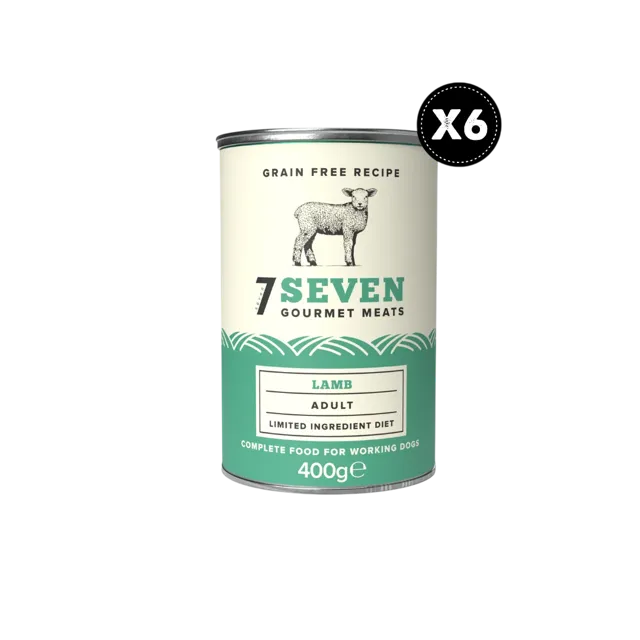
Seven Pet Seven Adult Tins: Lamb review
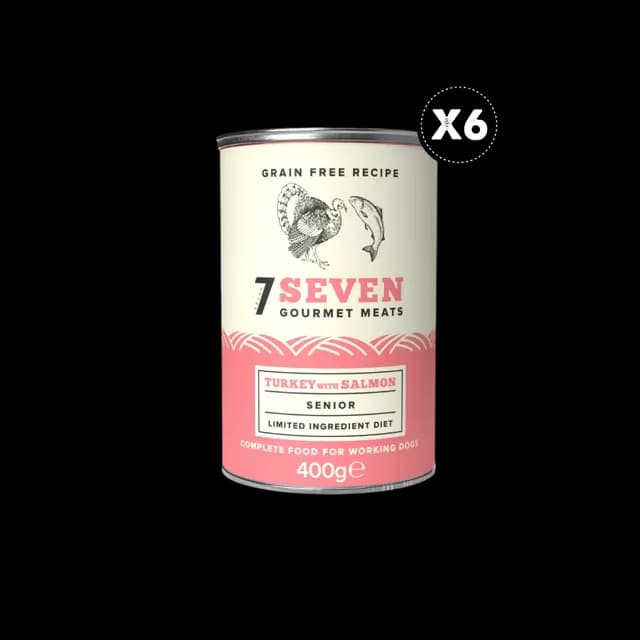
Seven Adult Tins is a five-strong set of 400g tins, each led by one headline animal at somewhere between 50% and 66%, with a light scatter of vegetables, fruit and botanicals behind it. Beef, beef with venison, chicken, lamb and wild boar cover the everyday tastes and the unusual ones in the same range. Our Excellent band holds four of the five, with the beef tin a step behind in our Good band.
Our view
Likely to suit
Whether your dog will eat anything put in front of them or needs something they have never met, there is a tin here pointed at them.
- Dogs that do best on one animal, since the chicken, lamb and wild boar tins each keep to a single named meat
- Owners who like a meat percentage printed up front, between 50% and 66% depending on the tin
- Dogs who have run out of ordinary meats, with wild boar and beef with venison still to try
- Older dogs feeling their joints, as the lamb tin prints glucosamine at 0.09% and chondroitin sulphate at 0.03%
- Rotation feeders, because the tins share a size and a construction, so swapping the animal changes very little else
- Dogs that need feeding up a little, since the beef tin is the most energy dense of the five
Worth watching
Read the label on the tin you are buying, because the detail varies across the range.
- That tin puts beef at 65% inside a meat and meat by-products heading, so the rest of the animal fraction has no species and cannot anchor an elimination diet
- The added panel is thin across the range, running to vitamin D3 at 200 IU with zinc at 25mg and manganese at 1.4mg on most tins, and no vitamin A or vitamin E line anywhere
- Herbs appear on the chicken tin as a single unnamed group, awkward if you are keeping a particular plant out of the bowl
- There is one size only, the 400g tin, so a small dog will be left with an opened tin to cover and keep cold between meals
Written by our editorial team. Independent guidance, not veterinary advice.
How this scores
How we scoreThe Details
Dog fit
Whether your dog will eat anything put in front of them or needs something they have never met, there is a tin here pointed at them. Read the label on the tin you are buying, because the detail varies across the range.
Wet
Adult
Lamb
The score, in context
Four of these tins settle in our Excellent band and the beef sits just under them in our Good band, while the benchmark adult wet food belongs to the Excellent band as well. Wet is a strong category, so holding four recipes at that line is a real result.
The wild boar's step down is easy to explain. Its named meat is 50% where the others run at 65% or 66%, more of the tin is given to vegetables and fruit, and at 79.0% moisture it is the wateriest of the five. That makes it a lighter tin rather than a lesser one, and for a dog that needs an unfamiliar animal it may still be the most useful thing on this shelf.
Across the whole set, what earns the placement is a named animal at the head of every list with printed percentages behind it, and dry-matter protein running from 39.2% up to 46.4%. The declaration has its gaps even so. The trace element panel is short, no label prints vitamin A or E, and four of the five tins leave their calories out, so the energy figures here are our estimate.
What's in it
Ingredients, as declared: 65% Lamb, Broccoli 3%, Blueberries 2%, Minerals 1%, Sunflower Oils 1%, Seaweed 0.1%, Glucosamine 0.09%, Chondroitin Sulphate 0.03%
Named ingredients
Nutritional additives
Vitamin Dg 200 IU. Trace Elements: Zinc (as Zinc Sulphate Monohydrate) 25mg, Manganese (as Manganous Sulphate Monohydrate) 1.4mg.
Ingredient notes
Nothing in the range has a shorter list than the beef with venison tin, and little on the whole wet shelf does either. It runs to beef at 66%, venison at 4%, minerals at 1%, and water making up the rest. Protein converts to 43.2% of dry matter and fat to 34.0%, which is a rich, straightforward tin with nothing to unpick.
The chicken and lamb tins follow one pattern. Chicken at 65% comes with carrots at 3%, blueberries at 2%, then turmeric, herbs, hemp oil and seaweed at 0.1% each. Lamb at 65% takes broccoli at 3%, blueberries at 2% and sunflower oils at 1%, and adds glucosamine at 0.09% with chondroitin sulphate at 0.03%. Both joint entries are modest amounts. They are a helpful extra at dinner, not a stand-in for anything your vet has prescribed.
The wild boar tin is the busiest of the five, with peas, carrots, butternut squash, blueberries and apples at 3% each, spinach at 1%, and yucca, yeasts, seaweed and sunflower oil at 0.1%. Boar itself is at 50%, and the tin comes out the leanest in the range at 5.0% fat as fed.
The beef tin is the odd one out for labelling style, writing its list as category headers with a named item inside each. Meat and meat by-products holds beef at 65%, vegetable holds sweet potato at 3% and fruits cranberry at 2%. Oil and fat covers sunflower oil at 0.7%, and algae covers seaweed at 0.1%. That style is legal and common, and it raises no hygiene worry. It does mean the animal fraction beyond the named beef could be any species, and could change from batch to batch.
The added panel is the range's weakest point. Vitamin D3 at 200 IU sits alongside zinc at 25mg and manganese at 1.4mg on every tin. Copper at 1.0mg and iodine at 0.75mg join on the chicken, and copper at 0.5mg on the wild boar. A tin with this much meat in it gets most of its micronutrition from the meat. A short panel is therefore not automatically a problem, though a printed vitamin A or E line would be reassuring to see.
Only the wild boar tin prints its own calories, at 92 kcal per 100g. For the other four the energy figures are our estimate, and they range from 92.2 kcal per 100g on the chicken up to 126.6 on the beef. The tin you choose changes the size of the portion noticeably.
How this variety differs
Lamb at 65% with broccoli at 3% and blueberries at 2%. No other tin in the range writes joint support into the recipe, and this one prints 0.09% glucosamine and 0.03% chondroitin sulphate. Sunflower oils at 1% add a named plant fat that the other red-meat tins do without.
Price and value
£6.23 a kilo, the same on all five recipes, in 400g tins sold in packs of 6.
As a guide, a 15kg adult dog in moderate condition would get through between 664 and 913 grams a day, the tin deciding where in that range you land. That works out at between £4.13 and £5.69, assuming about 840 kcal a day (110 × bodyweight^0.75, the standard maintenance estimate).
Nutritional analysis
Declared analysis
Estimated using Modified Atwater factors*
10.2%
8.5%
0.5%
3%
74%
Dry weight
39.2%
32.7%
1.9%
11.5%
14.7%
As-fed composition
Estimated breakdown of the finished product by ingredient category, from the declared ingredient list and ingoing weights. These are estimates, not measurements.
75%
16.7%
3.6%
1.2%
3.6%
Pricing & size
- Pack size
- 6x400g (£14.95, SKU 78968)
- Retailer pricing
- Coming soon
Live retailer pricing is not yet available for this food. Prices, cost per day and where to buy will appear here once retailer data is live.
Ingredients and nutrition are taken from manufacturer data. Retailer pricing is not yet live for this food.
Related dog food guides
Ranked shortlists that include foods like this one.