



Sainsbury's
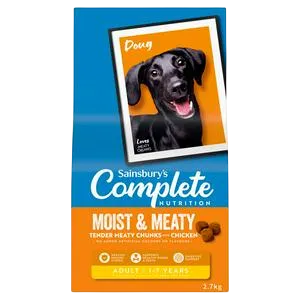
Sainsbury's Complete Nutrition Moist & Meaty: Tender Meaty Chunks with Chicken review
Sainsbury's Complete Nutrition Moist & Meaty is semi-moist food in the supermarket tradition: soft chunks that pour from the bag, keep in a cupboard and ask nothing at all of a tired jaw. There are two versions on a cereal base, one built around beef and one around chicken. Each names its headline meat at 4%, inside a 22% meat and animal derivatives block. Chicory extract goes in as a prebiotic and the added mineral panel is fully dosed. Both versions sit in our Poor band, a reading shaped by how little the list commits to rather than by anything untoward in the bag.
Our view
Likely to suit
If your dog has quietly given up on crunching biscuit, the texture is the reason to look here.
- Dogs with tired teeth or a sore jaw, since every chunk is soft the moment it leaves the bag
- Owners after the convenience of dry food without the crunch, with no thawing, no soaking and no fridge space needed
- Any adult build, since the feeding guide covers the smallest dogs through to 50kg
- With fat low at 7.0% as fed on both versions, this suits a dog that is a little heavy
- Households who pick the dog food up on the weekly shop and never order it in
Worth watching
This label leaves a good deal open, so give it a careful read before you decide.
- Cereals lead both lists without naming a grain, so the exact cereal can move from batch to batch
- Beef or chicken at 4% is the only part tied to a named species, with the rest declared as meat and animal derivatives
- That openness matters most on an elimination plan, which needs every animal and every grain named to work at all
- Third on both lists comes various sugars, one to note in a household that keeps added sugars out of the bowl
- Water content differs sharply between the two labels, 16.0% on the beef against 8.0% on the chicken, and the chicken chunks are the drier pair
Written by our editorial team. Independent guidance, not veterinary advice.
How this scores
How we scoreThe Details
Dog fit
If your dog has quietly given up on crunching biscuit, the texture is the reason to look here. This label leaves a good deal open, so give it a careful read before you decide.
Wet
Adult
Toy, Small, Medium, Large, Giant
Chicken
The score, in context
Both versions land in our Poor band together, with protein and processing and nutritional balance reading Poor on each while transparency comes back Good. We reward a label that names what is inside, ranks meat above cereal and shows its working. A recipe written in legal categories on a grain base collects very little of that credit. Be clear, though, about what the band is actually reading. It reads the label, not your dog. Nothing is wrong with a dog that eats this happily, holds a steady weight and looks well on it. The honest gap here is in what the maker tells you, and not in anything visible in the bowl.
What's in it
Ingredients, as declared: Cereals, Meat and Animal Derivatives (22%, including 4% Chicken), Various Sugars, Derivatives of Vegetable Origin (0.1% Chicory Extract, as a source of Prebiotic FOS), Oils and Fats, Minerals
Named ingredients
Nutritional additives
- Technological additives: Antioxidants, Preservatives - Nutritional additives: Calcium 1.6%, Vitamin A 17000 IU/kg, Vitamin D3 1500 IU/kg, Vitamin E 70mg/kg, Iodine (Calcium Iodate Anhydrous) 2.5mg/kg, Selenium (Sodium Selenite) 0.1mg/kg, Copper (Copper (II) Sulphate Pentahydrate) 8mg/kg, Iron (Iron (II) Sulphate Monohydrate) 60mg/kg, Manganese (Manganese (II) Oxide) 50mg/kg, Zinc (Zinc Oxide) 100mg/kg
Ingredient notes
Semi-moist sits in the space between a biscuit and a can. The beef version declares 16.0% moisture and the chicken 8.0%, enough to keep the chunks pliable while the food still pours, portions and stores like a dry one. For a dog that has started leaving hard kibble in the bowl, that combination is the entire point of the format.
Most of the list is written in umbrella terms. All four are legal groupings: cereals, oils and fats, meat and animal derivatives, and derivatives of vegetable origin. They cover an enormous range of quality, from genuinely good material to some very plain fractions. The packet gives no way of telling where any given batch sits. They also let a maker change the exact source between production runs, which is why so few entries here carry both a name and a figure.
The entries that do carry figures are the meat block at 22%, the named beef or chicken at 4% inside it, and chicory extract at 0.1%. Chicory is the one deliberate functional inclusion on the label. Its root is rich in inulin, which the packet describes as a source of prebiotic FOS. Down in the large intestine it feeds the bacteria a dog needs. A small figure, but a named one.
Sugars are on the list because dogs like them and because a soft chunk needs help staying soft, and in a semi-moist food they do both jobs at once. They are declared as various sugars rather than by source, so the packet will not tell you whether they came from cane, beet or a cereal. Keeping an eye on total sugar across the day is the sensible reading, particularly for a dog watching its waistline.
The analysis tells you what the ingredient order implies. On the beef version protein converts to 21.4% of dry matter, and on the chicken 19.6%. The carbohydrate estimate climbs to 57.8% and 61.4%, and most of the feeding falls to cereal. Fat is gentle at 8.3% and 7.6% of dry matter, and both recipes land at 312 kcal per 100g, which is where the format's water content shows up.
The added panel is the most precise part of the label. Calcium is declared at 1.6%, vitamin A at 17000 IU per kg, vitamin D3 at 1500 IU and vitamin E at 70mg, with the trace elements following at printed doses. Oxides and sulphates are mostly the forms they take, the long-standing conventional route. Selenium comes as sodium selenite, which pet food permits alongside just one other form, and it is much the commoner of the pair.
How this variety differs
Chicken takes the named 4% in this one, with everything else on the list matching the beef version word for word. The difference is water: at 8.0% declared this is much the drier chunk. With less moisture to strip out, the analysis moves less on conversion, leaving protein at 19.6% and the carbohydrate estimate at 61.4% of dry matter. Same feeding guide, same energy figure, a firmer piece in the bowl.
Price and value
Both versions are £1.81 a kilo, sold in a 2.7kg bag.
As a guide, a 15kg adult dog in moderate condition works through about 269 grams a day, taking around 840 kcal a day from the standard maintenance estimate of 110 × bodyweight^0.75. That comes to roughly £0.49 a day on either version. The label's own guide asks for more, 200 to 450 grams a day for a dog between 10 and 30kg.
Nutritional analysis
Declared analysis
18%
7%
2.5%
8%
8%
Dry weight
19.6%
7.6%
2.7%
8.7%
61.4%
As-fed composition
Estimated breakdown of the finished product by ingredient category, from the declared ingredient list and ingoing weights. These are estimates, not measurements.
22%
70.3%
4.7%
3%
Pricing & size
- Pack size
- 2.7kg
- Retailer pricing
- Coming soon
Live retailer pricing is not yet available for this food. Prices, cost per day and where to buy will appear here once retailer data is live.
Ingredients and nutrition are taken from manufacturer data. Retailer pricing is not yet live for this food.
Related dog food guides
Ranked shortlists that include foods like this one.