

Sainsbury's
Sainsbury's Nature's Goodness Puppy Terrine review
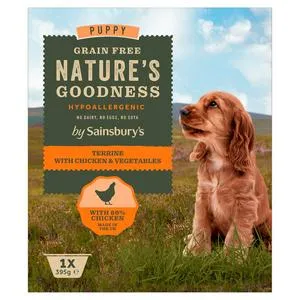
Sainsbury's Nature's Goodness Puppy Terrine leads with chicken at 60% and names everything that follows, from the 20% potato and 10% vegetables down to the citrus extracts at 0.004%. Rapeseed and salmon oils cover the fats, kelp and chicory sit in the tail, and protein converts to 40.0% of dry matter. It is a fully itemised own label wet puppy food, and it sits in our Excellent band.
Our view
Likely to suit
You want a first food your puppy takes to and a label you can actually follow, and this pot manages both.
- Chicken leads the recipe at 60% and is the only meat named, for a puppy who does well on it
- Owners who want the whole list itemised, right down to chicory at 0.056% and the citrus extracts at 0.004%
- At 123 kcal per 100g against a typical 106 for puppy wet food, this gives a growing pup energy in a modest volume
- Potato and a pea and carrot blend carry the plant side for a household that keeps grain out of the bowl
Worth watching
Have these label details clear before this becomes the everyday food.
- Salmon oil and an unnamed dried poultry plasma both sit in the recipe, so the chicken headline cannot anchor a strict exclusion diet
- The analysis prints no calcium. The additive panel gives calcium at 0.8% as fed, and a large breed growth plan is checked against the dry matter figure, so ask the maker for it
Written by our editorial team. Independent guidance, not veterinary advice.
How this scores
How we scoreThe Details
Dog fit
You want a first food your puppy takes to and a label you can actually follow, and this pot manages both. Have these label details clear before this becomes the everyday food.
Wet
Puppy
Toy, Small, Medium, Large, Giant
Chicken
The score, in context
This lands in our Excellent band, which is also where a typical puppy wet food sits, and it holds that place comfortably. Protein and processing and value both read Excellent, with nutritional balance and transparency Outstanding, so the strength is spread across the label instead of resting on one suit.
What earns the position is straightforward. A named meat at the top, a list itemised down to fractions of a percent at the bottom, and an analysis that lines up with both.
What's in it
Ingredients, as declared: Chicken 60%, Potato 20% (from 5% Dried Potato), Vegetables 10% (from 1.9% Dried Peas and Carrots), Minerals, Dried Poultry Plasma, Rapeseed Oil* 0.75%, Salmon Oil* 0.3%, Dried Tomato, Dried Kelp, Chicory 0.056%, Dried Basil, Plant, Citrus Extracts 0.004%, *Source of Omega 3 and Omega 6
Named ingredients
Nutritional additives
- Nutritional additives: per kg:, Calcium 0.8%, Vitamin A 1500IU, Vitamin D3 250IU, Vitamin E 40mg, Zinc (Zinc Sulphate Monohydrate) 20mg, Iron (Iron (II) Sulphate Monohydrate) 15mg, Manganese (Manganous Sulphate Monohydrate) 5mg, Copper (Copper (II) Sulphate Pentahydrate) 1.2mg, Iodine (Calcium Iodate Anhydrous) 0.5mg
Ingredient notes
The list opens with chicken at 60%, the only meat named, and that is what a wet food's meat line should look like. Protein converts to 40.0% of dry matter and fat to 34.0%. Energy comes out at 123 kcal per 100g against the 106 typical of a puppy wet food, an energy dense pot for its size.
The label writes potato at 20% back from 5% dried potato, and the 10% vegetables back from 1.9% dried peas and carrots. That is the honest way to write a rehydrated ingredient. Carbohydrate is estimated at 12.0% of dry matter, a little under the 13.6% typical, so the potato is not quietly running the recipe.
The fats are named individually, which many wet foods do not bother to do. Rapeseed oil at 0.75% is a good source of plant omega 3 and 6. A growing brain and coat use the long chain marine omegas, and salmon oil at 0.3% brings those. Fish therefore shows up in the allergen picture, on a recipe otherwise led by chicken.
Dried poultry plasma comes midway down the list. It is a protein rich fraction that helps a terrine set and carries useful immunoglobulins. Poultry names no particular bird, though, so this is the one entry that stops the chicken headline being the whole story for an elimination diet.
The tail is where the label is most generous with detail. It runs dried tomato, dried kelp, chicory at 0.056% whose inulin feeds the gut bacteria, dried basil, and plant and citrus extracts at 0.004%. Kelp brings a wide mineral spread including iodine, and the quantities are garnish, not substance.
On minerals, ash converts to 12.0% of dry matter. The additive panel lists calcium at 0.8% alongside vitamin A at 1500 IU, vitamin D3 at 250 IU, vitamin E at 40 mg and five trace elements. That calcium figure is given as fed, not on a dry matter basis, and the analysis itself prints none. A large breed puppy plan needs the number confirmed with the maker, since it cannot be read off the pot.
Price and value
£3.29 a kilo, sold in 395g packs.
A growing pup changes the sums every few weeks. Begin with the chart on the pack, then let the portion follow your pup as they fill out.
Nutritional analysis
Declared analysis
10%
8.5%
0.5%
3%
75%
Dry weight
40%
34%
2%
12%
12%
As-fed composition
Estimated breakdown of the finished product by ingredient category, from the declared ingredient list and ingoing weights. These are estimates, not measurements.
61.4%
5.3%
20%
10.8%
1.1%
1.4%
Pricing & size
- Pack size
- 395g
- Retailer pricing
- Coming soon
Live retailer pricing is not yet available for this food. Prices, cost per day and where to buy will appear here once retailer data is live.
Ingredients and nutrition are taken from manufacturer data. Retailer pricing is not yet live for this food.
Related dog food guides
Ranked shortlists that include foods like this one.