

Riverwood
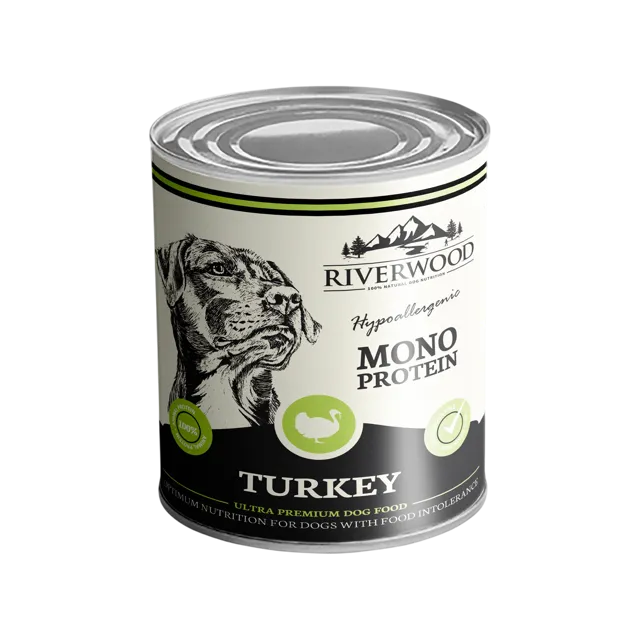
Riverwood Mono Protein Wet Food: Turkey review
Riverwood Mono Protein does one thing per tin and does it plainly. Every recipe is 70% of a single named animal, 28.5% broth, 1% minerals and 0.5% sunflower oil, with nothing else on the label at all. Eight animals are offered, from turkey and lamb through to goat, horse and wild boar, and every tin in the range earns our Excellent band.
Our view
Likely to suit
Few labels tell you as plainly as this one which animal is in the tin.
- Dogs working through an exclusion diet, since a tin holds one named animal and nothing else: no second meat, no unnamed fat, no fish oil
- Owners hunting for a genuinely new animal, with goat, horse, venison and wild boar all on offer
- Dogs that do better without starch, since the whole range is meat, broth, minerals and oil with nothing else on the label
- Owners who like to read a whole label in one breath, with four entries covering the entire recipe
- Dogs that need the water, as the duck tin alone is four fifths moisture
- Households with one dog on a restricted list and another eating anything, since every tin is built the same way
Worth watching
The simplicity hides a few things worth knowing about before you order.
- Veal is young beef, so that tin is not an escape route for a dog that reacts to beef
- The added panel changes from tin to tin, with vitamin A printed on the duck and venison labels and not on the rest
- Calories are our own estimate on the goat, horse and wild boar tins, so portions on those three may want adjusting by eye
- A calcium figure appears on the duck tin alone, so minerals are harder to keep a close eye on across the rest
- A 400 g tin is about half a day for a 15kg dog, so a household of larger dogs works through a pack quickly
Written by our editorial team. Independent guidance, not veterinary advice.
How this scores
How we scoreThe Details
Dog fit
Few labels tell you as plainly as this one which animal is in the tin. The simplicity hides a few things worth knowing about before you order.
Wet
Adult
Toy, Small, Medium, Large, Giant
Turkey
The score, in context
Every one of the eight tins lands in our Excellent band, and the gap between the strongest and the least of them is small. The wet shelf scores well generally, so the typical adult recipe wears that Excellent label as well. This range clears the mark on the strength of what it leaves out as much as what it puts in. Protein and processing reads Excellent on all eight, with nutritional balance and transparency reading Outstanding on every tin in the range.
What's in it
Ingredients, as declared: 70% turkey meat consisting of heart, meat, liver, stomach, neck, 28.5% broth, 1% minerals, 0.5% sunflower oil.
Named ingredients
Nutritional additives
Per kg: vitamin D3 200 IU, zinc 25 mg, manganese 1.4 mg, iodine 0.75 mg, copper 1 mg.
Ingredient notes
Four lines and the recipe is finished: 70% of the named animal, 28.5% broth or stock, 1% minerals and 0.5% sunflower oil. The lamb tin trims its mineral line to 0.1% and lifts the meat a fraction in its place.
Several of the labels open the animal up for you. The horse tin lists meat, heart, liver and lung. The lamb adds tripe. The turkey names heart, meat, liver, stomach and neck. The veal is heart, lung and tripe. Organ meat is where much of the vitamin content of a meat-only recipe lives, and printing which parts went in is more detail than most wet labels offer.
The only added fat is sunflower oil, at 0.5%. It is pressed from seed, low in saturated fat and carries some vitamin E of its own, which suits a recipe that has nothing else to lean on.
The carbohydrate line on these tins deserves a word. There is no starch ingredient anywhere in the range, yet the estimate reads as high as 23.3% of dry matter on the veal. The figure comes from subtracting everything else from the total, not from measuring starch. On a lean, meat-only label it mostly reflects rounding in the printed analysis, and there is nothing in the tin you could point at.
The added panel is short and dosed per kilo: vitamin D3 at 200 IU, zinc at 25 mg, manganese at 1.4 mg and iodine at 0.75 mg on most labels. Copper at 1 mg appears on several, and vitamin A joins on the duck and venison. The duck tin is also the only one to put a figure on calcium, at 1.3% of dry matter, a comfortable level for an adult dog.
How this variety differs
Turkey at 70%, named down to heart, meat, liver, stomach and neck. A lighter poultry option at 96.6 kcal per 100g, with protein converting to 51.4% of dry matter.
Price and value
Prices run from £9.48 to £12.52 a kilo depending on the animal, in 400 g tins sold as a pack of 6.
For a 15kg adult dog in moderate condition that comes to between £6.80 and £10.96 a day, or roughly 654 to 916 grams. The sums behind that assume about 840 kcal a day (110 × bodyweight^0.75, the standard maintenance estimate). The veal tin gives the lowest day rate of the eight despite not being the lowest per kilo, because it carries the most calories per 100 g and so takes the smallest portion.
Nutritional analysis
Declared analysis
10.8%
5.6%
0.5%
2.5%
79%
Dry weight
51.4%
26.7%
2.4%
11.9%
7.6%
As-fed composition
Estimated breakdown of the finished product by ingredient category, from the declared ingredient list and ingoing weights. These are estimates, not measurements.
70%
28.5%
0.5%
1%
Pricing & size
- Pack size
- 400 g tins, sold as a 6 x 400 g pack
- Retailer pricing
- Coming soon
Live retailer pricing is not yet available for this food. Prices, cost per day and where to buy will appear here once retailer data is live.
Ingredients and nutrition are taken from manufacturer data. Retailer pricing is not yet live for this food.
Related dog food guides
Ranked shortlists that include foods like this one.