


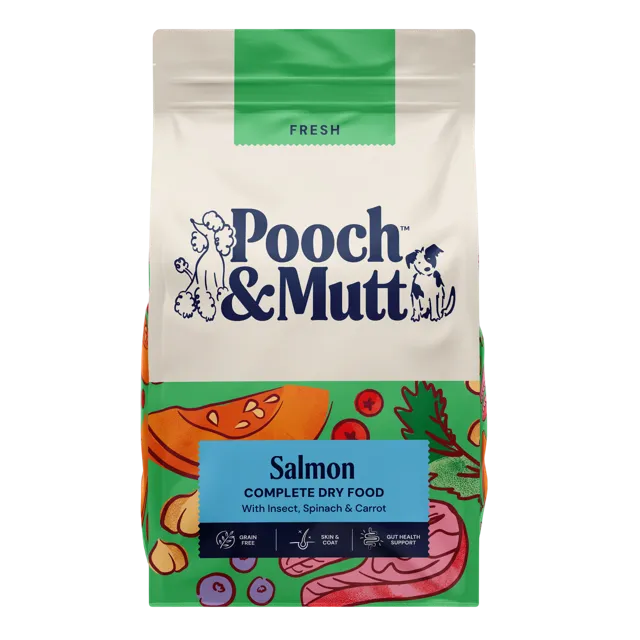

Pooch & Mutt
Pooch & Mutt Fresh Dry Food: Salmon review
Pooch & Mutt Fresh Dry Food is a pair of recipes with an unusually detailed label. The chicken bag leads with 50% fresh chicken and the salmon bag with 35% fresh salmon and 15% fresh insect. Both are built on sweet potato, potato flakes and chickpeas, with joint and gut supplements dosed at the bottom of the list. Almost every ingredient carries its own percentage. Both bags land in our Good band. The difference between them is the amount of animal protein each one gets over the line.
Our view
Likely to suit
This label prints a figure against nearly every line, so you can see what is in the bag before you buy it.
- Owners who read ingredients lists properly, since almost every entry down to the dried dill carries a percentage
- Owners with a puppy in the house and an older dog too, since both recipes cover puppy through to senior
- Owners of large breed puppies, as the calcium declaration on both recipes suits a big frame growing at speed
- Dogs with joints worth protecting, with glucosamine, chondroitin sulphate and green-lipped mussels all dosed in print
- Dogs kept away from poultry and red meat altogether, who have the salmon and insect recipe to turn to
Worth watching
Read these label details before you decide between the two bags.
- The chicken recipe uses poultry fat and hydrolysed poultry liver, and neither entry names its bird, so it cannot rule out turkey, duck or goose for a dog that needs them ruled out
- Salmon oil sits in the chicken recipe too, so neither bag is fish free
- Crushed egg shells appear in both, so egg is on the list whichever one you pick
- Lignocellulose is a purified fibre added for bulk without calories, and it does not come from a whole vegetable
Written by our editorial team. Independent guidance, not veterinary advice.
How this scores
How we scoreThe Details
Dog fit
This label prints a figure against nearly every line, so you can see what is in the bag before you buy it. Read these label details before you decide between the two bags.
Dry
Puppy, Adult, Senior
Toy, Small, Medium, Large, Giant
Salmon
The score, in context
The chicken recipe reaches our Good band. The salmon sits in the same band, level with the typical adult dry food, so both bags keep pace with the shelf and the chicken holds a slight edge. The difference is on the animal side of the ledger. The chicken declares 25% protein, or 27.8% of dry matter, against the salmon's 22% and 24.4%. Estimated carbohydrate reaches 44.5% of dry matter on the salmon where the chicken holds at 40.5%, both under the 46.2% typical for adult dry food. The two meet on protein and processing and on value, the chicken goes ahead on nutritional balance, and transparency reads Outstanding for the salmon against the chicken's Excellent. Naming explains that last one: the chicken bag has two poultry entries that skip the species, and the salmon bag has none.
What's in it
Ingredients, as declared: Fresh Salmon (35 %), Fresh Insect (15 %), Sweet Potatoes (15 %), Potato Flakes, Chickpeas (5 %), Dried Apple Pulp (3 %), Red Lentils (3 %), Hydrolysed Yeast (3 %), Pumpkin (3 %), Coconut Oil (2.9 %), Lignocellulose (2 %), Crushed Egg Shells (1.5 %), Sunflower Oil (1.5 %), Dried Spinach (1 %), Dried Carrots (1 %), Microalgae Oil (0.6 %), Potassium Chloride (0.4 %), Dried Rosehip (0.2 %), Dried Parsnip (0.2 %), Dried Blueberries (0.1 %), Dried Cranberries (0.1 %), Dried Rosemary (0.1 %), Dried Thyme (0.1 %), Dried Kelp (0.1 %), Dried Dill (0.1 %), Glucosamine (0.026 %), Green-Lipped Mussels (0.025 %), Chondroitin Sulphate (0.016 %), Brewer's Yeast (source of Mannan-oligosaccharides, 0.015 %), Chicory Root (source of Fructo-oligosaccharides, 0.01 %), Dried Turmeric (0.01 %), Mojave Yucca (0.01 %), Lactobacillus helveticus HA-122 inactivated (15x10¹¹ cells/kg).
Named ingredients
Ingredient notes
Both recipes lead on fresh meat. Water makes up most of that weight and cooking removes it, so the finished protein always sits below what a front label suggests. The chicken bag starts at 50% fresh chicken and lands at 27.8% protein on a dry matter basis, while the salmon bag starts at 35% fresh salmon plus 15% fresh insect and lands at 24.4%. Neither is a protein monster, and both put their fat up around 20% of dry matter, which is where the energy comes from.
The insect in the salmon recipe is the most interesting entry in either bag. Insect protein is a genuinely new animal protein for almost every dog, it is complete in the amino acids they need, and it comes with a far lighter footprint than farmed meat. A dog that reacts to the usual meats stands to gain from a protein it has never eaten before.
The starch side is shared. Sweet potato leads, which is the better of the common choices because it brings fibre and vitamins along with the starch, and potato flakes, chickpeas and red lentils follow it. There is no cereal in either recipe. Pumpkin and dried apple pulp add soft fibre, and hydrolysed yeast at 3% is a broken down yeast used for palatability and gut support.
The fats are handled differently in the two bags. The chicken recipe uses poultry fat at 5% and salmon oil at 2%. That poultry fat is the one place this careful label goes vague, since poultry might be any of chicken, turkey, duck or goose. The salmon recipe skips land animal fat entirely. Coconut oil at 2.9%, sunflower oil at 1.5% and microalgae oil at 0.6% do the work, and the microalgae supplies long chain omega 3s that the dog's body does not have to convert.
The supplement tail is where the label earns its detail. Glucosamine at 0.026%, green-lipped mussels at 0.025% and chondroitin sulphate at 0.016% cover the joints. Brewer's yeast at 0.015% brings prebiotic mannan-oligosaccharides and chicory root at 0.01% brings fructo-oligosaccharides for the same purpose, and an inactivated Lactobacillus culture closes both lists. By weight these are small inclusions, as joint and gut ingredients usually are, and each one still carries a printed dose.
Lignocellulose at 2% deserves an honest word. It is a purified plant fibre, and no vegetable you would recognise stands behind it. The job is to bulk a food out with almost no calories attached. Crude fibre lands at 4.7% of dry matter in the chicken and the salmon reads 4.2%, a modest job in both. Crushed egg shells at 1.5% are the calcium source, which is why calcium reads as it does on both.
How this variety differs
Fresh salmon at 35% with fresh insect at 15%, and not a land animal on the list anywhere. For a dog that must keep off meat, this is the bag. Microalgae oil at 0.6% adds marine omega 3s without a second fish. Protein is 22% and fat 17%, energy is 372 kcal per 100g and calcium works out at 1.44% of dry matter, so it is the gentler bowl of the two.
Price and value
£8.00 a kilo for either recipe, sold in 2kg and 10kg bags.
As a guide, a 15kg adult dog in moderate condition needs about 222 grams of the chicken a day. The salmon works out at about 226 grams, assuming around 840 kcal a day (110 × bodyweight^0.75, the standard maintenance estimate). The chicken comes to £1.78 a day and the salmon to £1.81. The label's own table asks 160 to 325 grams for dogs between 10kg and 25kg. That is a wide span, so let the scales and your dog's waistline settle it.
Nutritional analysis
Declared analysis
22%
17%
3.8%
7.2%
10%
Dry weight
24.4%
18.9%
4.2%
8%
44.5%
As-fed composition
Estimated breakdown of the finished product by ingredient category, from the declared ingredient list and ingoing weights. These are estimates, not measurements.
51.5%
26.5%
9.4%
5%
7.6%
Pricing & size
- Pack size
- 2kg (£20.99) · 10kg (£79.99)
- Retailer pricing
- Coming soon
Live retailer pricing is not yet available for this food. Prices, cost per day and where to buy will appear here once retailer data is live.
Ingredients and nutrition are taken from manufacturer data. Retailer pricing is not yet live for this food.
Related dog food guides
Ranked shortlists that include foods like this one.