


Pooch & Mutt
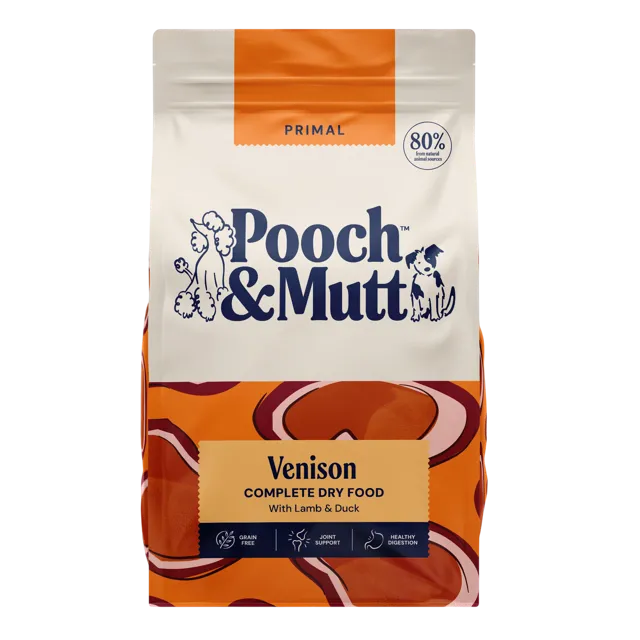
Pooch & Mutt Primal Dry Food: Venison with Lamb & Duck review
Pooch & Mutt Primal is the meat forward end of the brand's dry range. A concentrated protein from a less common animal opens each recipe at 32%, venison in one bag and wild boar in the other, with fresh lamb at 26% and duck protein at 10% behind it. Peas at 15% are the only real plant bulk, chicken fat carries the energy, and glucosamine and chondroitin sulphate are printed with their doses at the foot of the list. Both recipes land in our Excellent band, a clear step above the Good band the typical adult dry food occupies.
Our view
Likely to suit
If your dog eats like they mean it and you want most of the bag to be animal, start here.
- Dogs that do best on a high meat, low plant bowl, since peas are the only plant ingredient of any size
- Owners looking for less common meats, with venison or wild boar heading the recipe and duck alongside the lamb
- Working dogs and dogs with a busy diary, given how much protein and fat the analysis declares
- Dogs who need their joints looked after, since both glucosamine and chondroitin sulphate carry printed doses
- Owners of small dogs who find standard kibble too big, as the range includes a small kibble as well as the regular one
Worth watching
A few facts about the meat list are worth having straight.
- Chicken fat sits at 12% in both recipes, so a dog reacting to chicken is not clear of it, whatever the pack front promises
- The headline animal is never the only one, with lamb and duck declared in both bags, so neither recipe works as a single protein elimination diet
- These are rich, energy dense foods, so the portion matters more here than on an everyday kibble
- Puppies as well as adults are covered here, but the two recipes declare quite different calcium levels, so read the variety notes before feeding a large breed puppy
Written by our editorial team. Independent guidance, not veterinary advice.
How this scores
How we scoreThe Details
Dog fit
If your dog eats like they mean it and you want most of the bag to be animal, start here. A few facts about the meat list are worth having straight.
Dry
Puppy, Adult, Senior
Toy, Small, Medium, Large, Giant
Venison
The score, in context
Both recipes reach our Excellent band, a step up from the Good band where the typical adult dry food finishes. The reasons are all on the label. Named animal ingredients take up most of the recipe, and plant matter stops at peas with a little pumpkin, apple pulp and carrot behind them. Estimated carbohydrate lands at 37.1% of dry matter in the venison and 30.0% in the wild boar, against 46.2% for adult dry food generally. The wild boar has the edge on paper, with protein converting to 41.1% of dry matter where the venison manages 31.1%. That edge carries into our banding: nutritional balance reads Outstanding for the boar and Good for the venison, with transparency Outstanding on both.
What's in it
Ingredients, as declared: Venison Protein (32 %), Fresh Lamb (26 %), Peas (15 %), Chicken Fat (12 %), Duck Protein (10 %), Pumpkin (2 %), Dried Apple Pulp (2 %), Carrots (0.5 %), Glucosamine (0.019 %), Chondroitin Sulphate (0.012 %), Mannan-oligosaccharides (0.011 %), Fructo-oligosaccharides (0.008 %), Mojave Yucca (0.007 %), Dried Rosemary (0.003 %), Dried Turmeric (0.003 %), Spirulina (0.003 %).
Named ingredients
Ingredient notes
The first entry on each label is a protein rather than a fresh meat, and that is doing more work than it looks. Venison protein and wild boar protein at 32% are concentrated dried meat. Very little of that weight is lost between mixer and oven. Fresh lamb at 26% sits behind it, and water accounts for most of that 26% by the time it is cooked. Duck protein at 10% is another dried entry. The result is 28% protein declared in the venison and 37% in the wild boar.
Venison and wild boar are both genuinely less common in a dog's bowl. For a dog bored of the everyday meats, or reacting to them, that counts. Both are lean red meats that digest well, and venison in particular brings a useful helping of B vitamins with it.
Chicken fat at 12% is the energy source, and it is worth reading twice. Naming the bird is better labelling than the vague animal fat you see elsewhere, and chicken fat is a good, palatable fat. It also means chicken is present in a food whose front label says venison or wild boar, which is the one thing to know if chicken is the ingredient you are avoiding.
Peas at 15% are the whole plant story, with pumpkin at 2%, dried apple pulp at 2% and carrots at 0.5% behind them. Fibre and antioxidants come with the peas, and a little plant protein too. At this level they read as a considered inclusion, not a filler. Crude fibre lands at 3.1% of dry matter in both, which is on the low side and consistent with how little plant material is in here.
What closes the list is small in weight and properly dosed. Glucosamine and chondroitin sulphate cover the joints. Mannan-oligosaccharides and fructo-oligosaccharides are prebiotics for the gut, and mojave yucca is included for what owners notice on the lawn. Spirulina sits at trace level with dried rosemary and dried turmeric, and the rosemary is the natural antioxidant guarding the fats.
How this variety differs
Venison protein at 32% is the headline, and this is the milder of the two recipes on paper, with 28% protein, 17% fat and estimated carbohydrate at 37.1% of dry matter. It is also the only one made in a small kibble as well as the regular size, so it is the one to pick for a little dog. Calcium works out at 2.0% of dry matter, a firm level that reads better for an adult than for a large breed puppy.
Price and value
£7.00 a kilo, sold in 2kg and 10kg bags of the regular kibble, with the venison also made as a 2kg small kibble.
As a guide, a 15kg adult dog in moderate condition needs about 223 grams of the venison a day. The wild boar comes out at about 221 grams, assuming around 840 kcal a day (110 × bodyweight^0.75, the standard maintenance estimate). That comes to £1.56 a day on the venison and £1.54 on the wild boar. The label asks 163 to 325 grams for dogs between 10kg and 25kg, so weigh the first week's meals and settle from there.
Nutritional analysis
Declared analysis
28%
17%
2.8%
8.8%
10%
Dry weight
31.1%
18.9%
3.1%
9.8%
37.1%
As-fed composition
Estimated breakdown of the finished product by ingredient category, from the declared ingredient list and ingoing weights. These are estimates, not measurements.
68.3%
15.1%
4.5%
12.1%
0.1%
Pricing & size
- Pack size
- 2kg Regular Kibble (£18.99) · 10kg Regular Kibble (£69.99) · 2kg Small Kibble (£18.99)
- Retailer pricing
- Coming soon
Live retailer pricing is not yet available for this food. Prices, cost per day and where to buy will appear here once retailer data is live.
Ingredients and nutrition are taken from manufacturer data. Retailer pricing is not yet live for this food.
Related dog food guides
Ranked shortlists that include foods like this one.