
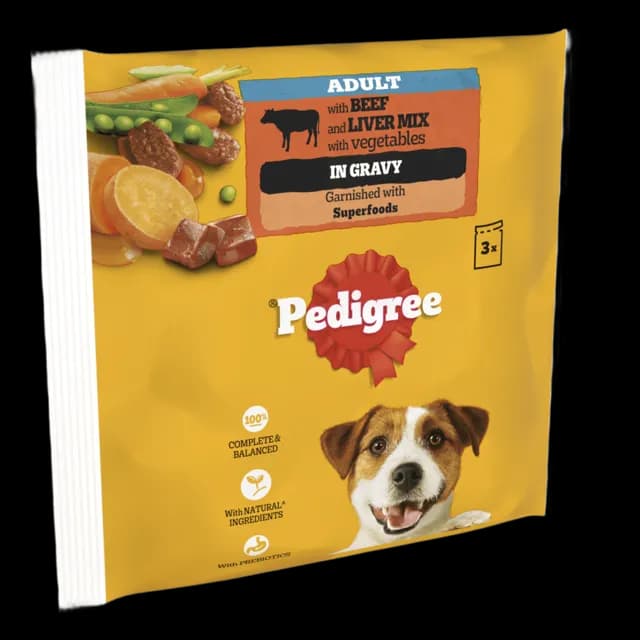

Pedigree
Pedigree Senior Wet: Mixed Selection in Loaf Tins review
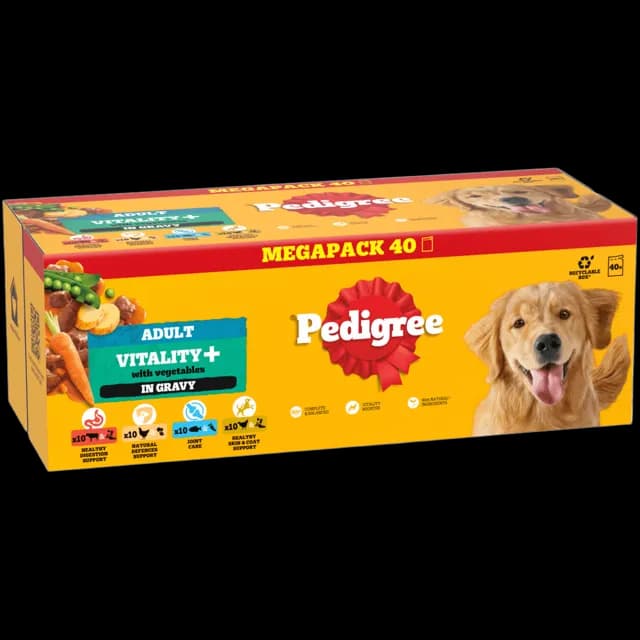
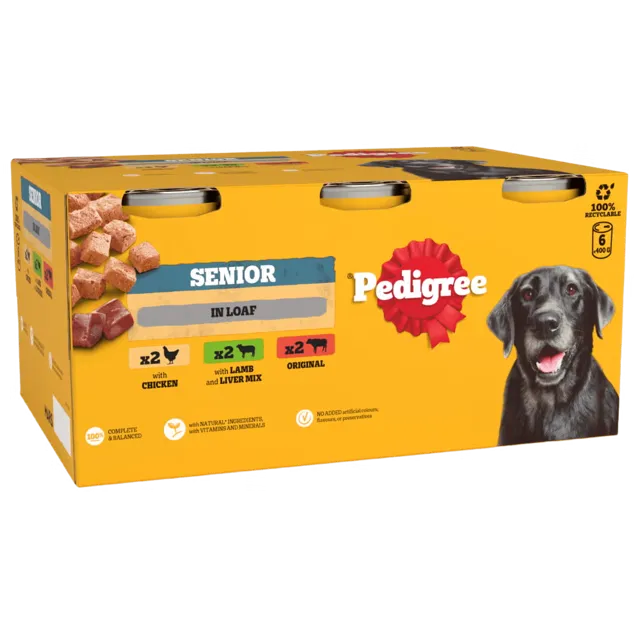
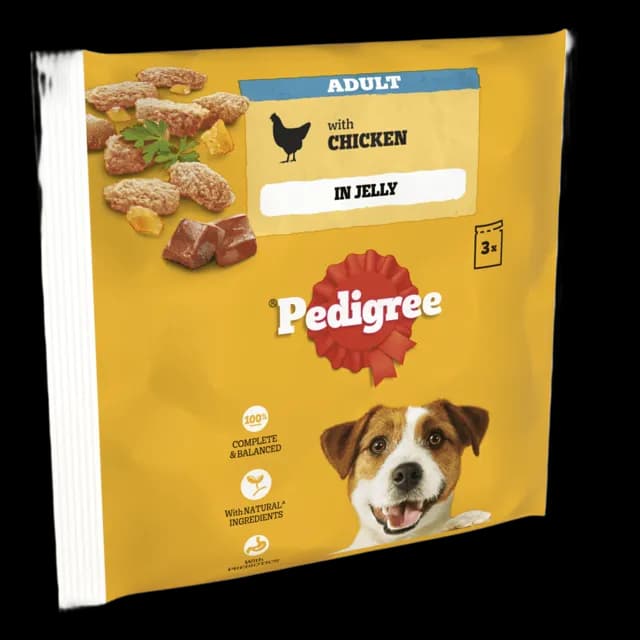
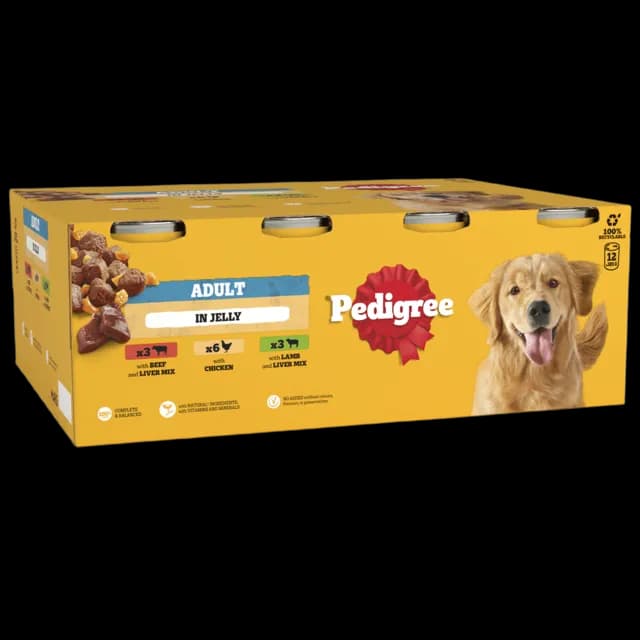
Pedigree Senior Wet arrives in two formats, a jelly pouch selection and a case of loaf tins, both written for older dogs. The pouches name chicken or poultry at 14% and their beef and lamb mixes at 6%, with pork liver at 9% alongside, while the tins name each meat at 4% with pork liver at 4%. Meat and animal derivatives carries everything else on both, and cereals go unnamed throughout. Both entries land in our Average band, the pouches nearer the top of it than the tins.
Our view
Likely to suit
An older dog who still looks forward to his dinner is worth keeping that way.
- Older dogs that find hard food heavy work, with a soft loaf and a jelly pouch to choose between
- Dogs whose appetite has faded, since the pouches rotate four recipes and the tins three
- Owners keeping a senior on a level weight, with the pouches at 80 kcal per 100g and the tins at 86 against 97 for the typical adult wet food
- Dogs whose drinking has dropped off with age, with moisture declared at 82.5% in the pouches and 81.0% in the tins
- Households that want a senior food from a familiar name they can pick up anywhere
- Owners feeding two dogs of different ages, since both formats are listed for adults as well as seniors
Worth watching
Senior labels often promise more than they declare, and this one keeps a good deal back.
- Meat and animal derivatives leads both labels, so the named meats are only ever a small declared portion of the animal content
- The pouches add oils and fats without saying which oils or which fats, which leaves the fat source open
- Cereals are unnamed on both formats and can change between batches, so neither can support a grain elimination plan
- Cassia gum at 2100 mg per kilo sets the jelly in the pouches, an additive some owners would rather do without
- Every recipe across both formats carries pork liver, so a dog kept off pork is not provided for here
- The pouch label's portions run lighter than energy needs suggest, asking 700 to 800 grams a day for a 15kg dog where our estimate is 1050 grams, so let your dog's condition guide the scoop
Written by our editorial team. Independent guidance, not veterinary advice.
How this scores
How we scoreThe Details
Dog fit
An older dog who still looks forward to his dinner is worth keeping that way. Senior labels often promise more than they declare, and this one keeps a good deal back.
Wet
Adult, Senior
Toy, Small, Medium, Large, Giant
Pork
The score, in context
Both entries stay inside our Average band, though they get there by different routes. The pouches come closest to leaving it: nutritional balance reads Outstanding, transparency Excellent and protein and processing Poor. They name chicken and poultry at 14% and hold estimated carbohydrate to 10.2% of dry matter, comfortably under the 15.8% typical for adult wet food. The tins pair Outstanding readings on nutritional balance and transparency with Poor on protein and processing, with smaller named meats at 4% and an estimated carbohydrate of 18.9%. The typical adult wet food reaches our Excellent band, so there is real ground between these two and the middle of the wet shelf. Almost all of it sits on the protein and processing side. What neither format is doing is feeding a dog badly. They are feeding a dog without telling you what is in the bowl.
What's in it
Ingredients, as declared: With Chicken: Meat and Animal Derivatives* (including Chicken 4% and Pork Liver 4%), Cereals, Minerals, Derivatives of Vegetable Origin (including Dried Beet Pulp 0.5%) *97% Natural, With Lamb and Liver Mix: Meat and Animal Derivatives* (including Mix of Lamb 4% and Pork Liver 4%), Cereals, Minerals, Derivatives of Vegetable Origin (including Dried Beet Pulp 0.5%) *97% Natural, Original: Meat and Animal Derivatives* (including Mix of Beef 4% and Pork Liver 4%), Cereals, Minerals, Derivatives of Vegetable Origin (including Dried Beet Pulp 0.5%) *97% Natural
Named ingredients
Nutritional additives
Additives per kg:, Nutritional additives:, Vitamin D₃: 300 IU, Vitamin E: 30.0 mg, Copper (Copper(II) sulphate pentahydrate): 1.5 mg, lodine (Calcium iodate, anhydrous): 0.23 mg, Iron (Iron(II) sulphate monohydrate): 3.0 mg, Manganese (Manganous sulphate, monohydrate): 1.8 mg, Zinc (Zinc sulphate, monohydrate): 19.4 mg
Ingredient notes
Both formats build on meat and animal derivatives, the legal category covering the fleshy parts and processing derivatives of warm blooded land animals. It can hold excellent material or very plain material, and a label using it gives you no way to know which, nor any guarantee that this month's batch matches last month's. The named entries are the fixed points. Chicken or poultry sits at 14% and the beef or lamb mixes at 6% in the pouches, while the tins name everything at 4%. Pork liver is at 9% or 4% depending on format.
Pork liver is the most useful thing on either list. Few things a dog eats carry more nutrition per gram, and this one brings vitamin A, B12, copper and selenium. It digests easily and it tastes good. With an older dog needing to be tempted, that matters.
The pouches list vegetable protein extracts high up, ahead of the cereals, so part of the protein reaching 48.0% of dry matter is plant rather than animal. They also carry oils and fats as an unnamed entry, which could be a beneficial animal fat or a plain processed oil, and the label does not commit either way. The tins skip both of those terms and go straight to cereals and derivatives of vegetable origin, with dried beet pulp at 0.5% named as the fibre.
The added panels are dosed and, for a senior food, sensibly weighted. The pouches carry vitamin E at 90.0 mg per kilo, with vitamin D3 at 200 IU and zinc at 22.7 mg. The tins run vitamin E at 30.0 mg, with vitamin D3 at 300 IU and zinc at 19.4 mg. A more generous vitamin E level in the pouches is a reasonable choice for an ageing dog. It is also the clearest sign on either label that the recipe was genuinely adjusted for the life stage and not just relabelled.
Read plainly, both are soft, moist, moderate meals that an older dog will eat happily, with the pouches the better analysis of the two and the tins the easier format to serve a big dog. The gap between them and a food we would score highly is not about safety or about digestibility. It is about being able to read what you are feeding, which neither label offers.
How this variety differs
A case of six 400g loaf tins across three recipes, chicken, a lamb and liver mix and the original beef, each naming its meat at 4% with pork liver at 4%. The list is shorter than the pouches, with no vegetable protein extracts and no thickener, and the recipe is declared 97% natural. Protein converts to 42.1% of dry matter and estimated carbohydrate to 18.9%, and the soft loaf is the easier texture for a dog whose teeth are past their best.
Price and value
Both formats come to £5.25 a kilo, the pouches in 12 x 100g and 40 x 100g packs and the tins in a case of 6 x 400g.
As a guide, feeding a 15kg adult dog in moderate condition works out at about £5.51 a day on the pouches, roughly 1050 grams, and about £5.13 a day on the tins, roughly 977 grams. Both come from the standard maintenance estimate of about 840 kcal a day (110 × bodyweight^0.75). The labels themselves ask for less. The pouches want 700 to 800 grams a day for a 15kg dog. The tins want 500 to 550 grams for a 10kg dog, rising to 1400 to 1500 grams at 40kg.
Nutritional analysis
Declared analysis
8%
4.8%
0.4%
2.2%
81%
Dry weight
42.1%
25.3%
2.1%
11.6%
18.9%
As-fed composition
Estimated breakdown of the finished product by ingredient category, from the declared ingredient list and ingoing weights. These are estimates, not measurements.
100%
Pricing & size
- Pack size
- 6x400g
- Retailer pricing
- Coming soon
Live retailer pricing is not yet available for this food. Prices, cost per day and where to buy will appear here once retailer data is live.
Ingredients and nutrition are taken from manufacturer data. Retailer pricing is not yet live for this food.
Related dog food guides
Ranked shortlists that include foods like this one.