


Skip to content
Off the Leash
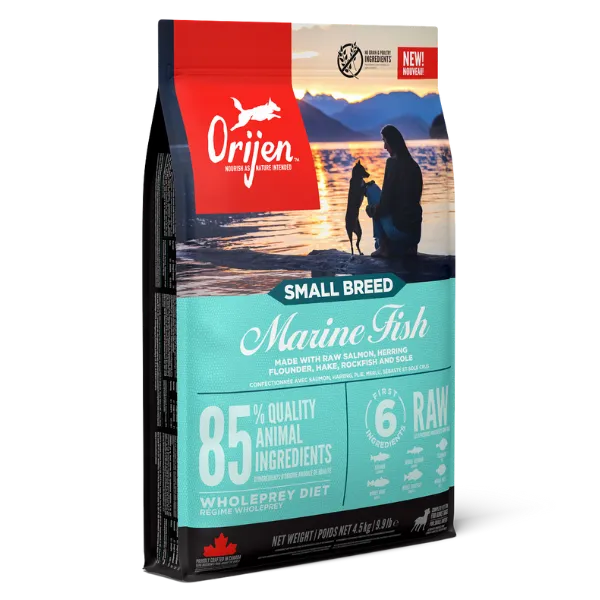
Orijen Small Breed – Marine Fish

Orijen

Orijen Small Breed: Marine Fish review

77.6/100Excellent
DryAdult

Orijen Small Breed shrinks the kibble without shrinking the recipe. Both bags are put together the same way. A long run of named animal ingredients comes first, then whole lentils, peas, chickpeas and beans for a modest starch load. Behind them sit New Zealand green mussels and dried kelp, then a tail of whole fruit and vegetables. One recipe is built entirely on fish, the other on poultry with a little quail alongside. Where adult dry food typically gets no further than our Good band, these two both reach our Excellent band.

Where to buy: coming soon
Live retailer pricing is coming soon. Once we have prices from UK retailers, the best price, cost per day and where to buy will appear here.

Our view

Likely to suit

Little dogs eat in little mouthfuls, and everything about these two bags is scaled to that.

  • Small breed adults, who get a kibble sized for them and a feeding table written around them
  • Owners who want the animal content named species by species, with no family word doing the work
  • Dogs that get on better with no grain, since whole lentils, peas, chickpeas and beans carry the starch here
  • Busy little dogs with a fast engine, since both recipes pack more energy into a mouthful than adult dry food usually does
  • Households torn between a fish bowl and a poultry one, since both recipes are built alike and simply swap the animal

Worth watching

Before you pick between the two, there are a few details to know.

  • Both recipes carry fish, and that is worth knowing for a small dog being kept clear of it
  • The poultry recipe runs to 18% fat, which is a lot of energy for a little dog that mostly patrols the sofa
  • Only the poultry recipe names puppies on its label, so a growing small breed wants that one rather than the fish
  • The energy per mouthful is high in both, so weigh a small dog's portion rather than judging it by eye, and count the treats on top

Written by our editorial team. Independent guidance, not veterinary advice.

How this scores

How we score
77.6/100Excellent
Protein and processingExcellent
Nutritional balanceOutstanding
TransparencyOutstanding
ValueExcellent

The Details

Dog fit

Little dogs eat in little mouthfuls, and everything about these two bags is scaled to that. Before you pick between the two, there are a few details to know.

Food type

Dry

Life stage

Adult

Breed size

Small

Main protein

Salmon

The score, in context

Both recipes reach our Excellent band, a step clear of the Good band that adult dry food typically settles in. The gap between the pair is narrow, and it is a matter of construction, with quality level across both. The fish bag runs leaner and keeps every animal ingredient inside one family, while the poultry bag carries more fat and a wider spread of species. Pick whichever your dog gets on with and let the small edge between them go.

What's in it

Ingredients, as declared: Raw salmon (17%), raw whole herring (16%), raw flounder (7%), raw whole hake (6%), raw whole rockfish (6%), raw whole sole (6%), dehydrated herring (5%), dehydrated sardine (5%), dehydrated pollock (5%), dehydrated mackerel (5%), dehydrated blue whiting (5%), whole red lentils, whole peas, whole chickpeas, whole green lentils, lentil fibre, whole pinto beans, sunflower oil, herring oil (2%), whole navy beans, raw New Zealand green mussels, dried kelp, fresh whole butternut squash, fresh whole pumpkin, dried chicory root, fresh whole apples, fresh whole carrots, fresh whole pears, fresh whole zucchini, mojave yucca, fresh beet greens, fresh kale, fresh spinach, fresh turnip greens, whole cranberries, whole blueberries, whole saskatoon berries, turmeric, milk thistle, burdock root, lavender, marshmallow root, rosehips.

Named ingredients

Raw salmon (17%), raw whole herring (16%), raw flounder (7%), raw whole hake (6%), raw whole rockfish (6%), raw whole sole (6%), dehydrated herring (5%), dehydrated sardine (5%), dehydrated pollock (5%), dehydrated mackerel (5%), dehydrated blue whiting (5%), whole red lentils, whole peas, whole chickpeas, whole green lentils, lentil fibre, whole pinto beans, sunflower oil, herring oil (2%), whole navy beans, raw New Zealand green mussels, dried kelp, fresh whole butternut squash, fresh whole pumpkin, dried chicory root, fresh whole apples, fresh whole carrots, fresh whole pears, fresh whole zucchini, mojave yucca, fresh beet greens, fresh kale, fresh spinach, fresh turnip greens, whole cranberries, whole blueberries, whole saskatoon berries, turmeric, milk thistle, burdock root, lavender, marshmallow root, rosehips.

Nutritional additives

Additives (per kg): Technological additives: 1b306(i) Tocopherol extracts from vegetable oils: 121mg, 1a330 Citric acid: 40mg. Sensory additives: Rosemary extract: 80mg. Nutritional additives: 3b606 (Zinc: 80 mg), 3b406 (Copper: 11mg), 3a821 Vitamin B1: 110 mg, 3a825i Vitamin B2: 20 mg, 3a314 Niacin: 200 mg, 3a841 Calcium-D-pantothenate: 60 mg, 3a831 Vitamin B6: 35 mg, 3a316 Folic Acid: 7 mg, Vitamin B12: 0.2 mg, 3a700 Vitamin E: 500 IU. Zootechnical additives: 4b1707 Enterococcus faecium DSM 10663/ NCIMB 10415 1×10⁹ CFU.

Ingredient notes

Both labels load the animal content at the front, and both name each species outright. Raw and fresh meat leads in each case. Fresh meat leaves most of its water behind in the oven, and the dried entries that follow end up carrying more of the kibble than their percentages let on. The analysis follows the construction. Protein converts to 45.5% of dry matter on the fish side and 44.3% on the poultry side, and estimated carbohydrate lands at 21.6% and 20.5% against 46.2% for adult dry food generally.

Both bags take their starch from legumes, not grain: peas and chickpeas, whole red and green lentils, then pinto and navy beans, and lentil fibre sits alongside them. Whole pulses bring their own protein and fibre with the starch. That is a good part of why the carbohydrate figures land as low as they do. Dried chicory root appears on both lists as the prebiotic, an inulin source the gut's friendly bacteria put to work.

New Zealand green mussels turn up on both labels, an unusual entry and a deliberate one, since that shellfish is a traditional choice for joint support. Dried kelp adds iodine and trace minerals. The fruit and vegetable tail runs from pumpkin and butternut squash through apples, carrots and pears to courgette, all of it used whole. Whole fruit on a label is the more honest way to do it.

The fats are named in both recipes, with no generic oil to hide behind, and a careful label reader will want exactly that. A marine oil carries the long-chain omega 3s in each bag. Copper is dosed at 11 mg per kilo in both, and zinc is declared with a figure against it in both. The fats are kept from turning by tocopherols and rosemary extract, and no synthetic preservative is needed. Enterococcus faecium appears on each as the named live culture.

The last stretch of each list runs from cranberries, blueberries and saskatoon berries through turmeric, milk thistle and burdock root, down to lavender and rosehips. Trace level is where all of it sits, and it is flourish more than function. Neither recipe needs it. Both stand on the animal content stacked at the top of the label, which is where you want a food's weight to be.

How this variety differs

Every animal ingredient in this one is a fish. Raw salmon at 17% and raw whole herring at 16% lead, with flounder at 7% and hake, rockfish and sole at 6% each behind them. Then comes a dried tier of herring, sardine, pollock, mackerel and blue whiting at 5% apiece. Ten fish are named in total, plus New Zealand green mussels, and the added oils are sunflower and herring, so no land animal appears anywhere on the list. A dog kept off poultry and red meat has an easy choice here, and it is a rare thing to find in a small breed bag. Protein is declared at 40% and fat at 15%, the leaner of the pair, and the label covers adults only.

Price and value

The fish recipe is £12.89 a kilo and the poultry one £12.22, and both are sold in 1.8kg and 4.5kg bags.

As a guide, a 15kg adult dog in moderate condition would eat about 226 grams a day of the fish recipe and 215 grams of the poultry one. That assumes around 840 kcal a day (110 × bodyweight^0.75, the standard maintenance estimate), and comes to £2.92 and £2.63 a day respectively. A small dog eats a fraction of that. The label's less active table asks 45 to 60 grams a day for a 4kg to 5kg dog on the fish recipe, and 45 to 48 grams on the poultry one.

Nutritional analysis

Declared analysis

Energy
371 kcal/100g
Protein

40%

Fat

15%

Fibre

4%

Ash

10%

Moisture

12%

Dry weight

Protein

45.5%

Fat

17%

Fibre

4.5%

Ash

11.4%

Carbs

21.6%

As-fed composition

Estimated breakdown of the finished product by ingredient category, from the declared ingredient list and ingoing weights. These are estimates, not measurements.

Meat

58.2%

Carbs

14.4%

Veg

0.2%

Oils

2.2%

Other

25%

Pricing & size
Pack size
1.8kg · 4.5kg
Retailer pricing
Coming soon

Live retailer pricing is not yet available for this food. Prices, cost per day and where to buy will appear here once retailer data is live.

Ingredients and nutrition are taken from manufacturer data. Retailer pricing is not yet live for this food.

Related dog food guides

Ranked shortlists that include foods like this one.

All reviews
Orijen Adult – Original
80/100Outstanding
4 varieties
Orijen

Adult

DryAll life stagesHigh energy
View review
Orijen Puppy – —
80/100Outstanding

Orijen

Puppy

DryPuppyGrain-free
View review

Featured feeding accessories

All feeding accessories

Brackenwood

Slow Feeder Maze Bowl

Slows fast eaters and eases gulping at mealtimes.

From £12.99· 4 retailers
View

Tarn & Co

Raised Double Diner

Height-set stand for easier, tidier eating.

From £28.99· 3 retailers
View

Reviewed by Off the Leash Editorial

Last updated 28 August 2026