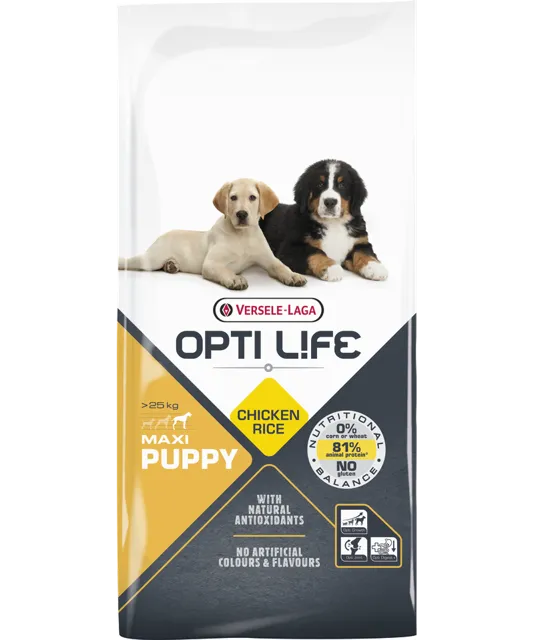

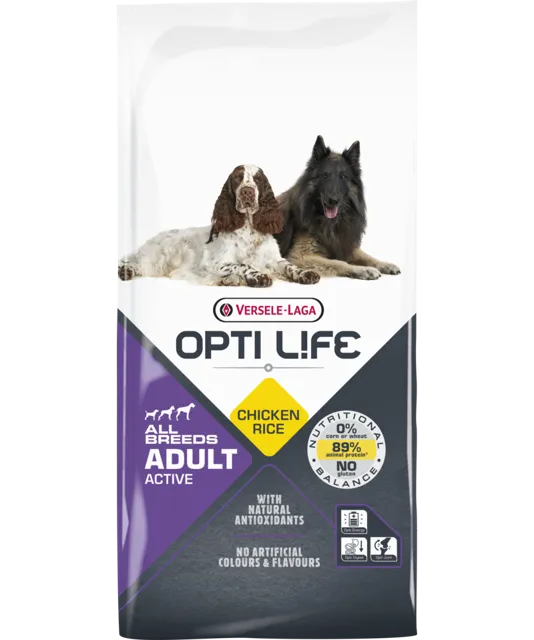

Opti Life
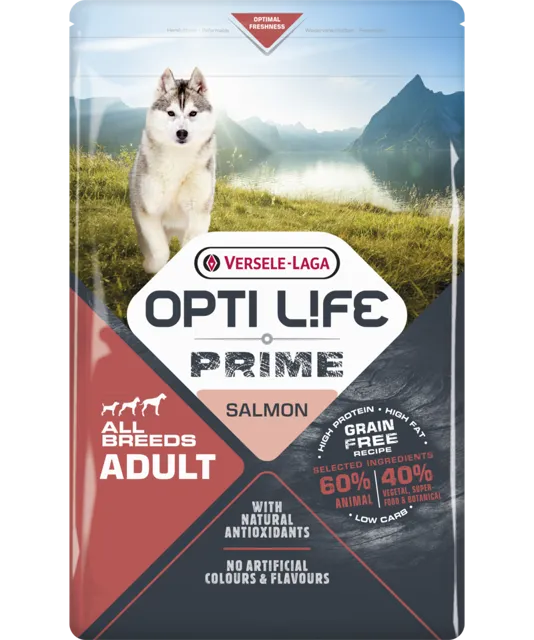
Opti Life Prime Adult: Salmon review
Opti Life Prime Adult is the meat-forward pair in the family, and the analysis proves the point. Dehydrated chicken at 46% or dehydrated salmon at 45% opens the list, potato at 15% and peas take over from rice entirely, and carbohydrate falls to roughly a quarter of dry matter. Turmeric, linseed, prebiotic FOS and a dosed glucosamine entry finish it off, and moisture is declared rather than left to be assumed. Both recipes sit in our Average band.
Our view
Likely to suit
If you have been feeding a rice-based kibble and want the meat share pushed properly up, this is where the brand takes it.
- Dogs off cereal altogether, with the starch coming from potato at 15% and peas where rice would normally sit
- Active adults of any size, with protein declared at 38.0% and the feeding table running from a 1kg dog to a 90kg one
- Owners choosing between birds and fish, with a chicken recipe and a salmon one built to the same plan
- Dogs with a dull coat, with dehydrated salmon leading one recipe and salmon oil supporting both
- Older dogs, with glucosamine at 250 mg/kg and turmeric further down the list
Worth watching
Read this first, then choose between the two bags.
- Neither list attaches a species to the animal fat or to the hydrolysed animal proteins, so the salmon recipe is not a single-protein fish diet however the front of the bag reads
- The chicken recipe carries salmon oil and dried whole eggs as well, so it is neither fish free nor egg free
- The chicken declares 20.0% fat and the salmon 18.0%, so weigh the portion for a quieter dog
- Peas sit third on both lists, which is worth knowing if legumes have ever unsettled your dog
Written by our editorial team. Independent guidance, not veterinary advice.
How this scores
How we scoreThe Details
Dog fit
If you have been feeding a rice-based kibble and want the meat share pushed properly up, this is where the brand takes it. Read this first, then choose between the two bags.
Dry
Adult
Toy, Small, Medium, Large, Giant
Salmon
The score, in context
Both recipes land in our Average band, held there by a Poor reading on protein and processing while the rest of the label reads far better. A dehydrated meat share of 46% and 45% is a genuinely high declaration, and because dehydrated meat has already lost its water it survives the oven in a way a fresh-meat headline does not. Carbohydrate comes out at 23.6% and 24.7% of dry matter against the 46.2% typical of an adult dry food. The analysis is printed with moisture declared instead of assumed, a small act of transparency worth more than it looks. The Good band holds the typical adult dry food, and this pair sits a step under it, though nutritional balance reads Outstanding on both. They stop climbing at the animal fat and hydrolysed protein that go unnamed here as they do across the brand, and at a joint entry stated but modest at 250 mg/kg.
Almost nothing separates the two, so let the animal decide and not the reading.
What's in it
Ingredients, as declared: salmon (dehydrated 45%), potato (15%), peas, animal fat, linseed, brewer's yeast, vegetable fibres (cellulose 2.5%), salmon oil (1%), minerals, hydrolysed animal proteins, FOS (0.3%), sea algae (Ascophyllum nodosum), glucosamine 250 mg/kg, rosemary (15 mg/kg), turmeric, green tea (10 mg/kg).
Named ingredients
Nutritional additives
_Nutritional additives:_ vitamine A 22000 IE, vitamine D3 1200 IE, vitamine E 500 mg, vitamine C 200 mg, β-caroteen 1 mg, biotine 1 mg, 3b103 (ijzer) 201 mg, 3b202 (jodium) 3.1 mg, 3b405 (koper) 8 mg, 3b502 (mangaan) 63 mg, 3b607 (zink) 13 mg, 3b801 (selenium) 0.2 mg. _Technological additives:_ clinoptilolite of sedimentary origin 10 g, sepiolite 2 g, antioxidants: tocopherols 22 mg.
Ingredient notes
The meat headline is the whole story here: dehydrated chicken at 46% on one recipe, dehydrated salmon at 45% on the other. Dehydrated is the word that counts. The water has gone before the weighing, so what the bag declares is roughly what the finished kibble holds. A fresh headline would shrink to a third of it in the oven. That is what pushes protein to a declared 38.0% on both, or 41.8% of dry matter.
Potato at 15% and peas take the place a cereal usually holds, which makes this a grain-free recipe and cuts the starch load sharply. Carbohydrate lands at 23.6% of dry matter on the chicken and at 24.7% on the salmon, roughly half the 46.2% a typical adult dry food carries. The fibre comes from cellulose at 2% and 2.5%, a purified powder with no vegetable behind it. At those levels it is a light touch compared with the brand's other ranges.
Both labels still list animal fat and hydrolysed animal proteins without naming an animal. That is worth being straight about on the salmon recipe in particular. A fish-led ingredient list is the sort of thing an owner reaches for when they are ruling meats out, and these two entries mean the recipe cannot do that job cleanly. For a dog simply doing better on fish, it is a non-issue.
Calcium works out at 1.43% of dry matter and ash at 9.3% and 9.9%, which is what a high dehydrated-meat share brings with it, since dried meats carry more bone-derived mineral than fresh ones do. Both figures are comfortable for an adult dog, and they are the signature of how the recipe is built, not something added on top.
The tail earns its place. Marine omega 3s arrive with the salmon oil, and the plant ones with linseed. B vitamins come from brewer's yeast, iodine from sea algae, and prebiotic FOS is declared at 0.3%, a meaningful dose and not a token one. Turmeric sits near the end as an antioxidant, an unusual entry on a kibble label and a welcome one, and rosemary and green tea close the list as the preservatives. Iron is dosed heavily at 201 mg per kilo, and biotin at 1 mg is declared on the chicken recipe.
How this variety differs
Dehydrated salmon at 45% with salmon oil added at 1% on top. That is the recipe for a dog that struggles with poultry, or one whose coat needs work. It runs slightly leaner at 18.0% fat and 365 kcal per 100g, with more ash at 9.0% and marginally more fibre at 3.5%, and no egg appears on the list. Both the hydrolysed animal proteins and the animal fat are still unnamed, so it is fish-led without being fish-only.
Price and value
£4.54 a kilo for both recipes, sold in a 2.5kg bag and the largest size.
As a guide, a 15kg adult dog in moderate condition eats about 222 grams a day where the chicken recipe is in the bowl, or 230 grams where the salmon is. Around 840 kcal a day is the target (110 × bodyweight^0.75, the standard maintenance estimate). That comes to £1.01 and £1.05 a day. The label asks 145 to 160 grams for a 15kg dog on the chicken recipe, so let the waistline settle the gap between the two.
Nutritional analysis
Declared analysis
Estimated using Modified Atwater factors*
38%
18%
3.5%
9%
9%
Dry weight
41.8%
19.8%
3.8%
9.9%
24.7%
As-fed composition
Estimated breakdown of the finished product by ingredient category, from the declared ingredient list and ingoing weights. These are estimates, not measurements.
38.4%
38.8%
3.2%
8.7%
10.9%
Pricing & size
- Pack size
- 2,5 kg (EAN 5410340330661) · 12,5 kg (EAN 5410340330692)
- Retailer pricing
- Coming soon
Live retailer pricing is not yet available for this food. Prices, cost per day and where to buy will appear here once retailer data is live.
Ingredients and nutrition are taken from manufacturer data. Retailer pricing is not yet live for this food.
Related dog food guides
Ranked shortlists that include foods like this one.