
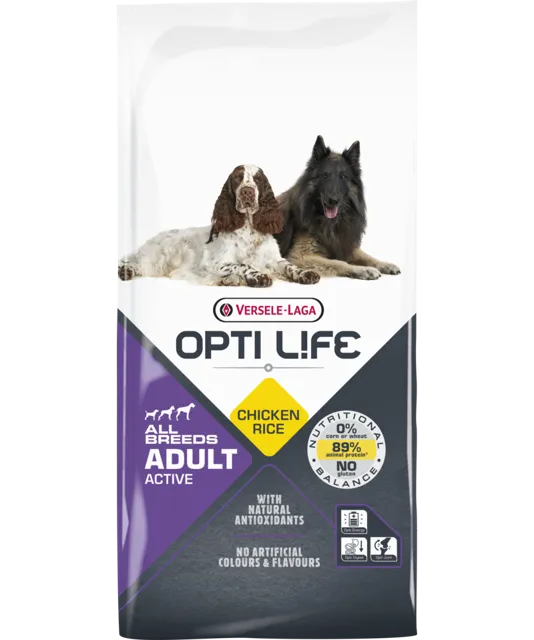

Opti Life
Opti Life Adult Sterilised/Light: Mini review
Flavour
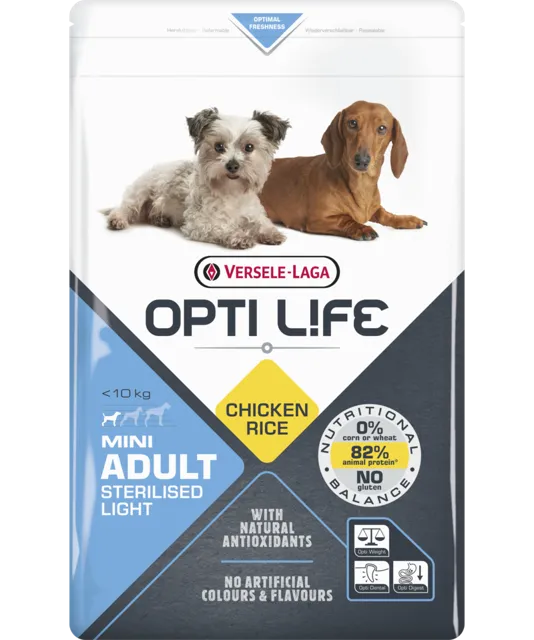
Opti Life Adult Sterilised/Light takes the brand's chicken and rice recipe and rebuilds it for a dog who puts on weight without trying. Fat comes down to single figures on the larger bag, fibre goes up with cellulose declared at 6%, and L-carnitine is dosed at 40 mg per kilo. That is the standard set of moves a light diet makes. Dehydrated chicken still leads both labels, at 27% and 31%, so the meat has not been quietly traded away to make room. Both bags sit in our Good band.
Our view
Likely to suit
If your dog was neutered and the waistline quietly went missing, this is the version of the recipe that answers it.
- Neutered dogs whose appetite outlived their energy needs, with fat cut to 9.5% on the medium and maxi bag
- Owners who would rather fill the bowl than shrink it, since cellulose adds bulk without adding energy
- Small dogs on the same plan, with a mini kibble at 11.0% fat and 375 kcal per 100g
- Older dogs carrying weight and stiffening with it, with glucosamine at 500 mg/kg on both bags
- Households after a named and counted meat share, with dehydrated chicken at 27% and 31%
Worth watching
A few things follow from the way a light food is built, and they are worth knowing.
- Most of the calorie-diluting is done by cellulose at 6% on the larger bag, a purified fibre and not the whole-vegetable kind
- Carbohydrate is estimated at 51.1% of dry matter on the medium and maxi recipe, above the 46.2% typical of an adult dry food, because the calories have come out of the fat instead
- Chicken, dried whole eggs and salmon oil are all in the recipe, so it fits neither a chicken-free nor a fish-free plan
- Animal fat and hydrolysed animal proteins appear without a species on both labels, so neither bag can anchor an elimination trial
Written by our editorial team. Independent guidance, not veterinary advice.
How this scores
How we scoreThe Details
Dog fit
If your dog was neutered and the waistline quietly went missing, this is the version of the recipe that answers it. A few things follow from the way a light food is built, and they are worth knowing.
Dry
Adult
Small
Chicken
The score, in context
Both bags land in our Good band, and they get there the way the rest of the brand does. A dehydrated named meat comes first, percentages sit beside the meat, the rice and each fibre source, the mineral and vitamin panel is dosed line by line, and glucosamine is stated in milligrams. Our Good band is where the typical adult dry food comes to rest as well, so this pair sits level with the shelf around it. The trade that makes it a light diet also trims a little from our nutritional balance reading, because carbohydrate rises as fat falls. Protein and processing stays at Average, held there by an animal fat and a hydrolysed protein that name no species.
What's in it
Ingredients, as declared: chicken (dehydrated, 31%), rice (31%), rice flour, vegetable fibres (cellulose 4.5%, beet pulp 1%), linseed, animal fat, hydrolysed animal proteins, minerals, salmon oil, brewer's yeast, dried whole eggs, FOS (0.1%), MOS (0.1%), sea algae (Ascophyllum nodosum), glucosamine 500 mg/kg, rosemary (18 mg/kg), green tea (12 mg/kg).
Named ingredients
Nutritional additives
_Nutritional additives:_ vitamin A 26400 IU, vitamin D3 1440 IU, vitamin E 600 mg, vitamin C 240 mg, β-carotene 1.2 mg, taurine 1100 mg, L-carnitine 40 mg, 3b103 (iron) 75 mg, 3b202 (iodine) 3 mg, 3b405 (copper) 10 mg, 3b503 (manganese) 50 mg, 3b605 (zinc) 100 mg, 3b607 (zinc) 25 mg, 3b801 (selenium) 0.2 mg, 3b8.12 (selenium) 0.1 mg. _Technological additives:_ antioxidants: tocopherols 26 mg/kg, clinoptilolite of sedimentary origin 10 g/kg, sepiolite 3.4 g/kg.
Ingredient notes
A light kibble is made by three moves, and all three are visible here. Fat drops to a declared 9.5% on the medium and maxi bag and 11.0% on the mini, and crude fibre rises to 4.0% and 3.8%. L-carnitine arrives at 40 mg per kilo, the entry usually chosen to help the body work with the fat it does have. Nothing is hidden in a proprietary blend.
Dehydrated chicken leads at 27% on the larger recipe and 31% on the mini, with rice matched to it at the same percentage each time. The water is gone from dehydrated meat before it goes on the scales, so the bag's figure is close to what the finished kibble holds. That is not how a fresh-meat headline behaves. Keeping the meat share up while pulling the fat down is the harder way to build a diet food, and it shows in a protein figure of 26.1% and 29.9% of dry matter.
Cellulose is the ingredient a light recipe leans on hardest, declared here at 6% on the larger bag and 4.5% on the mini, with beet pulp at 1% behind it in both. Being purified plant fibre, cellulose passes through a dog almost untouched. That is exactly why it is used: it fills the bowl and the stomach while contributing next to nothing in calories. Cellulose is processed, not fibre taken straight off a vegetable, and the label printing the percentage tells you how central it is.
The knock-on is in the carbohydrate. Fat comes out and fibre goes in, so starch takes a bigger share of what remains. Carbohydrate is estimated at 51.1% of dry matter on the medium and maxi recipe and 46.4% on the mini. That is the arithmetic of every light kibble rather than a quirk of this one, and it is why the portion on the bag matters more here than on a richer food.
Two entries give a family where a species belongs: animal fat, and hydrolysed animal proteins. On a recipe where fat is scarce the first of those is still doing real work. Around them the label is generous: linseed and salmon oil for the omega 3s, then brewer's yeast, sea algae and dried whole eggs. FOS and MOS come at 0.1% each, taurine at 1100 mg per kilo, and rosemary and green tea as the antioxidant preservatives.
How this variety differs
The small-breed version, and slightly less severe about it. Dehydrated chicken and rice sit at 31% each, cellulose eases back to 4.5%, and the panel reads 27.5% protein and 11.0% fat at 375 kcal per 100g, with carbohydrate at 46.4% of dry matter. A small dog burns through energy faster than a large one, so the gentler cut is the right call, and glucosamine still arrives at 500 mg/kg.
Price and value
£4.54 a kilo for both. The mini comes in a 7.5kg bag and a smaller one, and the medium and maxi comes in the largest size alone.
As a guide, a 15kg adult dog in moderate condition eats about 230 grams a day of the medium and maxi recipe or 224 grams of the mini. Assume around 840 kcal a day (110 × bodyweight^0.75, the standard maintenance estimate). That comes to £1.04 and £1.02 a day. The label's own table is deliberately tighter than that, asking 135 to 150 grams for a 15kg dog, because it is portioning for weight loss rather than maintenance. Follow the bag and the waistline while your dog is slimming.
Nutritional analysis
Declared analysis
27.5%
11%
3.8%
7%
Dry weight
29.9%
12%
4.1%
7.6%
46.4%
As-fed composition
Estimated breakdown of the finished product by ingredient category, from the declared ingredient list and ingoing weights. These are estimates, not measurements.
33.1%
49.9%
7.6%
3.3%
6%
Pricing & size
- Pack size
- 2,5 kg (EAN 5410340311370) · 7,5 kg (EAN 5410340311387)
- Retailer pricing
- Coming soon
Live retailer pricing is not yet available for this food. Prices, cost per day and where to buy will appear here once retailer data is live.
Ingredients and nutrition are taken from manufacturer data. Retailer pricing is not yet live for this food.
Related dog food guides
Ranked shortlists that include foods like this one.