


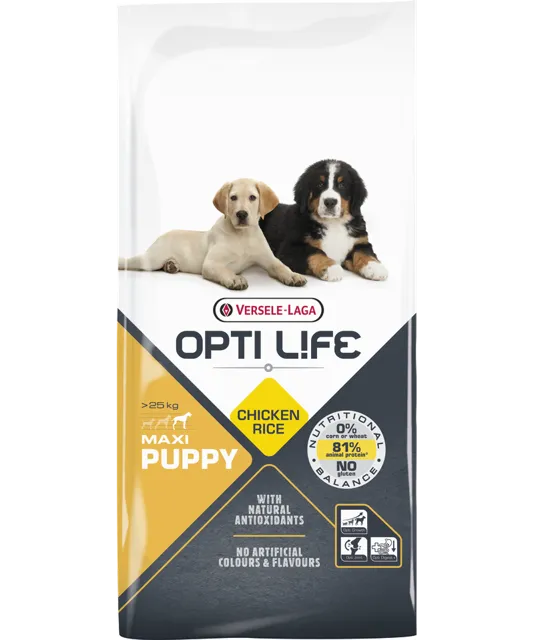

Opti Life
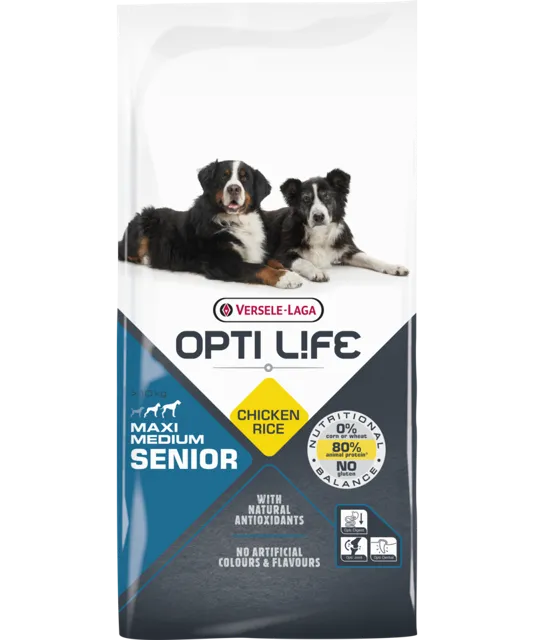
Opti Life Adult: Mini review
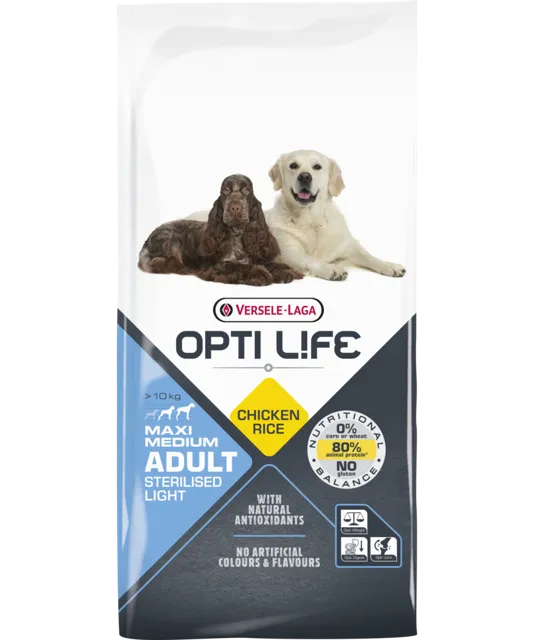
Opti Life Adult is one chicken and rice recipe cut four ways for four kinds of dog. Dehydrated chicken heads every list, between 28% and 40% of the recipe depending which bag you lift, and rice sits beside it. The same supporting cast follows each time: salmon oil and linseed, sea algae, brewer's yeast, dried whole eggs, a prebiotic pair and a glucosamine entry stated in milligrams. All four sit in our Good band.
Our view
Likely to suit
Pick the bag that matches your dog's size and the recipe underneath barely changes, which is the point of a range built like this.
- Dogs of any size, since the range is cut into mini, medium and maxi kibbles with an all-breeds Active recipe alongside
- Working dogs and dogs that never sit down, with the Active recipe carrying 32.0% protein and 22.0% fat at 440 kcal per 100g
- Owners who like the meat named at the top, since dehydrated chicken makes up between 28% and 40% of every recipe
- Older dogs feeling their hips, with glucosamine printed on all four bags, at 500 mg/kg on three of them and 250 mg/kg on the Medium
- Small dogs with big appetites, with the Mini adding krill and a butyric acid entry aimed at the gut lining
Worth watching
A handful of things on the back of the bag are worth a moment.
- Every one of the four is led by chicken, and that rules the range out where a chicken sensitivity has been diagnosed
- Only a family name is given for the animal fat and for the hydrolysed animal proteins, so a strict elimination plan cannot lean on these labels
- Salmon oil runs through all four and the Mini adds krill, so a fish-free bag is not on offer here
- Carbohydrate swings from 29.3% to 47.8% of dry matter across the range, so the four are not interchangeable at feeding time
Written by our editorial team. Independent guidance, not veterinary advice.
How this scores
How we scoreThe Details
Dog fit
Pick the bag that matches your dog's size and the recipe underneath barely changes, which is the point of a range built like this. A handful of things on the back of the bag are worth a moment.
Dry
Adult
Small
Chicken
The score, in context
The four share our Good band, which is unusual for a range that varies this much inside. Dehydrated chicken at the head of every list does most of the lifting, since dehydrated meat has already lost its water and the percentage on the bag survives the oven. Around it sit printed fibre percentages, a mineral and vitamin panel dosed entry by entry, and glucosamine stated rather than implied. Our scoring puts a typical adult dry food in that same Good band, so these four keep level with the middle of the shelf. Two things stop the band rising: neither the animal fat nor the hydrolysed protein is named, and cellulose stands in for fibre from whole vegetables.
What's in it
Ingredients, as declared: chicken (dehydrated, 35%), rice (25%), rice flour, animal fat, vegetable fibres (cellulose 4%, beet pulp 1%), linseed, hydrolysed animal proteins, salmon oil, brewer's yeast, minerals, krill, FOS (0.5%), dried whole eggs, MOS (0.1%), sea algae (Ascophyllum nodosum), salts of fatty acids (butyric acid), glucosamine 500 mg/kg, rosemary (18 mg/kg), green tea (12 mg/kg).
Named ingredients
Nutritional additives
_Nutritional additives:_ vitamin A 26400 IU, vitamin D3 1440 IU, vitamin E 600 mg, vitamin C 240 mg, β-carotene 1.2 mg, taurine 1100 mg, 3b103 (iron) 90 mg, 3b202 (iodine) 3.5 mg, 3b405 (copper) 12 mg, 3b503 (manganese) 60 mg, 3b605 (zinc) 120 mg, 3b607 (zinc) 30 mg, 3b801 (selenium) 0.24 mg, 3b8.12 (selenium) 0.12 mg. _Technological additives:_ antioxidants: tocopherols 26 mg/kg, clinoptilolite of sedimentary origin 10 g/kg, sepiolite 1.5 g/kg.
Ingredient notes
The headline is dehydrated chicken, and the percentage moves with the recipe: 40% on Active, 35% on Mini, 30% on Medium and 28% on Maxi. The meat goes on the scales with its water already gone, so those figures survive cooking. A fresh-meat headline does not manage that. These read straighter than they look.
Rice and rice flour sit immediately behind the chicken, usually at a percentage close to it, and the effect on the analysis is dramatic. Carbohydrate lands at 29.3% of dry matter on Active, where the typical adult dry food runs at 46.2%, and climbs to 47.8% on Maxi. Protein runs the same way, from 34.8% of dry matter down to 26.6%. The four share a recipe, not a nutritional profile.
Fibre comes from cellulose at 4% with beet pulp at 1% behind it on three of the recipes, and cellulose alone on Maxi. Beet pulp is a fermentable fibre a gut can put to use, whereas cellulose is a purified powder that passes through largely untouched, doing its work by bulk. It is a legitimate choice and a processed one, and the label at least prints how much is in there.
Two entries stop short of naming an animal. Animal fat is doing real nutritional work here, and the hydrolysed animal proteins are what make the kibble taste worth eating. A dog with no particular sensitivity will never notice, but the pair is the reason a chicken-led recipe here cannot be treated as a single-protein diet.
The rest is thoughtfully assembled. Linseed is there for plant omega 3s and salmon oil for the marine kind, and dried whole eggs add a highly usable protein. Brewer's yeast brings B vitamins, sea algae is where the iodine and trace minerals come from, and FOS and MOS feed the gut's own bacteria. Taurine is dosed on every bag, 550 mg on the Medium and 1100 mg on the other three, and rosemary and green tea close each list as the antioxidant preservatives.
How this variety differs
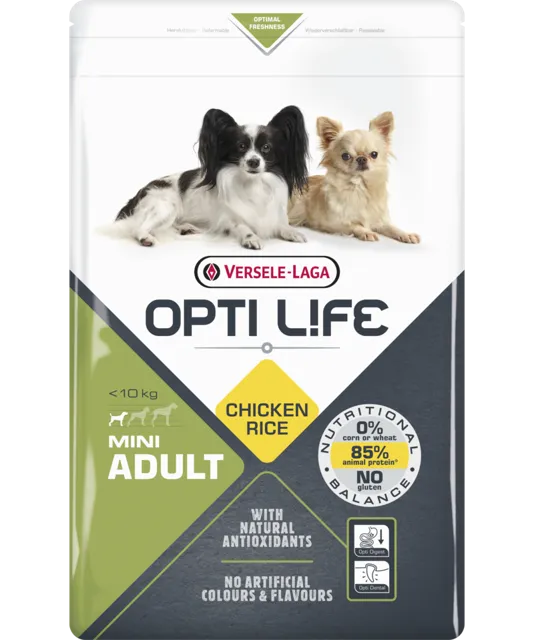
A small-breed kibble with the second highest meat share, dehydrated chicken at 35% against rice at 25%, giving 29.0% protein, 18.0% fat and 420 kcal per 100g with carbohydrate at 38.0% of dry matter. It is also the most interesting label of the four. Krill joins the fish oils, and FOS is dosed at 0.5% where the other three carry 0.1%. Salts of fatty acids from butyric acid are included as well, the short-chain fat a large intestine uses as fuel.
Price and value
£4.54 a kilo across the four. Medium is sold in a 2.5kg bag and the largest size, Mini in 2.5kg and 7.5kg bags, and Active and Maxi in the largest size only.
As a guide, a 15kg adult dog in moderate condition eats between 191 and 210 grams a day, and which end of that range depends on the recipe in the bowl. The target is around 840 kcal a day (110 × bodyweight^0.75, the standard maintenance estimate). That works out at between £0.87 and £0.95 a day, and the denser Active recipe is the one that goes furthest per gram.
Nutritional analysis
Declared analysis
29%
18%
2.5%
7.5%
Dry weight
31.5%
19.6%
2.7%
8.2%
38%
As-fed composition
Estimated breakdown of the finished product by ingredient category, from the declared ingredient list and ingoing weights. These are estimates, not measurements.
36.3%
45.5%
5.4%
7.9%
4.9%
Pricing & size
- Pack size
- 2,5 kg (EAN 5410340311455) · 7,5 kg (EAN 5410340311462)
- Retailer pricing
- Coming soon
Live retailer pricing is not yet available for this food. Prices, cost per day and where to buy will appear here once retailer data is live.
Ingredients and nutrition are taken from manufacturer data. Retailer pricing is not yet live for this food.
Related dog food guides
Ranked shortlists that include foods like this one.