



NuTRIBALance
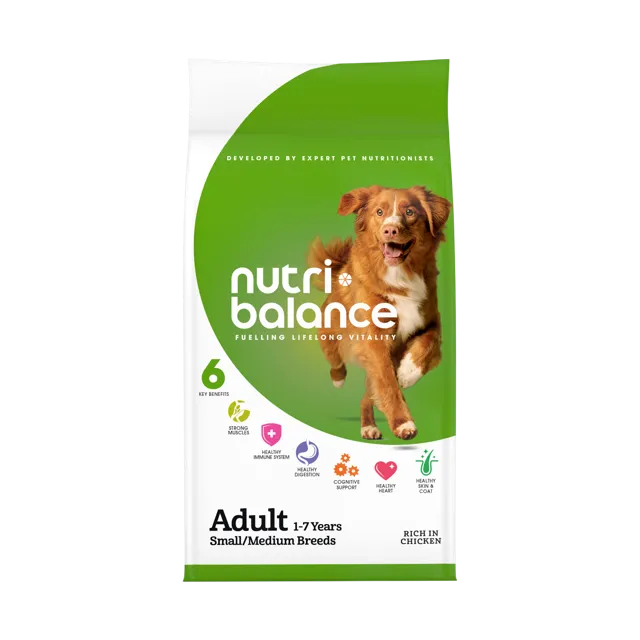
Nutribalance Small & Medium Breed Adult review
Nutribalance Small & Medium Breed Adult is a straightforward cereal-based kibble with joint support written into the recipe rather than added as an afterthought. Chicken meal leads at 24%, whole barley, whole maize and rice follow it, and glucosamine, MSM and chondroitin each carry a printed percentage. Two prebiotics and a fibre source round it out. It comes out in our Good band.
Our view
Likely to suit
Plenty of households simply want a dependable everyday bag that gets on with the job.
- Small and medium breed adults, the two sizes the feeding table is written around
- Older dogs whose owners want joint support built into the food, with glucosamine, MSM and chondroitin all declared
- With barley, maize and rice carrying most of the energy, this one suits a dog long used to cereal
- Dogs with an unsettled digestion, given beet pulp fibre alongside both FOS and MOS prebiotics
Worth watching
Before you decide, a few things on this bag are worth a look.
- Poultry oil and turkey digest both name a category rather than a species, so neither pins down an elimination diet
- This is not a fish-free recipe, since salmon oil is in at 1%
Written by our editorial team. Independent guidance, not veterinary advice.
How this scores
How we scoreThe Details
Dog fit
Plenty of households simply want a dependable everyday bag that gets on with the job. Before you decide, a few things on this bag are worth a look.
Dry
Adult
Small, Medium
Chicken
The score, in context
This one earns our Good band, and it earns it by being ordinary in the useful sense. Nothing here falls short. Chicken meal at 24% is a named and already dried protein, and the joint compounds come with real percentages printed, not a vague wave in their direction. Against that, protein converts to 27.2% of dry matter and estimated carbohydrate to 47.8%, a shade above the 46.2% typical of adult dry food. The label prints no moisture, so both figures assume 8%. Transparency comes back Outstanding while protein and processing and nutritional balance each read Average. That is how a recipe reads when it leans on cereal and then prints almost all of it.
What's in it
Ingredients, as declared: Chicken Meal (24%), Whole Barley, Whole Maize, Rice, Poultry Oil (7%), Turkey Meal (4%), Sugar Beet Pellets (4%), Turkey Digest (2%), Salmon Oil (1%), Chicory Extract (as a source of Prebiotic FOS) (0.2%), Mannan-oligosaccharides (Prebiotic MOS) (0.1%), Glucosamine (0.027%), MSM (0.027%), Chondroitin (0.019%)
Named ingredients
Nutritional additives
Nutritional Additives: Vitamins: Vitamin A 25,000IU, Vitamin D3 2,000IU, Vitamin E 150mg, Taurine 500mg, L-Carnitine 100mg. Trace Elements: Zinc (as Zinc Sulphate Monohydrate) 75mg, Iron (as Iron (ll) Sulphate Monohydrate) 40mg, Manganese (as Manganese (ll) Oxide) 30mg, Copper (as Copper (II) Sulphate Pentahydrate) 8mg, Iodine (as Calcium Iodate Anhydrous) 1.5mg, Selenium (as Sodium Selenite) 0.10mg
Ingredient notes
Chicken meal at 24% is the anchor, and meal is a more honest headline than it sounds. Its water is driven off before it goes into the mixer. So the declared figure stays honest once the kibble is made. A fresh meat percentage cannot say the same. Turkey meal at 4% sits behind it as a second named bird.
Whole barley, whole maize and rice do most of the carrying. Keeping the barley and maize whole is the better choice, since the grain holds on to more of its own fibre and micronutrients that way. All three cook down into something a dog digests comfortably. There is gluten here, since barley carries it, and a household avoiding gluten will want to know that.
Two entries stay vague. Poultry oil at 7% is a substantial part of the recipe, and it names only a family of birds. Turkey digest at 2% is the palatant here, sprayed on so the kibble tastes worth eating. Salmon oil at 1% is the one named fat, and it is the recipe's omega 3 source.
The digestive side has had more thought put into it than a plain cereal recipe usually gets. Sugar beet pellets at 4% supply both soluble and insoluble fibre. Chicory extract at 0.2% brings FOS and mannan-oligosaccharides at 0.1% bring MOS, and the two prebiotics feed the gut's friendly bacteria from slightly different directions.
The joint compounds are what make this label worth a second look. Glucosamine and MSM are each declared at 0.027% and chondroitin at 0.019%. You can see precisely what is going in. Taurine at 500 mg and L-carnitine at 100 mg per kilo are declared too. The trace minerals come as sulphates and oxides, the ordinary route and one that works perfectly well. Zinc is the largest of them at 75 mg per kilo.
Price and value
£3.00 a kilo, sold in a 2kg bag.
As a guide, a 15kg adult dog in moderate condition eats about 221 grams a day, assuming around 840 kcal a day (110 × bodyweight^0.75, the standard maintenance estimate). That works out at roughly £0.66 a day. The label's own table asks 160 to 280 grams for a dog between 12kg and 25kg. Your dog's waistline can settle where in that range to land.
Nutritional analysis
Declared analysis
25%
14%
2.5%
6.5%
Dry weight
27.2%
15.2%
2.7%
7.1%
47.8%
As-fed composition
Estimated breakdown of the finished product by ingredient category, from the declared ingredient list and ingoing weights. These are estimates, not measurements.
30%
61.6%
0.2%
8%
0.2%
Pricing & size
- Pack size
- 2kg - £5.99 (£3.00/kg)
- Retailer pricing
- Coming soon
Live retailer pricing is not yet available for this food. Prices, cost per day and where to buy will appear here once retailer data is live.
Ingredients and nutrition are taken from manufacturer data. Retailer pricing is not yet live for this food.
Related dog food guides
Ranked shortlists that include foods like this one.