


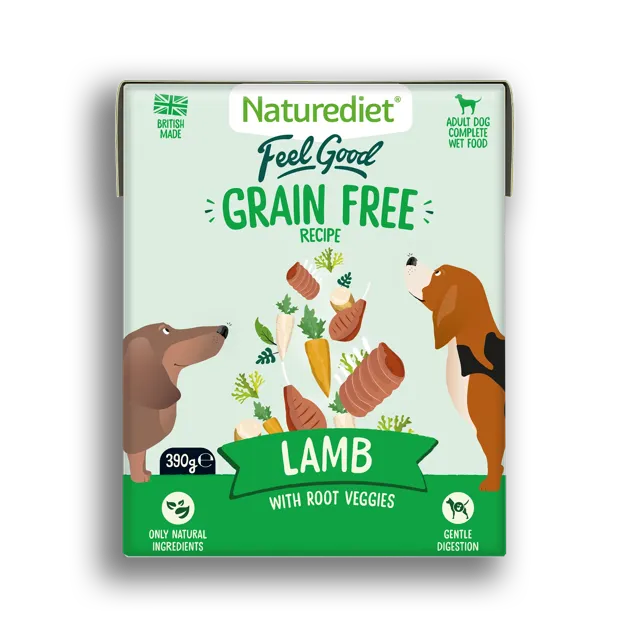

Naturediet
Naturediet Feel Good Grain Free: Lamb review
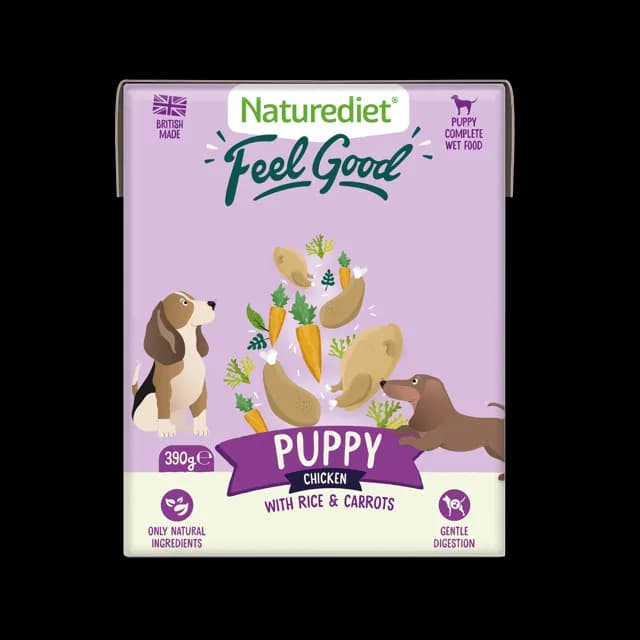
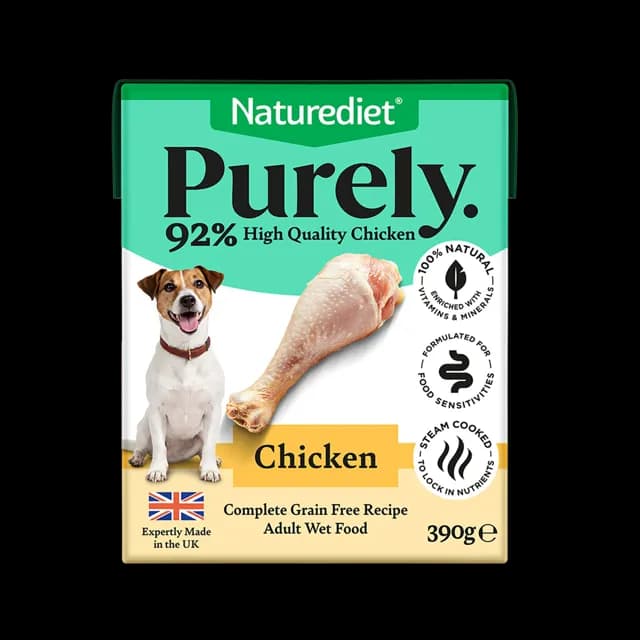
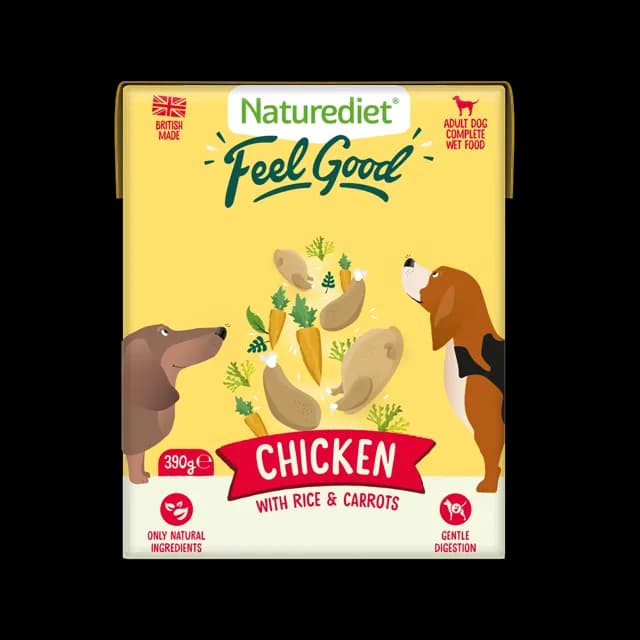
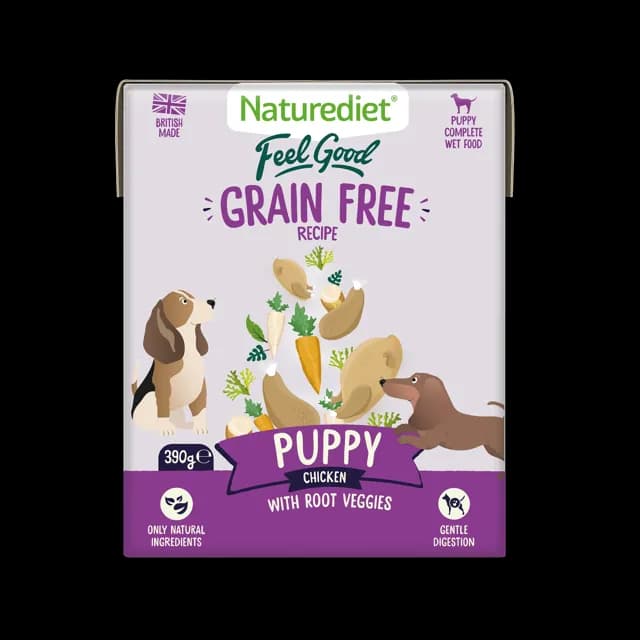
Naturediet Feel Good Grain Free is the cereal-free corner of the Naturediet kitchen. Three cartons, each declaring its animal content at 60%, with carrot, potato and parsnip in small printed amounts and dried egg and seaweed closing the list. Nothing here needs looking up, and the three recipes all come out in our Outstanding band.
Our view
Likely to suit
If you would rather read a label than decode one, this range keeps things refreshingly plain.
- Grain-avoiding households, since the three labels carry no cereal at all and the starch comes from potato and parsnip in printed amounts
- Owners who want a plain figure for the animal content, printed at 60% on every carton
- Dogs settled on one meat, as the chicken and the lamb each keep to a single named animal
- Dogs that take their water where they can get it, with moisture making up roughly three quarters of every serving
- Households feeding more than one size of dog, since a single carton size serves the smallest and the largest
Worth watching
A short list still holds a few things worth matching against your own dog.
- Dried egg appears on all three labels, and no carton here will anchor an elimination diet where egg is the suspect
- No species is given for the whitefish in the salmon carton, one to note if you keep a precise fish list
- Fat on the salmon runs to 34.6% on a dry matter basis, the richest of the three, so pace it if your dog puts weight on quickly
- One carton size serves the whole range, so a toy breed will be feeding from an opened carton across more than one meal
Written by our editorial team. Independent guidance, not veterinary advice.
How this scores
How we scoreThe Details
Dog fit
If you would rather read a label than decode one, this range keeps things refreshingly plain. A short list still holds a few things worth matching against your own dog.
Wet
Adult
Toy, Small, Medium, Large, Giant
Lamb
The score, in context
All three cartons finish in our Outstanding band, within a whisker of each other. No recipe is stronger than the others, so pick the animal your dog gets on with. Wet food does well on our scoring generally, and this range clears the Excellent band where the middle of the wet shelf settles. The meat share is printed, the starch is small and named, and nothing on the label is doing a job it cannot explain.
What's in it
Ingredients, as declared: Lamb - 60%, Carrot - 3.5%, Potato - 3.5%, Parsnip - 3%, Dried Egg, Dried Seaweed
Named ingredients
Nutritional additives
_(the page labels this "Added Vitamins & Minerals (per kg):")_: - Vitamin A - 3,300IU - Vitamin D3 - 275IU - Iron (as Iron (II) Sulphate Monohydrate) - 13.2mg - Copper (as Copper (II) Sulphate Pentahydrate) - 1.32mg - Manganese (as Manganous Sulphate Monohydrate) - 2.2mg - Zinc (as Zinc Sulphate Monohydrate) - 27.5mg
Ingredient notes
Each carton opens with its animal content at 60%, given as a percentage rather than left to guesswork. The chicken and the lamb each put one named meat to all of that work, while the salmon carton runs salmon at 42% with whitefish at 18% behind it. Protein converts to 35.7% of dry matter on the chicken and lamb and 38.5% on the salmon. For food fed from a carton, the analysis is properly meat-led.
The plant side is deliberately small. Carrot sits at 3.5%, potato at 3.5% and parsnip at 3%, each with a figure beside it. Cereal is nowhere on the three labels, so the grain-free claim holds the whole way down the list. No carbohydrate figure is declared, so ours is an estimate. It converts to 17.9% of dry matter on the chicken. The lamb reads 19.7% and the salmon 9.6%. The typical adult wet food runs at 15.8%.
Dried egg and dried seaweed close every label. Egg is a genuinely useful protein and brings fat and minerals in with it. Seaweed is the quiet mineral source in recipes like this one, iodine included. That is why it turns up at trace level in so many natural foods. Neither is present in quantity, but both are worth noticing if you keep an avoidance list.
The added vitamins and minerals amount to a short panel with a printed figure against every entry, covering vitamins A and D3 and the trace metals iron, copper, manganese and zinc. A recipe carrying this much fresh meat brings a fair share of its micronutrition with it, so a panel this brief reads as confidence rather than as economy.
How this variety differs
Lamb at 60% on the same vegetable base, for a dog that has been moved off poultry or has simply grown tired of it. A touch less ash than the chicken and slightly more carbohydrate at an estimated 19.7% of dry matter, with energy matching at 122 kcal per 100g.
Price and value
The chicken carton is £4.02 a kilo and the lamb and salmon cartons are £4.13, all in the same 390g carton sold in boxes of 18.
As a guide, a 15kg adult dog in moderate condition needs roughly 689 to 739 grams a day, assuming about 840 kcal a day (110 × bodyweight^0.75, the standard maintenance estimate). Depending on the carton, that comes to between £2.77 and £3.05 a day. Naturediet's own chart puts that dog between 488 and 780 grams a day.
Nutritional analysis
Declared analysis
10%
8%
2%
2.5%
72%
Dry weight
35.7%
28.6%
7.1%
8.9%
19.7%
As-fed composition
Estimated breakdown of the finished product by ingredient category, from the declared ingredient list and ingoing weights. These are estimates, not measurements.
68.8%
18%
3.5%
9.7%
Pricing & size
- Pack size
- 18 x 390g Cartons - £28.98
- Retailer pricing
- Coming soon
Live retailer pricing is not yet available for this food. Prices, cost per day and where to buy will appear here once retailer data is live.
Ingredients and nutrition are taken from manufacturer data. Retailer pricing is not yet live for this food.
Related dog food guides
Ranked shortlists that include foods like this one.