

Nature's Protection
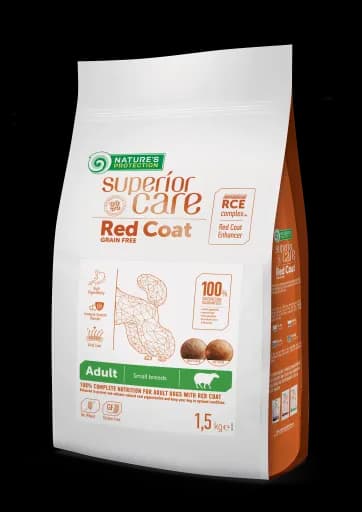
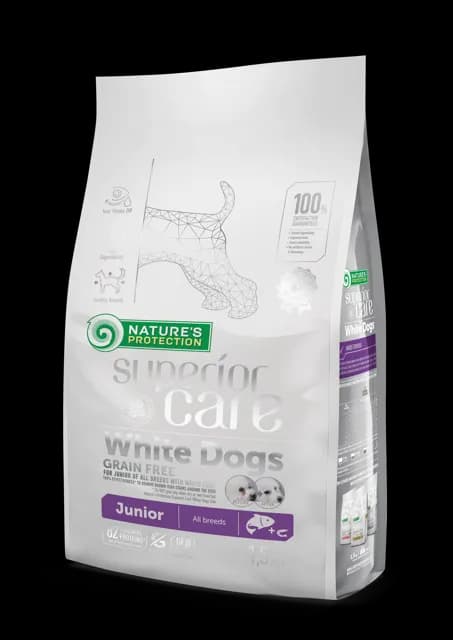
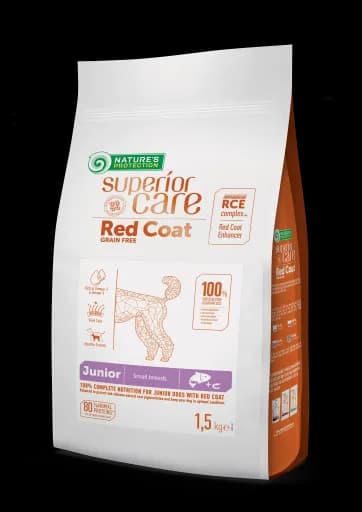
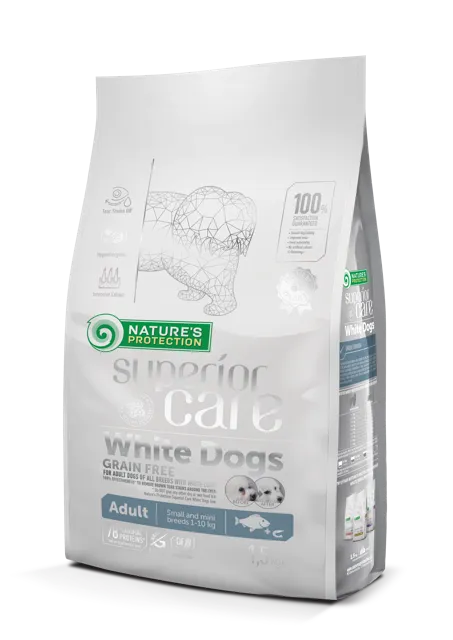
Nature's Protection Superior Care White Dogs Adult Small & Mini Breed: With White Fish review
Flavour
Nature's Protection Superior Care White Dogs Adult Small & Mini Breed puts two rather different recipes under one name. The white fish variety is free of grain and leads with 41% white fish over dried potato pulp, sweet potato and peas, and it comes out in our Average band. The lamb variety is built the older way, opening with rice, poultry fat and barley before it reaches the lamb, and it finishes in our Average band as well. Both are portioned for small and mini adults, and both carry the range's pale-coat thinking in the form of marigold, green tea and linseed.
Our view
Likely to suit
Your small white dog and that pale coat are exactly what this range was drawn up for.
- Owners of small and mini breed adults in pale coats, the dog the range takes its name from
- Households that want the meat named and counted, which the white fish recipe does at 41%
- Small dogs kept off cereal, since the white fish variety leaves grain out altogether
- Fussier little eaters, because the lamb recipe brings hydrolysed chicken liver and dried egg in to keep the bowl interesting
Worth watching
The two recipes are not interchangeable, so it helps to know where they part company.
- Salmon oil appears in both varieties, so neither of them is a fish free bowl
- The lamb recipe names rice, poultry fat and barley before it names the lamb, which matters if you want the meat at the front of a list
- Hydrolysed chicken liver and soya protein isolate both sit in the lamb recipe, so it is not the bowl for a dog kept off either one
- Poultry fat runs through both labels without naming a bird, which keeps either recipe from anchoring a strict elimination trial
Written by our editorial team. Independent guidance, not veterinary advice.
How this scores
How we scoreThe Details
Dog fit
Your small white dog and that pale coat are exactly what this range was drawn up for. The two recipes are not interchangeable, so it helps to know where they part company.
Dry
Adult
Small
White Fish
The score, in context
Both varieties finish in one band, and how differently they get there is worth seeing. The white fish recipe sits in our Average band, a step under the Good band where the typical adult dry food finishes. A 41% named fish declaration and a cereal free base hold it up. The lamb recipe joins it in our Average band, and the reason it reads lower inside that band is structural. Nothing in the bowl is troubling. Rice, poultry fat and barley all appear before the lamb, and the lamb itself carries no percentage. Protein is declared at 21%, and we estimate the meat content at around 17.3% of the recipe. Its protein and processing reads Poor, with nutritional balance at Average and transparency Good. The meat share is what holds it back, and not the printing. It is still a complete food for a small white dog that suits it. There is simply less animal behind it than behind its stablemate.
What's in it
Ingredients, as declared: 41% white fish (dry and finely ground), dried potato pulp, sweet potato, peas, poultry fat, krill flour (minimum 4%), sugar beet pulp, salmon oil, dynamic micronized clinoptilolite (1 %), linseed, fructo-oligosaccharide (FOS), cassava extract, green tea, dried marigold (source of lutein).
Named ingredients
Nutritional additives
- **Nutritional additives:** vitamin A (3a672a) - 18000 IU, vitamin D3 (3a671) - 1500 IU, vitamin E (3a700) - 530 mg, folic acid (3a316) - 1 mg, biotin (3a880) - 1 mg, iron (II ) sulfate monohydrate (3b103) - 50 mg, anhydrous calcium iodate (3b202) - 1.5 mg, copper (II) sulfate pentahydrate (3b405) - 5 mg, manganous sulfate monohydrate (3b503) - 20 mg, Zinc Sulfate Monohydrate (3b605)) - 115mg, Sodium Selenite (3b801) - 0.1mg. - **Technological additives:** rosemary extract, tocopherol extracts from vegetable oils (1b306 (i)).
Ingredient notes
The white fish recipe opens at 41%, declared dry and finely ground. Its water has gone before the weighing, so that percentage largely survives into the finished kibble. Protein converts to 26.4% of dry matter and fibre to 4.4%, the higher of the two on both counts.
The lamb recipe is put together on a different plan. Rice, poultry fat and barley take the first three places, the lamb sits fourth with no percentage against it, and soy protein isolate follows as a plant protein source. Protein is declared at 21% and fat at 18%, so the energy leans towards the fat side. The label prints no moisture figure at all, so the dry matter readings on this variety work from an assumed 8%, the usual level for a kibble.
The pale-coat idea shows up in the small print of both. Lutein comes from the dried marigold, catechins from the green tea, and the plant form of omega 3 from linseed. The lamb recipe goes further with dried cranberry, borage oil and grape seed extract. Grape seed needs a word of explanation, not worry. The trouble with grapes belongs to the fruit itself, and what is used here is the pressed seed residue, an antioxidant.
Both varieties carry salmon oil, and the white fish recipe adds krill flour at a declared minimum of 4%, which gives it the stronger marine position of the pair. Neither recipe suits a dog being kept off fish.
The lamb recipe carries a few doses the fish one does not, with taurine at 1200 mg and DL-methionine at 2.5 g, two amino acids with roles in heart function and coat condition. Vitamin C at 600 mg and zinc sulphate at 145 mg sit alongside them. Calcium works out at 0.87% of dry matter in the lamb and 1.32% in the white fish, both comfortable adult levels.
Beyond that the tails are short and sensible. The fibre work falls to sugar beet pulp, FOS looks after the friendly bacteria down in the large intestine, and clinoptilolite at 1% binds. Rosemary extract and tocopherols from vegetable oils close both labels, keeping the fats from turning rather than adding anything nutritional.
How this variety differs
White fish at 41%, declared dry and finely ground, over a base of dried potato pulp, peas and sweet potato, with no cereal at any point. Krill flour at a declared minimum of 4% joins salmon oil on the marine side, fibre is the higher of the two recipes at 4.4% of dry matter, and calcium works out at 1.32%.
Price and value
£6.06 a kilo across both varieties. The lamb is sold in 1.5kg and 10kg bags, the white fish in 1.5kg.
As a guide, a 15kg adult dog in moderate condition needs around 840 kcal a day (110 × bodyweight^0.75, the standard maintenance estimate). That is about 218 grams a day of the lamb, at £1.32, or about 250 grams of the white fish, at £1.51. These are small and mini breed recipes, so a real bowl in this house will be a fraction of that, and both energy figures are estimated rather than declared.
Nutritional analysis
Declared analysis
Estimated using Modified Atwater factors*
24%
13%
4%
9.5%
9%
Dry weight
26.4%
14.3%
4.4%
10.4%
44.5%
As-fed composition
Estimated breakdown of the finished product by ingredient category, from the declared ingredient list and ingoing weights. These are estimates, not measurements.
45%
47.8%
4.2%
3%
Pricing & size
- Pack size
- 1,5 Kg
- Retailer pricing
- Coming soon
Live retailer pricing is not yet available for this food. Prices, cost per day and where to buy will appear here once retailer data is live.
Ingredients and nutrition are taken from manufacturer data. Retailer pricing is not yet live for this food.
Related dog food guides
Ranked shortlists that include foods like this one.