



Natural Woodland
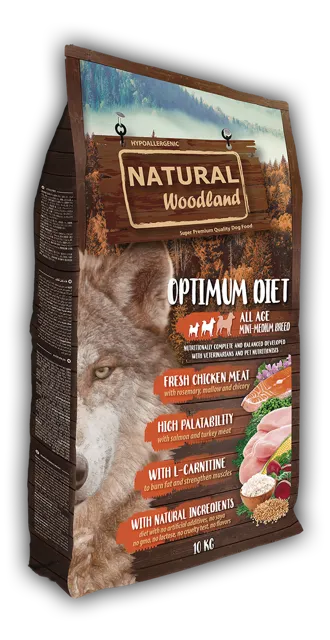
Natural Woodland Optimum Diet: Mini-Medium review
Flavour
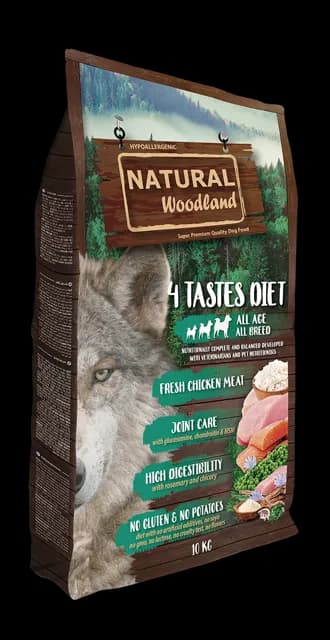
Natural Woodland Optimum Diet is a two size range that keeps a mixed cereal base and builds a poultry recipe on top of it. Dehydrated turkey and chicken open both lists with fresh chicken at 10% behind them, while wheat, barley, rice and corn share the carrying between them. The Large bag prints a joint pair and the Mini-Medium leaves it out, and both recipes name their oils properly, with dehydrated salmon at 2% and fish oil at 0.5%. Both sit in our Good band.
Our view
Likely to suit
If cereal has never bothered your dog, this is a plain, well fed bowl with nothing exotic about it.
- Dogs of any age, with puppies, adults and seniors all named on both bags
- Bigger dogs, with the Large recipe shaped for them and its joint pair printed at 650 mg/kg glucosamine and 150 mg/kg chondroitin
- Small and medium dogs, because the Mini-Medium bag is made to a kibble they can handle comfortably
- Dogs that eat poultry happily, as dehydrated turkey and chicken lead both lists with fresh chicken at 10% behind
- Owners who like an omega source named rather than implied, with dehydrated salmon at 2% and fish oil at 0.5% in both recipes
Worth watching
A few label points repay reading before you pick between the bags.
- Wheat sits high in both recipes, so it is the first thing to check when cereal has caused your dog trouble before
- One percentage covers the dehydrated turkey and chicken together, so how much of each bird you get stays unknown
- The Mini-Medium recipe does not carry the glucosamine and chondroitin that the Large one prints
- Neither label declares calcium, and both are sold for puppies, so a large breed pup needs that figure from the maker before you start
Written by our editorial team. Independent guidance, not veterinary advice.
How this scores
How we scoreThe Details
Dog fit
If cereal has never bothered your dog, this is a plain, well fed bowl with nothing exotic about it. A few label points repay reading before you pick between the bags.
Dry
Puppy, Adult, Senior
Toy, Small, Medium, Large, Giant
Chicken
The score, in context
Both bags come out in our Good band, the same level the typical adult dry food reaches. The reasons are easy enough to see. The meat total is moderate once the dehydrated and fresh entries are counted together, four cereals share the base, and the two birds at the top of each list are declared as a single figure.
What the recipes do well is name what they use. The oils are specified, the herbs are dosed, and every trace mineral gets its own line. Carbohydrate lands at 43.5% and 40.2% of dry matter, both under the 46.2% typical of the category. A dog that has never reacted to cereal will feed perfectly well on this.
What's in it
Ingredients, as declared: Dehydrated turkey and chicken meat (20%), Fresh chicken (10%), Wheat, Peas (8%), Chicken oil (7.5%), Barley, Corn (6%), Rice (5%), Chicken liver hydrolysate (2%), Dehydrated salmon (2%), Beet Pulp (2%), Carob, Fish oil (0.5%), Yeast, Mineral substances, Rosemary (1,200 mg/kg), Chicory (500 mg/kg), Mallow (400 mg/kg).
Named ingredients
Nutritional additives
| Additive (per kg) | Amount | |---|---| | Vitamin A | 18.000 IU/kg | | Vitamin D3 | 1.400 IU/kg | | Vitamin E | 150 mg/kg | | Iron | 75 mg/kg | | Iodine | 3,5 mg/kg | | Copper | 10 mg/kg | | Manganese | 7,5 mg/kg | | Zinc | 120 mg/kg | | Selenium | 0,12 mg/kg | | L-carnitin | 40 mg/kg | | Technological Additives: Natural antioxidants (tocopherols) | — |
Ingredient notes
Four cereals appear across these recipes and they are not equal. Barley is a genuinely useful grain, easily digested once cooked and carrying fibre, selenium and copper along with its starch. Of the common cereals, rice is the one that sits most gently in a dog's gut. Corn is perfectly digestible when cooked, though it is chosen for economy as much as for nutrition. Wheat is the one that draws real debate, since it is linked with dietary intolerance more often than any other grain, and it sits high on both of these lists. For most dogs that is a non-issue. Where there has been itching or loose stools, it is the first thing to rule out.
The meat is poultry throughout. Dehydrated turkey and chicken lead at 18% in the Large recipe and 20% in the Mini-Medium, with fresh chicken at 10% behind in both. The dried entry is the one to read, since its water has already gone before the percentage is calculated. Chicken liver hydrolysate at 2% is a palatant, the small addition that gives a plain kibble a flavour dogs go for, and liver is genuinely nutrient dense in its own right.
The omega sources are the quiet strength of both labels. Dehydrated salmon at 2% and fish oil at 0.5% are named, not hidden behind a general term. The omega 3s in fish oil come long chain, ready for a dog to use directly, which linseed and other plant sources cannot match. Chicken oil supplies the bulk of the fat, at 5% in the Large recipe and 7.5% in the Mini-Medium.
What is left on the list is small, named and dosed. Beet pulp at 2% and carob supply gentle fibre, with brewers' yeast behind them, and chicory at 500 mg/kg feeds the gut bacteria. Rosemary at 1,200 mg/kg keeps the fats from turning rancid. Malva, listed as mallow on the Mini-Medium label, is at 400 mg/kg on both. Tocopherols do the preserving, a vitamin E based natural alternative to chemical preservatives.
Both labels dose L-carnitine at 40 mg/kg, an amino acid the body leans on when it turns fat to energy. They print their trace minerals individually too: iron at 75 mg, zinc at 120 mg, iodine at 3.5 mg and selenium at 0.12 mg per kilo. The gap in an otherwise well populated panel is calcium, which is not declared on either bag despite both being sold for growth.
How this variety differs
The smaller kibble and the fuller build, at 28.0% protein and 16.0% fat for 379 kcal per 100g, on 20% dehydrated turkey and chicken with chicken oil up at 7.5%. Carbohydrate drops to 40.2% of dry matter, helped by peas at 8% sitting ahead of the barley, corn at 6% and rice at 5%. It carries no glucosamine or chondroitin, so a stiffening older dog is better served by the Large recipe.
Price and value
The Large recipe is sold in a 10kg bag and the Mini-Medium in 2kg and 10kg.
As a guide, a 15kg adult dog in moderate condition would eat about 227 grams a day of the Large recipe or about 222 grams of the Mini-Medium. Work that from around 840 kcal a day (110 × bodyweight^0.75, the standard maintenance estimate). A dog of that weight belongs on the Mini-Medium bag by size. A puppy on either will want considerably more than its adult ration while it is growing, so watch the ribs and not the scoop.
Nutritional analysis
Declared analysis
28%
16%
3%
8%
Dry weight
30.4%
17.4%
3.3%
8.7%
40.2%
As-fed composition
Estimated breakdown of the finished product by ingredient category, from the declared ingredient list and ingoing weights. These are estimates, not measurements.
34%
48.6%
0.8%
8%
8.7%
Pricing & size
- Pack size
- 2 and 10 kg.
- Retailer pricing
- Coming soon
Live retailer pricing is not yet available for this food. Prices, cost per day and where to buy will appear here once retailer data is live.
Ingredients and nutrition are taken from manufacturer data. Retailer pricing is not yet live for this food.
Related dog food guides
Ranked shortlists that include foods like this one.