


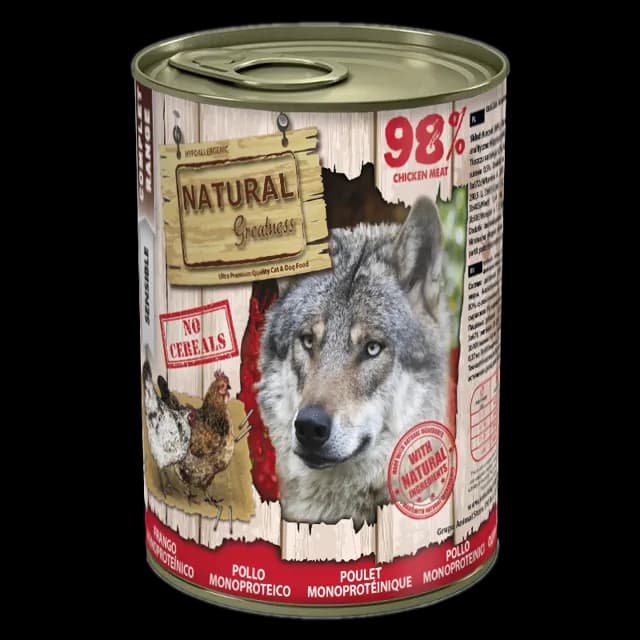

Natural Greatness
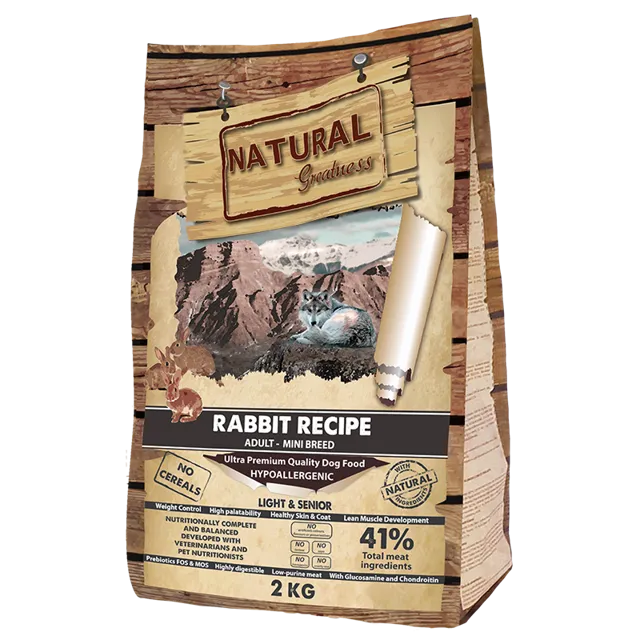
Natural Greatness Ultra Premium Adult Mini Breed: Rabbit Recipe review
Flavour
Natural Greatness Adult Mini Breed puts two very different recipes into the same small kibble. The rabbit is the lean one, built on a single uncommon meat with peas, potato and a proper run of fruit and vegetables through the list. The salmon is the rich one, fishier and fattier, with a bigger energy load behind it. Both finish in our Good band, so the ranking will not decide this one. Pick the recipe that suits your dog.
Our view
Likely to suit
Small dogs are short-changed on choice more often than they should be, and this pair opens two quite different doors.
- Small breed adults and seniors, since both recipes are made to a kibble and a portion a little mouth can manage
- Dogs that flare on the everyday meats, since the rabbit recipe takes every meat entry from one unusual animal
- Small dogs a bit heavier than they should be, since the rabbit sits at 9.5% fat and the salmon at 16.5%
- Older small dogs needing joint help early, with glucosamine at 900 mg/kg and chondroitin at 200 mg/kg on the rabbit label
- Committed fish eaters, since the salmon recipe leads on dehydrated salmon at 20% and adds fresh salmon at 10%
Worth watching
Before you choose between the two, each bag has something you should know.
- Pork fat and salmon oil both sit in the rabbit recipe, so it stops short of being a true one animal food once you read past the meat entries
- Chicken oil at 9.5% sits high in the salmon recipe, which matters for a dog you are steering clear of chicken
- Carbohydrate in the rabbit recipe reaches 47.4% of dry matter, above the 46.2% typical of adult dry food and enough that plants are carrying a fair share
- Calcium goes undeclared on both labels, and both are written for adults and seniors, not for growing dogs
Written by our editorial team. Independent guidance, not veterinary advice.
How this scores
How we scoreThe Details
Dog fit
Small dogs are short-changed on choice more often than they should be, and this pair opens two quite different doors. Before you choose between the two, each bag has something you should know.
Dry
Adult, Senior
Small
Rabbit
The score, in context
Both recipes reach our Good band, and that is where the adult dry category tends to finish as well. The distance between them is short and easy to explain. The rabbit keeps every meat entry on one animal and holds its fat modest. The salmon puts potato protein fourth and draws most of its fat from chicken, not from the fish pictured on the bag. Both are sound small dog food; they simply answer different questions.
What's in it
Ingredients, as declared: Dehydrated rabbit meat (26%), Peas, Potato, Fresh rabbit meat (10%), Beet pulp, Hydrolysed rabbit (3%), Pea protein, Yeast, Linseed, Potato protein, Pork fat (1.7%), Salmon oil, Sunflower oil, Mixed fruit (apple and cranberry), Mixed vegetables (tomato and spinach), Carrot, Pumpkin, Seaweed, Inulin (FOS 0.1%), Mannan-oligosaccharides (MOS 0.1%), Mineral Substances, Yucca schidigera, Glucosamine (900 mg/kg), Chondroitin (200 mg/kg), Rosemary, Parsley.
Named ingredients
Nutritional additives
Vitamin a 20000 IU, Vitamin D3 2000 IU, Vitamin E 600 mg, Vitamin C 200 mg, Iron (Sulphate Monohydrate) 75 mg, Iodine (Potassium Iodide) 3.5 mg, Copper (Sulphate Pentahydrate) 10 mg, Manganese (Sulphate Monohydrate) 7.5 mg, Zinc (Zinc Oxide) 120 mg, Selenium (Sodium Selenite) 0.12 mg, Taurine 850 mg, L Carnitine 250 mg.
Ingredient notes
Each recipe opens with a dehydrated meat. For a kibble that is the right way round. Drying happens before the percentage is calculated, so the figure on the label survives into the bowl more or less intact. A fresh meat headline is a much smaller thing once the oven has been at it. The rabbit declares 26% dehydrated with 10% fresh behind it; the salmon declares 20% dehydrated with 10% fresh.
Rabbit is the reason to look at the first recipe. Few dog foods use it, so many dogs have never eaten rabbit at all. A meat a dog has never met is one it cannot yet have reacted to. Hydrolysed rabbit at 3% keeps the meat side on that one animal from top to bottom. The honest caveat is the fat and oil: pork fat at 1.7%, salmon oil and sunflower oil all appear, so this is a single meat recipe rather than a single animal one.
The salmon recipe reads richer in every respect, at 28.5% protein and 16.5% fat with 388 kcal per 100g, and carbohydrate down at 40.2% of dry matter. Its fat comes from chicken oil at 9.5%, which is worth knowing given the fish on the label, with salmon hydrolysate at 2% and salmon oil at 1.5% adding to the fish content. Potato protein takes fourth place. It is a plant protein, and it will not match what meat provides even as it lifts the declared figure.
The rabbit recipe has by far the fuller plate behind its meat, with carrot, pumpkin, apple, cranberry, tomato, spinach and seaweed all there by name. Linseed adds plant omega 3s, and beet pulp adds gentle fibre. The salmon takes the tidier route: linseed, beet pulp and chicory, then a citrus extract made from grapefruit, orange, tangerine and bergamot working as an antioxidant.
Both labels dose taurine, at 850 mg on the rabbit and 1000 mg on the salmon, which supports heart muscle and is a good thing to see printed on a grain free food. Both carry prebiotics: FOS and MOS at 0.1% each on the rabbit, mannan-oligosaccharide on the salmon, feeding the gut bacteria that keep a dog comfortable. Yucca schidigera is on both lists for one practical reason: stool odour.
How this variety differs
The lean, novel meat option, with rabbit dehydrated at 26%, hydrolysed at 3% and fresh at 10% and no other meat anywhere on the list. Fat stays at 9.5% and the joint pair gets real doses, at 900 mg/kg glucosamine and 200 mg/kg chondroitin. The fruit and vegetable run through the middle of the label is the fullest in the range. Pork fat at 1.7%, salmon oil and sunflower oil supply the fats.
Price and value
Both recipes are sold in 2kg and 6kg bags.
As a guide, a 15kg adult dog in moderate condition would eat about 245 grams a day on the rabbit and about 216 grams on the salmon. The maths behind that is around 840 kcal a day (110 × bodyweight^0.75, the standard maintenance estimate). A dog that size is above the weight these small breed bags are written for. Closer to home, the rabbit label asks 190 grams a day for a 10kg dog and the salmon label 137 grams for a quiet one of the same weight.
Nutritional analysis
Declared analysis
28%
9.5%
4%
7%
Dry weight
30.4%
10.3%
4.3%
7.6%
47.4%
As-fed composition
Estimated breakdown of the finished product by ingredient category, from the declared ingredient list and ingoing weights. These are estimates, not measurements.
39%
54.3%
0.7%
2.6%
3.4%
Pricing & size
- Pack size
- 2 kg / 6 kg
- Retailer pricing
- Coming soon
Live retailer pricing is not yet available for this food. Prices, cost per day and where to buy will appear here once retailer data is live.
Ingredients and nutrition are taken from manufacturer data. Retailer pricing is not yet live for this food.
Related dog food guides
Ranked shortlists that include foods like this one.