


Skip to content
Off the Leash
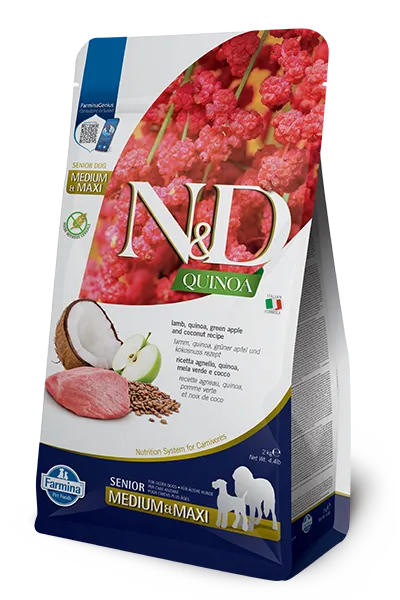
N&D Quinoa Medium & Maxi – Senior Lamb, Green Apple & Coconut

Natural & Delicious

Natural & Delicious N&D Quinoa Medium & Maxi: Senior Lamb, Green Apple & Coconut review

66.8/100Good
DryAdultSenior

N&D Quinoa Medium & Maxi is a family of five everyday recipes, each built for a particular job and each using quinoa seed at 8% as its signature. The construction is consistent. A named animal comes fresh and dehydrated at the top, with pea starch as the binder. Herring protein and herring oil supply the marine omegas. Then comes a short set of plants chosen for whatever that recipe is aiming at, from fennel and mint to broccoli and asparagus. The additive panels are printed in full and the trace minerals are chelated throughout. All five land in our Good band.

Where to buy: coming soon
Live retailer pricing is coming soon. Once we have prices from UK retailers, the best price, cost per day and where to buy will appear here.

Our view

Likely to suit

Sometimes a dog needs the bowl to do one specific thing, and this is a range that picks its target and builds towards it.

  • Owners who want a food aimed at a particular need without moving to a prescription diet
  • Dogs that do best with a named animal first on the list, and lamb, venison and duck are all here
  • Owners with cereal off the shopping list, since quinoa is a seed and not a true grain, with pea starch doing the binding
  • Dogs with ageing joints, because glucosamine and chondroitin close every recipe in the range
  • Owners who read the additive panel, with chelated trace minerals and dosed amino acids on every label

Worth watching

Whichever recipe you pick, four things hold true across the whole range.

  • All five recipes carry dehydrated herring protein and herring oil, which leaves no fish-free choice in the range
  • Chicken fat is in four of the five, the skin and coat venison being the exception, so poultry is present in most of the range
  • Pea starch is the main carbohydrate throughout, and it is the refined fraction and not the whole pulse
  • These are ordinary foods with a purpose rather than treatments, so a dog already under a vet's care should stay on whatever plan the vet has set

Written by our editorial team. Independent guidance, not veterinary advice.

How this scores

How we score
66.8/100Good
Protein and processingGood
Nutritional balanceGood
TransparencyOutstanding
ValueGood

The Details

Dog fit

Sometimes a dog needs the bowl to do one specific thing, and this is a range that picks its target and builds towards it. Whichever recipe you pick, four things hold true across the whole range.

Food type

Dry

Life stage

Adult, Senior

Breed size

Medium

Main protein

Lamb

The score, in context

Our Good band holds all five recipes, and the average adult dry food shares it with them. They get there by naming their animals, printing their percentages and keeping the additive panel generous. They also hold each other close enough that the band is the same across a range with very different targets. Underneath that shared band the recipes are not interchangeable. Declared protein runs from 22.0% of dry matter on the urinary recipe up to 30.8% on the weight management lamb, and energy from 314 to 396 kcal per 100g. Choose on the job you want the food to do, not on where the band sits.

What's in it

Ingredients, as declared: lamb (20%), dehydrated lamb protein (18%), pea starch, chicken fat, pea fibre, quinoa seed extracted (8%), dried eggs, linseed, dehydrated herring protein, fish oil (from herring), dried green apple (2.5%), dried coconut (2.5%), carob pods, alfalfa meal, inulin (0.6%), fructo-oligosaccharides (0.6%), yeast extract (source of manno-oligo-saccharides) (0.6%), psyllium husks and seeds, potassium chloride, calcium sulphate dihydrate, dried brewers' yeast, aloe vera extract, glucosamine, chondroitin sulphate.

Named ingredients

Lamb (20%), dehydrated lamb protein (18%), pea starch, chicken fat, pea fibre, quinoa seed extracted (8%), dried eggs, linseed, dehydrated herring protein, fish oil (from herring), dried green apple (2.5%), dried coconut (2.5%), carob pods, alfalfa meal, inulin (0.6%), fructo-oligosaccharides (0.6%), yeast extract (source of manno-oligo-saccharides) (0.6%), psyllium husks and seeds, potassium chloride, calcium sulphate dihydrate, dried brewers' yeast, aloe vera extract, glucosamine, chondroitin sulphate.

Nutritional additives

Nutritional additives: Vitamin A 15000IU; Vitamin D3 1500IU; Vitamin E 600mg; Vitamin C 150mg; Niacin 37.5mg; Calcium D-pantothenate 15mg; Vitamin B2 7.5mg; Vitamin B6 6mg; Vitamin B1 4.5mg; Biotin 0.38mg; Folic acid 0.45mg; Vitamin B12 0.1mg; Choline chloride 3000mg; Beta-carotene 2mg; Zinc (Zinc chelate of hydroxy analogue of methionine): 163.8mg; Manganese (Manganese chelate of hydroxy analogue of methionine): 64.6mg; Iron [Iron(II) chelate of glycine hydrate]: 58.3mg; Copper (Copper chelate of hydroxy analogue of methionine): 5.4mg; Selenium (Selenised yeast inactivated): 0.14960mg; Iodine (Calcium iodate anhydrous): 1.56mg; DL-methionine, technically pure 5000mg; Taurine 2000mg; L-lysine monohydrochloride, technically pure 2000mg; L-tryptophan 2000mg; L-carnitine 650mg. Technological additives: microcrystalline cellulose. Sensory additives: green tea extract 100mg; rosemary extract.

Ingredient notes

Every recipe here opens with a named animal in fresh form and then again as a dehydrated protein, which is the pattern worth looking for. Cooking removes the bulk of the water fresh meat carries. The dehydrated entry is what actually gets the protein into the kibble. The declared totals differ by recipe, from 18% and 18% on the duck to 20% and 20% on the venison and the weight management lamb.

Quinoa seed at 8% is the range's signature. Quinoa is a pseudo-cereal. The plant it comes from is a relative of spinach and no member of the grass family, so these recipes stay free of true grain. The seed supplies carbohydrate and a genuinely useful protein content for a plant. It sits alongside pea starch, which is the refined starch fraction of the pea and does most of the binding work, and pea fibre in the recipes that use it.

Herring is the marine element throughout, as dehydrated herring protein and as herring oil. That gives omega 3 in the ready-formed version a dog uses directly, with no conversion needed. Four of the five recipes take their added fat from chicken. Only the venison is built on fish oil, so poultry runs through most of the range whatever the animal on the front says.

The plants change with the purpose. The digestion recipe takes fennel, mint and artichoke at 2.0% each. The senior has green apple and coconut at 2.5% each, and the skin and coat has coconut and turmeric at the same level. Cranberry at 2.5% marks the urinary, and the weight management lamb gets broccoli and asparagus at 2.5% each. Inulin and fructo-oligosaccharides look after the gut across the board, with psyllium husks and yeast-derived mannan-oligosaccharides alongside them. Aloe vera extract appears everywhere.

The additive panels are declared to the milligram and chelated where it counts. Most of the range carries zinc at 163.8 mg, manganese at 64.6 mg, iron at 58.3 mg and copper at 15.8 mg per kilo, all in chelated form. Selenium comes from selenised yeast and taurine sits at 1000 mg. The senior recipe goes further with taurine at 2000 mg, L-tryptophan at 2000 mg, L-lysine at 2000 mg and L-carnitine at 650 mg, while the urinary lifts vitamin C to 300 mg. Glucosamine and chondroitin close every ingredients list with no printed dose. Read them as a standing nudge for joint comfort, not a measured supplement.

How this variety differs

The one recipe here written for older dogs, with lamb at 20% and dehydrated lamb protein at 18%, plus dried green apple and coconut at 2.5% each and carob pods behind them. Fibre is much higher at 6.5% and energy lower at 356 kcal per 100g, which suits a dog that has slowed down. It also carries the richest amino acid panel of the five, with taurine and L-tryptophan both at 2000 mg and L-carnitine at 650 mg per kilo. This is the only bag in the range sold in 1.5kg.

Price and value

Bag sizes vary by recipe. The digestion lamb, the skin and coat venison and the weight management lamb come in 2.5kg and 7kg, the urinary in 2kg and 7kg, and the senior lamb in 1.5kg and 5kg.

As a guide to how far a bag goes, take a 15kg adult dog in moderate condition on around 840 kcal a day (110 × bodyweight^0.75, the standard maintenance estimate). That dog would eat about 212 grams a day of the urinary recipe at one end. At the other it would be 268 grams of the weight management lamb, with the rest of the range in between. A leaner recipe means a bigger scoop.

Nutritional analysis

Declared analysis

Energy
355.6 kcal/100g
Protein

27%

Fat

15%

Fibre

6.5%

Ash

7.7%

Moisture

9%

Dry weight

Protein

29.7%

Fat

16.5%

Fibre

7.1%

Ash

8.5%

Carbs

38.2%

As-fed composition

Estimated breakdown of the finished product by ingredient category, from the declared ingredient list and ingoing weights. These are estimates, not measurements.

Meat

45.9%

Carbs

36.7%

Veg

2.9%

Oils

7.3%

Other

7.2%

Pricing & size
Pack size
1.5kg - 5kg
Retailer pricing
Coming soon

Live retailer pricing is not yet available for this food. Prices, cost per day and where to buy will appear here once retailer data is live.

Ingredients and nutrition are taken from manufacturer data. Retailer pricing is not yet live for this food.

Related dog food guides

Ranked shortlists that include foods like this one.
All reviews

Featured feeding accessories

All feeding accessories

Brackenwood

Slow Feeder Maze Bowl

Slows fast eaters and eases gulping at mealtimes.

From £12.99· 4 retailers
View

Tarn & Co

Raised Double Diner

Height-set stand for easier, tidier eating.

From £28.99· 3 retailers
View

Reviewed by Off the Leash Editorial

Last updated 28 August 2026