


Skip to content
Off the Leash
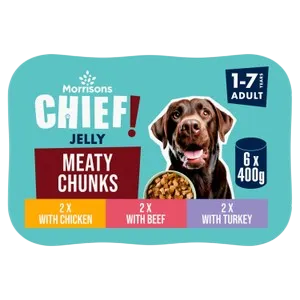
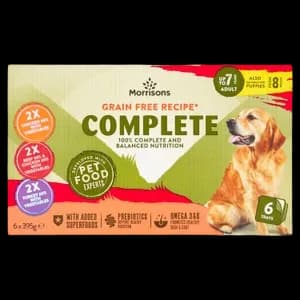
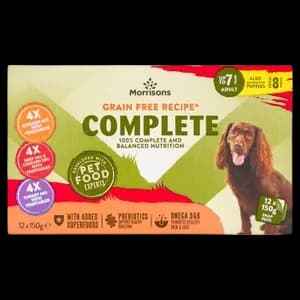
Morrisons Tins – Chunks In Jelly

Morrisons

Morrisons Tins: Chunks In Jelly review

31.7/100Average
WetAdult

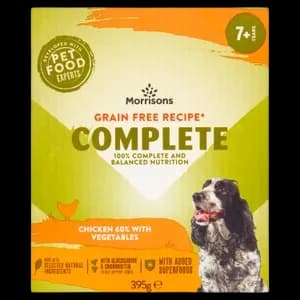
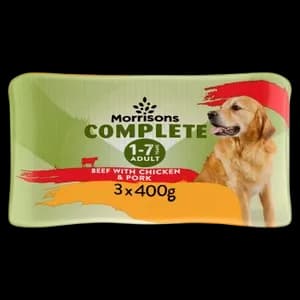
Morrisons Tins cover two everyday supermarket lines. One is chunks in jelly and one a smooth loaf, and each is sold under three flavour names. Both build their animal content from meat and animal derivatives, with only the headline species pinned down at 4%, and the jelly version adds unnamed cereals and various sugars behind it. Both land in our Average band. The modest animal content behind the label sets that placement, and there is nothing in the tin to be troubled by.

Where to buy: coming soon
Live retailer pricing is coming soon. Once we have prices from UK retailers, the best price, cost per day and where to buy will appear here.

Our view

Likely to suit

You do not need anything elaborate to feed a dog well, and this is about as unfussy as dinner gets.

  • Owners who buy dog food on the weekly shop and want something they can pick up alongside everything else
  • Dogs that have eaten supermarket tins for years without a moment's trouble and have no reason to change now
  • Households with a dog that drinks sparingly, since these tins are better than four fifths water by weight
  • Dogs that like a change of flavour name, with beef, chicken and turkey printed on both lines
  • Dogs of every size, as the jelly label prints a feeding figure from small dogs right up to the very largest

Worth watching

Before you buy, it helps to know what a label written in category terms leaves open.

  • Meat and animal derivatives does the heavy lifting on both tins, with only 4% tied to the named animal, so neither line can anchor an elimination diet
  • The cereals on the jelly labels are not named, and carbohydrate there converts to an estimated 37.9% of dry matter where the typical adult wet food runs at 15.8%
  • If you keep added sweetness out of your dog's bowl, various sugars sit on the jelly labels
  • Neither tin declares its calories, so the energy figures shown here are our own estimates

Written by our editorial team. Independent guidance, not veterinary advice.

How this scores

How we score
31.7/100Average
Protein and processingPoor
Nutritional balanceGood
TransparencyGood
ValueAverage

The Details

Dog fit

You do not need anything elaborate to feed a dog well, and this is about as unfussy as dinner gets. Before you buy, it helps to know what a label written in category terms leaves open.

Food type

Wet

Life stage

Adult

Breed size

Toy, Small, Medium, Large, Giant

Main protein

Chicken

The score, in context

Our scoring leaves both tins in the Average band, and the typical adult wet food reaches our Excellent band, so there is real distance between the two. Protein and processing reads Poor on the jelly and Average on the loaf, and that is the heart of it. A recipe written as meat and animal derivatives, cereals and various sugars leaves a scoring system very little named meat to reward, whatever the contents turn out to be. Transparency reads Good on both, and nutritional balance reads Good on the jelly and Outstanding on the loaf, so the analysis itself is sound rather than the problem. Dogs have been fed on tins like these for generations and done perfectly well on them, and nothing on this page says otherwise.

What's in it

Ingredients, as declared: With Beef - Meat and Animal Derivatives (33%, including 4% Beef), Cereals, Minerals, Various Sugars, With Chicken - Meat and Animal Derivatives (33%, including 4% Chicken), Cereals, Minerals, Various Sugars, With Turkey - Meat and Animal Derivatives (33%, including 4% Turkey), Cereals, Minerals, Various Sugars

Named ingredients

With Beef - Meat and Animal Derivatives (33%, including 4% Beef), Cereals, Minerals, Various Sugars, With Chicken - Meat and Animal Derivatives (33%, including 4% Chicken), Cereals, Minerals, Various Sugars, With Turkey - Meat and Animal Derivatives (33%, including 4% Turkey), Cereals, Minerals, Various Sugars
Ingredient notes

Meat and animal derivatives is a legal catch-all. It covers the fleshy parts and the processing by-products of warm-blooded land animals. That can be good muscle meat and organ, or it can be far plainer material. The maker is free to change what goes into it while the wording on the tin stays exactly the same. On the jelly tins that term carries 33% of the recipe with 4% named as beef, chicken or turkey. On the loaf it carries 60%, again with 4% named.

The loaf is the meatier of the two once the water is set aside. Its protein converts to 44.4% of dry matter and its fat to 36.1%, against 32.4% and 16.2% for the jelly, so it is both richer and more concentrated. Neither figure is out of the ordinary for a wet food, and the loaf in particular reads as a proper meat tin on the analysis alone.

The jelly tins list cereals without saying which, so wheat, maize, rice and barley are all possible and any of them can be swapped in between batches. Various sugars follow. Sugar goes into a tin for the taste, and a small amount will not upset a healthy dog. It does nothing nutritionally, and plenty of owners would rather not read it on a label. The loaf skips both. It keeps to the meat term and minerals, with rosemary at 0.02% acting as a natural antioxidant and not as seasoning.

Calcium on the jelly tins converts to 1.62% of dry matter, a comfortable level for adult maintenance. The loaf gives no calcium figure at all, which is the pattern across both labels: what is declared is declared thinly.

None of this makes the tins a worry. They are ordinary supermarket food built to a familiar shape, and the reason they read as they do here is that the label tells you so little about itself. If your dog is thriving on them, keep going. If you would rather read the recipe than take it on trust, that is the one thing this label cannot give you.

How this variety differs

Chunks in jelly, with the animal content at 33% and 4% of the tin named as beef, chicken or turkey depending on which label you pick up. Cereals and various sugars sit behind it, and the carbohydrate estimate of 37.9% of dry matter is much the higher of the two lines. At an estimated 71 kcal per 100g it is also the lighter tin, so portions run larger.

Price and value

The chunks in jelly are £1.88 a kilo, in a 400g tin sold six to a pack. The loaf is £1.69 a kilo, in the same 400g tin sold twelve to a pack.

For a 15kg adult dog in moderate condition, assume about 840 kcal a day (110 × bodyweight^0.75, the standard maintenance estimate). Feeding then works out at around £2.22 a day on the jelly and £1.64 a day on the loaf. That corresponds to roughly 1183 grams a day of the jelly or 968 grams of the loaf. Neither label declares its energy, so both of those weights rest on our own calorie estimates. The jelly label's own guide puts a 10 to 20 kg dog on 800 to 1600 grams a day.

Nutritional analysis

Declared analysis

Energy
71 kcal/100g

Estimated using Modified Atwater factors*

Protein

6%

Fat

3%

Fibre

0.5%

Ash

2%

Moisture

81.5%

Dry weight

Protein

32.4%

Fat

16.2%

Fibre

2.7%

Ash

10.8%

Carbs

37.9%

As-fed composition

Estimated breakdown of the finished product by ingredient category, from the declared ingredient list and ingoing weights. These are estimates, not measurements.

Meat

99%

Added water

0.6%

Carbs

0.3%

Other

0.1%

Pricing & size
Pack size
6 x 400g
Retailer pricing
Coming soon

Live retailer pricing is not yet available for this food. Prices, cost per day and where to buy will appear here once retailer data is live.

Ingredients and nutrition are taken from manufacturer data. Retailer pricing is not yet live for this food.

Related dog food guides

Ranked shortlists that include foods like this one.
All reviews

Featured feeding accessories

All feeding accessories

Brackenwood

Slow Feeder Maze Bowl

Slows fast eaters and eases gulping at mealtimes.

From £12.99· 4 retailers
View

Tarn & Co

Raised Double Diner

Height-set stand for easier, tidier eating.

From £28.99· 3 retailers
View

Reviewed by Off the Leash Editorial

Last updated 28 August 2026