



Happy Dog
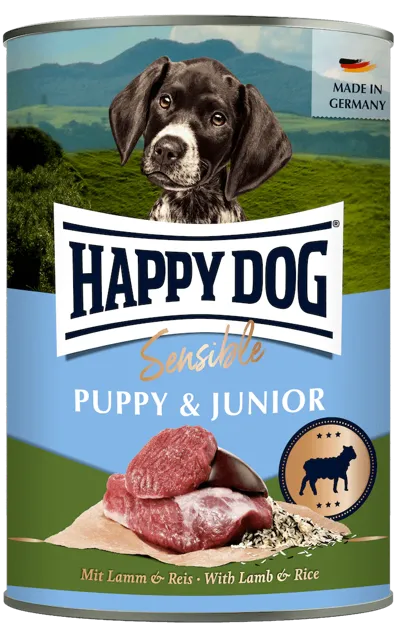
Happy Dog Puppy & Junior Wet: Lamb review
Happy Dog Puppy & Junior Wet is a two recipe growth line, and the pair differ more than their names suggest. Both are heavily meat based and almost free of starch, with protein converting to 45.9% and 48.2% of dry matter. Eggshell powder supplies the calcium in each, and a short botanical tail covers everything else. The salmon recipe itemises the meat it uses and the lamb recipe keeps that detail to itself, and both land in our Good band.
Our view
Likely to suit
If your pup eats better from a soft bowl than a dry one, both of these were built for that job.
- Growing dogs that want meat and not starch, with protein converting to 45.9% and 48.2% of dry matter across the two recipes
- Puppies who drink too little, since most of what a wet food weighs arrives in the bowl as water
- Owners topping up a kibble diet, where either recipe brings aroma and moisture to a meal that needs both
- Households that like a heart nutrient dosed in print, with taurine at 1000 mg and L-carnitine at 300 mg per kilo in both recipes
Worth watching
You will want a handful of things clear before either of these becomes the main meal.
- Calcium converts to 2.05% and 1.97% of dry matter, which large breed growth plans usually sit below, so check it against the feeding plan if your pup will grow big
- Salmon oil runs through both recipes, so neither can anchor a fish free elimination diet
Written by our editorial team. Independent guidance, not veterinary advice.
How this scores
How we scoreThe Details
Dog fit
If your pup eats better from a soft bowl than a dry one, both of these were built for that job. You will want a handful of things clear before either of these becomes the main meal.
Wet
Puppy
Toy, Small, Medium, Large, Giant
Lamb
The score, in context
There is less between these two than the two labels suggest. Both reach our Good band, a step below the typical wet puppy food in our Excellent band, which makes this a strong field to be measured in.
The gap between the pair is mostly about what the labels say, not about what is likely to be in the tin. The salmon label names the chicken parts it uses and declares its moisture; the lamb label does neither, and a buyer is left taking the meat on trust.
What's in it
Ingredients, as declared: Meat and animal derivatives (61 %, of which 8 % lamb), rice* (4 %), eggshell powder, psyllium husks*, mussel powder, canola oil, salmon oil, cellulose, chicory powder, yeasts* (extract), savory*, birch leaves*, camomile* *) dried
Named ingredients
Nutritional additives
Vitamins/kg: vitamin D3 (3a671)) 300 I.E., vitamin E (3a700i) 12 mg, vitamin B1 (3a821) 2,5 mg, L-carnitine (3a910) 300 mg, taurine (3a370) 1000 mg NB - When calculating Calcium Content, please use this formula to calculate calcium as a percentage on a dry matter basis: 1) 100% – % Moisture = % Dry Matter 2) [(As Fed Calcium %)/(% Dry Matter)] X 100%
Ingredient notes
Start with what the two share. Both are built almost entirely from meat, with the starch reduced to a token: rice at 4% in the lamb recipe, rice with potato at 2% in the salmon one. Carbohydrate converts to 2.3% and 6.2% of dry matter against 13.6% typical of a wet puppy food, which is genuinely lean for the category and the best thing about both labels.
The lamb recipe leads with meat and animal derivatives at 61%, of which 8% is declared as lamb. That leaves the great majority of the meat unattributed. The term covers everything from excellent material down to the ordinary, and plenty of good makers use it, but nothing on this pack lets a buyer tell which end of that range they are getting.
The salmon recipe is far more forthcoming. Its 53% of meat and animal by-products is itemised as chicken neck, meat, liver, heart and stomach, with salmon then added at 5%. Few things a dog can eat are as nutrient dense as liver, so seeing it named is welcome. It is worth being clear, though, that this is a chicken recipe with a salmon accent, not a fish dinner.
Eggshell powder supplies the calcium in both, and it supplies plenty: calcium converts to 2.05% of dry matter in the lamb recipe and 1.97% in the salmon one. A small or medium pup will put all of that to work. A large breed growth plan generally aims lower, and that is the reason for the note above.
Fat comes from canola oil and salmon oil in the lamb recipe and from chicken fat, rapeseed oil and salmon oil in the salmon one, converting to 39.1% and 34.2% of dry matter respectively. These are rich bowls by any measure, which suits growth but does mean portions want measuring rather than eyeballing.
The tail is short and sensible. Psyllium husk and chicory powder handle fibre and the prebiotic side, mussel powder and yeast extract sit behind them, and savory, birch leaves and chamomile provide the herb note. Cellulose sits alongside as bulk fibre, and crude fibre is declared at 0.4% in both.
The added panel is modest but well chosen. Taurine at 1000 mg per kilo and L-carnitine at 300 mg per kilo appear on both, with vitamin E at 12 mg and vitamin B1 at 2.5 mg. The lamb recipe adds vitamin D3 at 300 IU.
How this variety differs
The lamb recipe declares 61% meat and animal derivatives with 8% of that named as lamb, rice at 4%, and a panel of 10.1% protein, 8.6% fat, 0.4% crude fibre and 2.4% crude ash. No moisture is printed, so the dry matter conversions here rest on an assumed 78%: protein 45.9%, fat 39.1%, ash 10.9% and carbohydrate 2.3%. Calcium converts to 2.05% of dry matter and energy is estimated at 110 kcal per 100g. It lands in our Good band, and the unnamed meat is what keeps it from climbing higher.
Price and value
£9.97 a kilo for both recipes, sold as single 400g packs and in sixes.
Feeding a puppy is a moving target, never a fixed amount. Match the daily total to the growth chart for their age and for the adult size they will reach, then keep revising it as they fill out.
Nutritional analysis
Declared analysis
Estimated using Modified Atwater factors*
10.1%
8.6%
0.4%
2.4%
Dry weight
45.9%
39.1%
1.8%
10.9%
2.3%
As-fed composition
Estimated breakdown of the finished product by ingredient category, from the declared ingredient list and ingoing weights. These are estimates, not measurements.
64.5%
21%
4%
0.3%
1.7%
8.5%
Pricing & size
- Pack size
- 400g, 6 x 400g
- Retailer pricing
- Coming soon
Live retailer pricing is not yet available for this food. Prices, cost per day and where to buy will appear here once retailer data is live.
Ingredients and nutrition are taken from manufacturer data. Retailer pricing is not yet live for this food.
Related dog food guides
Ranked shortlists that include foods like this one.