



Green Pantry
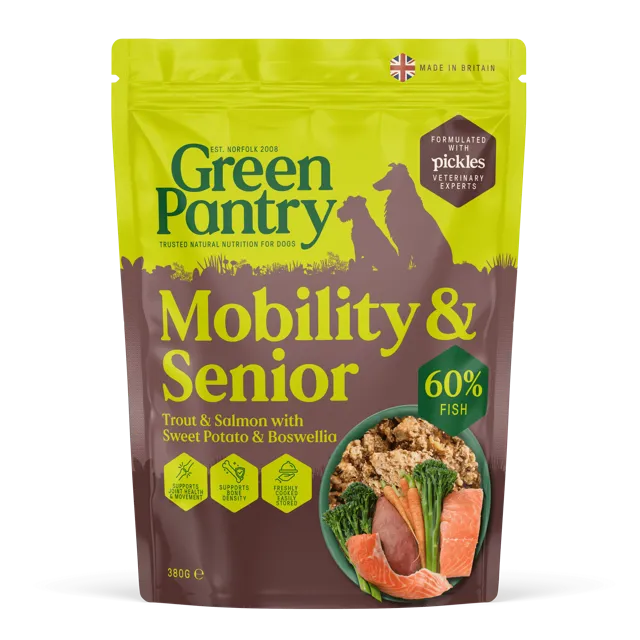
Green Pantry Fresh Food: Mobility & Senior review
Flavour
Green Pantry Fresh Food is a four-pouch range with a job written on each label: digestion, skin and coat, weight and ageing joints. Every recipe leads with a named animal at 60% or more and the vegetables behind it are printed with their own percentages. The pouches hold noticeably more food and less water than most wet food does. The Gut Health and the Mobility & Senior pouches reach our Excellent band, with the Skin & Coat and the Low Fat recipes a step behind them in Good.
Our view
Likely to suit
Pick the pouch by the thing you are trying to help with, because that is exactly how the range is arranged.
- Owners who want a food pointed at one job, with a separate recipe for digestion, for skin and coat, for weight and for older joints
- Owners who read percentages, since the named animal leads every recipe at 60% or more and the vegetables are weighed beside it
- Bigger dogs and busy ones, as these pouches run between 132 and 170 kcal per 100g where most wet food sits nearer 97
- Older dogs who are slowing down, with collagen peptides, turmeric and boswellia joining the joint ingredients in the Mobility & Senior pouch
- Dogs who need to lose a bit: the Low Fat pouch holds fat to 4.5% of the pouch and still declares white fish at 70%
- Dogs with unsettled digestion, as psyllium husks, slippery elm and fennel all appear on the Gut Health label
Worth watching
The labels are unusually detailed, and a few of the details are worth catching before you commit.
- If you are excluding one meat precisely, note that plasma is listed with no animal named against it
- The Low Allergen pouch carries oats and salmon oil, so gentle on the skin does not mean free of grain or of fish
- On the Low Fat and Mobility recipes, white fish is a description and not a species
- The trace minerals are chelated with protein hydrolysates on every label, another reason none of the four can anchor a strict elimination diet
- Joint support on the Mobility pouch is printed at 0.005% glucosamine and 0.0025% each of chondroitin and MSM, so it sits alongside a vet's own dosing and does not replace it
Written by our editorial team. Independent guidance, not veterinary advice.
How this scores
How we scoreThe Details
Dog fit
Pick the pouch by the thing you are trying to help with, because that is exactly how the range is arranged. The labels are unusually detailed, and a few of the details are worth catching before you commit.
Wet
Puppy, Adult, Senior
Toy, Small, Medium, Large, Giant
Salmon
The score, in context
Two of these pouches finish inside our Excellent band, the digestion recipe and the senior one, with the other two a step under them in Good. The middle of the wet shelf already sits in that same Excellent band, since the category scores well. Reaching it takes a pouch with most of its weight in named meat. Transparency reads Outstanding on all four recipes, and protein and processing, nutritional balance and value all sit between Good and Excellent, the profile of a range that does most things well and nothing eccentrically.
What holds the figures steady is the plant base. Carbohydrate converts to between 21.6% and 39.9% of dry matter across the four, where the typical adult wet food runs at 15.8%. These recipes carry more vegetable and more oat or rice than a straight meat and broth pouch. It is also why they are so dense. Moisture runs from 57.0% to 70.0%, under what most wet food declares, so a pouch goes further than its weight suggests.
What's in it
Ingredients, as declared: Salmon (29%), White Fish (19%), Carrots, Trout (12%), Broccoli, Sweet Potato, Beet Pulp, Minerals, Sunflower Oil, Psyllium Husks, Coconut Oil (0.24%), AuraGuard (calcium carbonate, citrus extract, maltodextrin, sodium chloride) (0.1%), Collagen Peptides (0.05%), Boswellia (0.05%), Turmeric (0.05%), Glucosamine (0.005%), Chondroitin sulphate (0.0025%), Methylsulphonylmethane (MSM) (0.0025%), Black Pepper. Botanicals & Herbs: Psyllium Husks,Turmeric (with black pepper) Coconut Oil. Functional Ingredients: AuraGuard, Collagen Peptides, Glucosamine, Chondroitin, MCT Oil, Plasma.
Named ingredients
Nutritional additives
Nutritional Additives (per kg): Vitamins: Vitamin A 2,500 IU, Vitamin E 20 IU; Trace Elements: Zinc (Zinc Chelate of Protein Hydrolysates) 35 mg, Manganese (Manganese Chelate of Protein Hydrolysates) 15 mg, Copper (Copper (II) Chelate of Protein Hydrolysates) 3 mg, Iodine (Calcium Iodate Anhydrous) 0.5 mg.
Ingredient notes
Each recipe opens with its animal and a printed share. Gut Health leads on turkey at 60%, Low Allergen on duck at 60%, Low Fat on white fish at 70%. Mobility takes three fish: salmon at 29%, white fish at 19% and trout at 12%. Protein converts to between 28.4% and 36.7% of dry matter, a solid meat-led reading for food fed from a pouch.
The vegetable side gets more attention here than most wet labels give it. Carrots run to 14% on the Gut Health pouch with pumpkin at 10% and sweet potato at 8.2%, and carrots reappear at 8% alongside brown rice at 10.8% on the Low Fat. Cooked carrots bring vitamin A, plus soluble fibre and antioxidants. Beet pulp and psyllium husks add the steady, gentle fibre that most dogs digest without fuss.
Cellulose appears on three of the labels. Purified plant fibre is what it is, and it does not behave like the fibre in whole vegetables. It earns its place by adding bulk without calories. A weight recipe wants exactly that. Recognise it for what it is, a processed fibre supplement, and do not read it as another vegetable.
AuraGuard turns up on all four labels at 0.1% and is unusual in printing its own components, calcium carbonate with citrus extract, maltodextrin and sodium chloride. Plasma sits near it on three lists without naming its animal. The botanicals then change with the job. Slippery elm and fennel sit on the Gut Health pouch, nettle and chamomile on the Low Allergen. Ginger goes in the weight recipe, and turmeric with black pepper on the Mobility. These are all trace level, and none of them is why you would buy the food.
The added panel is dosed on every label, with zinc, manganese, copper and iodine given as chelates and figures printed beside each. Two of the four panels print vitamin D3. The other two list vitamins A and E alone, and there the otherwise thorough labels go quiet.
How this variety differs
Salmon at 29%, white fish at 19% and trout at 12% make this the only recipe built entirely on fish, closed by collagen peptides, boswellia, turmeric and the joint ingredients. Broccoli and coconut oil at 0.24% fill it out. Two recipes here reach our Excellent band, and this is one of them.
Price and value
£9.65 a kilo, the same figure across all four recipes, sold as a single pouch and in larger packs.
As a guide we start from about 840 kcal a day for a 15kg adult dog in moderate condition (110 × bodyweight^0.75, the standard maintenance estimate). Feeding then works out at between £4.75 and £6.15 a day depending on the recipe. That corresponds to roughly 493 to 637 grams a day. The label's own guide for a dog of 11 to 20 kg runs from 460 to 916 grams a day across the four.
Nutritional analysis
Declared analysis
11%
8%
1%
3.5%
70%
Dry weight
36.7%
26.7%
3.3%
11.7%
21.6%
As-fed composition
Estimated breakdown of the finished product by ingredient category, from the declared ingredient list and ingoing weights. These are estimates, not measurements.
60%
23.7%
5.4%
9.1%
0.7%
1.2%
Pricing & size
- Pack size
- 1 Pouch · 8 Pouch · 24 Pouch
- Retailer pricing
- Coming soon
Live retailer pricing is not yet available for this food. Prices, cost per day and where to buy will appear here once retailer data is live.
Ingredients and nutrition are taken from manufacturer data. Retailer pricing is not yet live for this food.
Related dog food guides
Ranked shortlists that include foods like this one.