
Skip to content
Off the Leash
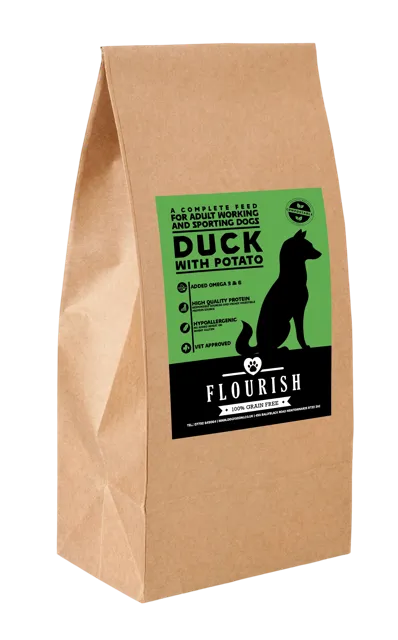
Flourish Grain Free Working and Sporting Dog – Duck and Potato (Hypoallergenic)

Flourish

Flourish Grain Free Working and Sporting Dog: Duck and Potato (Hypoallergenic) review

61/100Good
DryAdult

Flourish Grain Free Working and Sporting Dog is a four protein range for dogs that earn their dinner. Three of the four are built the same way, with half the bag declared as one named animal, the fresh and dried shares printed, and sweet potato, potato and peas underneath. The duck is the outlier, put together to its own plan around potato. Readings run from Good up to Excellent, with the beef the strongest of the four.

Where to buy: coming soon
Live retailer pricing is coming soon. Once we have prices from UK retailers, the best price, cost per day and where to buy will appear here.

Our view

Likely to suit

Whether your dog works a full day outdoors or simply never stops moving, there is a protein here that will keep up.

  • Working and sporting dogs, since every recipe in the range is built for output
  • Rotation feeders, with four named animals on one shelf and three of them sharing a single construction
  • Dogs kept off cereal, since all four recipes take their starch from sweet potato, potato and peas
  • Owners who want the animal named, as each recipe pins its meat to a species rather than a category
  • Dogs who find it hard to keep condition on, since energy runs from 350 to 375 kcal per 100g across the four

Worth watching

The four are not interchangeable, and a few differences matter when you pick one.

  • The omega 3 supplement in the beef and turkey recipes goes unsourced, so neither is a guaranteed fish free bowl
  • All four labels cover adults only, so a growing puppy needs a recipe written for growth
  • These are energy dense recipes, so portions want pulling back in a week when the work stops

Written by our editorial team. Independent guidance, not veterinary advice.

How this scores

How we score
61/100Good
Protein and processingAverage
Nutritional balanceAverage
TransparencyOutstanding
ValueGood

The Details

Dog fit

Whether your dog works a full day outdoors or simply never stops moving, there is a protein here that will keep up. The four are not interchangeable, and a few differences matter when you pick one.

Food type

Dry

Life stage

Adult

Breed size

Toy, Small, Medium, Large, Giant

Main protein

Duck

The score, in context

The four do not finish level. The beef reads Excellent. The turkey, the salmon and the duck all read Good, the exact position of the middle of the adult dry category. Nothing in that spread should put you off any of them, because the whole range sits level with the category average at the very least and the beef climbs a band clear of it.

The pattern is readable straight off the labels. The three that declare half the bag as one named animal finish higher, and each of them prints the fresh and dried shares separately. The duck declares 36% and hands the rest of the bowl to potato at 31%, which is why it settles where it does. The salmon sits a shade under the turkey partly on a shorter declared trace element panel, printing zinc, iron, manganese and iodine where the beef and the turkey also print copper and selenium.

What's in it

Ingredients, as declared: Duck 36% (Including Dried Duck 27%, Duck Fat 7% & Duck Gravy 2%), Potato (31%), Peas, Beet Pulp (7%), Brewer's Yeast, Linseed, Minerals, Vitamins

Named ingredients

Duck 36% (Including Dried Duck 27%, Duck Fat 7% & Duck Gravy 2%), Potato (31%), Peas, Beet Pulp (7%), Brewer's Yeast, Linseed, Minerals, Vitamins

Nutritional additives

_(label panel "NUTRITIONAL ADDITIVES (PER KG)")_: Vitamins: Vitamin A 14,400 IU, Vitamin D3 1,925 IU, Biotin 145 mcg. Trace Elements: Iron (Iron (II) Sulphate Monohydrate) 50 mg, Zinc (Zinc Sulphate Monohydrate) 50 mg, Manganese (Manganous Sulphate Monohydrate) 35 mg, Copper (Copper (II) Sulphate Pentahydrate) 12 mg, Iodine (Calcium Iodate Anhydrous) 1 mg, Selenium (Sodium Selenite) 0.19 mg

Ingredient notes

The beef, salmon and turkey recipes share a shape. Each declares 50% of the bag as its named animal and prints the split. The beef reads 28% freshly prepared Angus beef with 19% dried beef and 3% beef fat. The turkey is 28% fresh with 20% dried and 2% stock, and the salmon and trout 36% fresh with 12% dried salmon and 2% stock. Fresh meat goes in wet and comes out of the oven a good deal lighter. So in each recipe the dried share counts for more in the finished bag than the list order lets on.

The duck is assembled differently. Duck is declared at 36%: dried duck at 27%, duck fat at 7% and duck gravy at 2%. Its meat therefore arrives almost entirely pre-dried, and none of it shrinks in the oven. Potato at 31% then does the job sweet potato does elsewhere, with brewer's yeast adding B vitamins and a little protein. No unnamed omega supplement appears on this label. Duck is therefore the one animal on its whole list.

Across the range the plant side is the same short handful: sweet potato, potato, peas and beet pulp, with linseed for plant omega 3. Not one of the four lists carries wheat, rice or maize.

Working recipes need to be dense, and these are. Fat runs from 12.0% of dry matter in the duck, salmon and turkey up to 14.1% in the beef, and protein from 28.3% to 31.5%. A dog in real work can hold condition on a sensible bowl. The carbohydrate estimate runs 43.5% to 48.2% of dry matter, against the 46.2% typical of adult dry food.

The small print is where the range is both generous and vague. FOS at 96 mg/kg and MOS at 24 mg/kg are dosed in three of the four, and the added minerals carry figures line by line. The fruit and vegetable entries are frankly trace, with carrot below 0.1% in the beef, cranberry at 0.3% in the turkey and asparagus at 0.3% in the salmon. The omega 3 supplement in the beef, salmon and turkey is the single entry with no source given, and on the salmon that hardly matters since the recipe is fish already.

How this variety differs

The odd one out, and deliberately so. Duck is declared at 36% and arrives almost entirely as dried duck at 27%, with duck fat at 7% and duck gravy at 2% behind it, and potato at 31% instead of sweet potato. Brewer's yeast brings B vitamins, and duck is the sole animal on the list. That makes this the recipe to reach for if you are steering a dog away from the commoner birds.

Price and value

£4.79 a kilo across all four recipes. The beef, salmon and turkey come in a 15kg bag and the duck in a 12kg bag, and some bag artwork still shows the previous 12kg pack for the three larger ones.

As a guide, a 15kg adult dog in moderate condition works through 224 to 240 grams a day depending on the recipe, landing between £1.07 and £1.15 a day. Those figures assume about 840 kcal a day, the standard maintenance estimate of 110 × bodyweight^0.75. Real work will push a dog's need above that.

Nutritional analysis

Declared analysis

Energy
350 kcal/100g
Protein

26%

Fat

11%

Fibre

4%

Ash

8%

Moisture

8%

Dry weight

Protein

28.3%

Fat

12%

Fibre

4.3%

Ash

8.7%

Carbs

46.7%

As-fed composition

Estimated breakdown of the finished product by ingredient category, from the declared ingredient list and ingoing weights. These are estimates, not measurements.

Meat

29%

Added water

7%

Carbs

52.7%

Other

11.3%

Pricing & size
Pack size
12 kg
Retailer pricing
Coming soon

Live retailer pricing is not yet available for this food. Prices, cost per day and where to buy will appear here once retailer data is live.

Ingredients and nutrition are taken from manufacturer data. Retailer pricing is not yet live for this food.

Related dog food guides

Ranked shortlists that include foods like this one.

All reviews
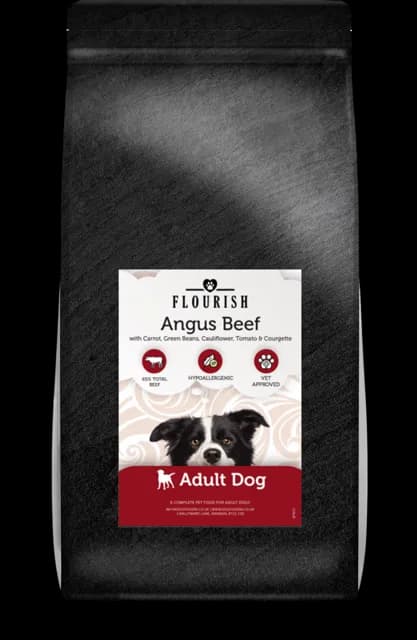
Flourish Adult – Angus Beef
80/100Outstanding
4 varieties
Flourish

Adult

DryAdult · SeniorSingle protein
View review

Featured feeding accessories

All feeding accessories

Brackenwood

Slow Feeder Maze Bowl

Slows fast eaters and eases gulping at mealtimes.

From £12.99· 4 retailers
View

Tarn & Co

Raised Double Diner

Height-set stand for easier, tidier eating.

From £28.99· 3 retailers
View

Reviewed by Off the Leash Editorial

Last updated 28 August 2026