




Feedwell
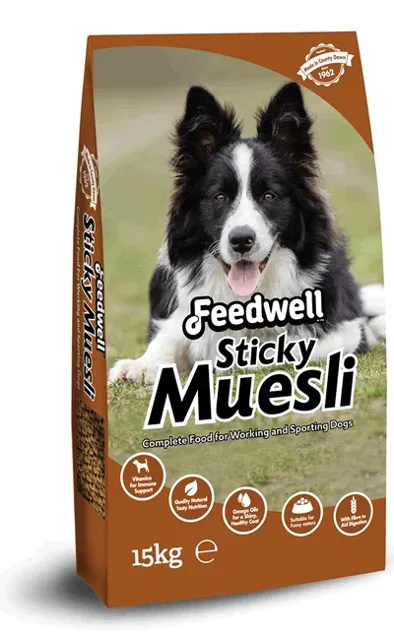
Feedwell Muesli review
Feedwell Muesli is a plain, old fashioned British kibble built from four broad categories rather than a named list. Protein is declared at 18% and fat at only 6%, which makes it one of the lighter adult foods you will come across, and every vitamin and mineral dose is printed. It sits in our Poor band because the label pins down so little, and nothing in the bag is the reason. For a steady adult dog on a simple routine it feeds perfectly happily.
Our view
Likely to suit
If your dog does best on a light, uncomplicated bowl, this is about as uncomplicated as dry food gets.
- Adult dogs living a gentle routine, with fat declared at 6% and protein at 18%
- Owners watching a waistline that has crept up, since the bowl can stay a decent size while the fat stays low
- Households where a toy breed and a giant eat side by side, because this label covers both ends
- Dogs kept away from fish, because nothing marine is declared anywhere on this list
Worth watching
Before you buy your first bag, it helps to know what the label leaves out.
- A suspected meat sensitivity has nothing to work with here, since the meat is named as a family and not as a species
- Cereals are grouped in the same broad way, which means the grain inside can change from batch to batch without the pack changing
- Ash and moisture are missing from the analysis, so the label cannot be converted onto a dry matter basis for comparison
- Protein at 18% is on the light side for a hard working dog, so a busy spaniel will get through a lot of bowl
Written by our editorial team. Independent guidance, not veterinary advice.
How this scores
How we scoreThe Details
Dog fit
If your dog does best on a light, uncomplicated bowl, this is about as uncomplicated as dry food gets. Before you buy your first bag, it helps to know what the label leaves out.
Dry
Adult
Toy, Small, Medium, Large, Giant
The score, in context
This one comes out in our Poor band, some way below the Good band where the typical adult dry food settles. Nearly the whole gap is down to what the label declines to spell out. Four broad categories carry the whole recipe, no species is named anywhere, and with ash and moisture absent there is no way to put the analysis onto a dry matter footing. Energy has to be estimated too. It comes out around 314 kcal per 100 grams, against 357 for the typical adult dry food. That makes it a genuinely light kibble. Fed to an adult dog with ordinary needs, it does the job it was made for. Protein and processing reads Poor and so does transparency, for the same reason the band does: naming, not nutrition.
What's in it
Ingredients, as declared: Cereals and Cereal derivatives, Meat and Meat derivatives, Oils, Fats and Minerals.
Named ingredients
Nutritional additives
Nutritional Additives: Vitamin A: 10,000IU/kg, Vitamin D: 1,500IU/kg, Vitamin E: 80mg/kg, Ferrous Sulphate, Monohydrate: 333mg/kg, Cupric Sulphate Monohydrate 16mg/kg, Manganous Oxide: 80.64mg/kg, Zinc Oxide: 14mg/kg, Sodium Selenite: 2.2mg/kg
Ingredient notes
The whole recipe is four entries long: cereals and cereal derivatives, meat and meat derivatives, oils and fats, and minerals. Umbrella terms like these are not proof of poor ingredients, and plenty of long standing British mills have used them for recipes that fed working dogs for decades. What they take away is knowledge. You cannot tell which grain, which animal or which fat you are buying, and the mill stays free to move between sources as supply changes.
Meat and meat derivatives is the entry owners ask about most. Derivatives covers the parts of the carcass we do not eat ourselves, offal above all. Offal is nutritious in its own right. The catch is the one above: with no species attached, a dog known to react to one animal cannot reliably be kept clear of it here.
The analysis reads light all the way through. Protein at 18%, fat at 6% and fibre at 3.5% describe a gentle, low fat food. The pack's own guide reflects that, asking 250 to 350 grams a day for a dog between 12kg and 25kg. That is a generous looking bowl, which owners of steady, food focused dogs often actively want.
Doses are attached to the added vitamins and minerals, and plenty of labels manage no such thing. Vitamin A is declared in full, vitamin D at 1,500 IU per kilo and vitamin E at 80 mg. Iron is at 333 mg, manganese at 80.64 mg, copper at 16 mg, zinc at 14 mg and sodium selenite at 2.2 mg. Two small notes on form. The zinc goes in as zinc oxide, and a dog takes that up less readily than the chelated forms other labels use. Of the two selenium sources permitted in the EU, sodium selenite is the commoner one. Both are entirely standard and both are working at everyday inclusion levels.
Price and value
£1.33 a kilo, sold in a single 15kg bag.
A 15kg adult dog in moderate condition works through roughly 268 grams a day on the standard maintenance estimate of about 840 kcal (110 × bodyweight^0.75), which puts feeding at around £0.36 a day. For a dog of that weight the pack's own table asks 250 to 350 grams. The waistline is the better guide when they differ.
Nutritional analysis
Declared analysis
Estimated using Modified Atwater factors*
18%
6%
3.5%
Dry weight
19.6%
6.5%
3.8%
As-fed composition
Estimated breakdown of the finished product by ingredient category, from the declared ingredient list and ingoing weights. These are estimates, not measurements.
32.5%
50%
17.4%
Pricing & size
- Pack size
- 15kg (£19.99)
- Retailer pricing
- Coming soon
Live retailer pricing is not yet available for this food. Prices, cost per day and where to buy will appear here once retailer data is live.
Ingredients and nutrition are taken from manufacturer data. Retailer pricing is not yet live for this food.
Related dog food guides
Ranked shortlists that include foods like this one.