



Feedwell
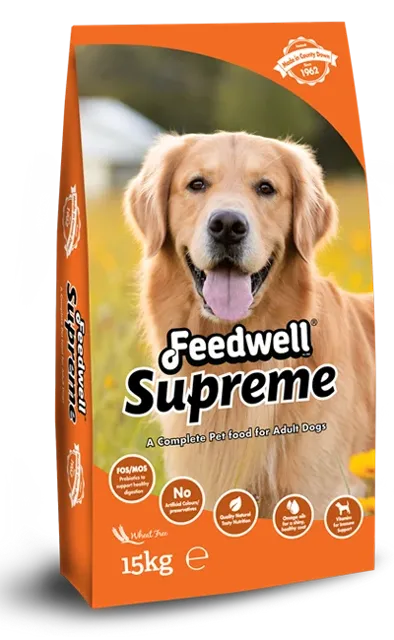
Feedwell Supreme review
Feedwell Supreme swaps the vague grain of its stablemates for whole maize, named outright, and pairs it with meat meal and soya oil. It is also the one recipe in the family to declare ash and moisture, so the pack can be read properly. Protein is 23.5% as fed and 25.5% once the water is out, with carbohydrate estimated at 50.0% of dry matter. It sits in our Average band, mainly because the animal side stays anonymous, and it remains a straightforward everyday bag for an adult dog with no particular grain worries.
Our view
Likely to suit
If you like knowing exactly what the starch in your dog's bowl is, this label at least tells you.
- Adult dogs that get on well with maize, which this label names outright
- Owners who like to do the dry matter sums, since ash at 10% and moisture at 8% are both declared
- Owners of larger adult dogs, since the feeding guide runs from small breeds all the way past 35kg
- Dogs that settle best on one unchanging recipe, this one being short enough to stay the same bag after bag
Worth watching
Some details are worth a look before you order a big sack.
- Meat meal carries no species, so a dog being kept off one particular animal cannot be managed on this food
- Maize being named helps, but a dog that reacts to maize has nowhere to hide in a recipe led by it
- Carbohydrate is estimated at 50.0% of dry matter against 46.2% for the typical adult dry food, so starch is doing plenty of the work
- Ash converts to 10.9% of dry matter, the usual sign that meat meal brings bone along with its protein
Written by our editorial team. Independent guidance, not veterinary advice.
How this scores
How we scoreThe Details
Dog fit
If you like knowing exactly what the starch in your dog's bowl is, this label at least tells you. Some details are worth a look before you order a big sack.
Dry
Adult
Toy, Small, Medium, Large, Giant
The score, in context
Set against an adult dry food of ordinary make, which we place in the Good band, this one comes out in our Average band. The declared analysis is not what causes that. Protein converts to 25.5% of dry matter and fat to 9.8%, both perfectly normal for a maize based kibble. The weight falls on the animal entry instead: meat meal with no species attached, sitting second behind a grain, with estimated carbohydrate at half the dry matter. Protein and processing reads Poor and so does nutritional balance, with transparency Good alongside them. The fair translation is that the label tells you very little about the meat, and no harm is being done to your dog.
What's in it
Ingredients, as declared: Whole maize, meat meal, soya oil, vitamins and minerals
Named ingredients
Nutritional additives
Nutritional Additives: Vitamin A: 10,000IU/kg, Vitamin D: 1,500IU/kg, Vitamin E: 80mg/kg, Ferrous Sulphate, Monohydrate: 333mg/kg, Cupric Sulphate Monohydrate 16mg/kg, Manganous Oxide: 80.64mg/kg, Zinc Oxide: 14mg/kg, Sodium Selenite: 2.2mg/kg.
Ingredient notes
Whole maize leads, and naming it is a genuine courtesy from a mill whose other bags say cereal and leave it there. Maize is a dense energy grain that cooks well into kibble and brings natural antioxidants with it, and using the whole grain keeps its fibre in the mix. Maize is also among the grains most often suspected in a dog that reacts to its food. That matters here, because the starch has nowhere else to come from.
Second on the list is meat meal, the dried, rendered concentrate supplying most of the animal protein in the finished kibble. Per kilo it is far more protein dense than fresh meat, which is how a recipe this short reaches 23.5% protein. It brings bone with it as well, and the declared ash of 10% is the visible sign of that.
Soya oil provides the fat at 9%, an omega 6 rich plant oil rather than a rendered animal fat, and no marine oil appears anywhere on the list. Vitamins and minerals close the recipe out with doses printed. Vitamin A is given its own figure, vitamin D is at 1,500 IU and vitamin E at 80 mg. Iron follows at 333 mg, manganese at 80.64 mg, copper at 16 mg, zinc oxide at 14 mg and sodium selenite at 2.2 mg per kilo.
Because moisture is declared at 8%, this pack can be read on a dry matter basis, which is the only fair way to line two foods up. Protein lands at 25.5%, fat at 9.8%, fibre at 3.8% and estimated carbohydrate at 50.0%, next to 46.2% for the typical adult dry food. Energy is estimated at 320 kcal per 100 grams, a shade under the 357 typical, so bowls come out on the larger side.
Price and value
£1.43 a kilo. Bags come in 2.5kg, 8kg and 15kg, with the 2.5kg also sold five to a pack.
Take a 15kg adult in moderate condition needing about 840 kcal a day, the standard maintenance estimate of 110 × bodyweight^0.75, and the bowl works out at around 263 grams, or roughly £0.38 a day. For a dog that size the label suggests 250 to 350 grams. Where the two disagree, trust the waistline.
Nutritional analysis
Declared analysis
Estimated using Modified Atwater factors*
23.5%
9%
3.5%
10%
8%
Dry weight
25.5%
9.8%
3.8%
10.9%
50%
As-fed composition
Estimated breakdown of the finished product by ingredient category, from the declared ingredient list and ingoing weights. These are estimates, not measurements.
32.5%
50%
10.6%
6.9%
Pricing & size
- Pack size
- 2.5kg (£5.15) · 8kg (£13.50) · 5 x 2.5kg (£25.75) · 15kg (£21.50)
- Retailer pricing
- Coming soon
Live retailer pricing is not yet available for this food. Prices, cost per day and where to buy will appear here once retailer data is live.
Ingredients and nutrition are taken from manufacturer data. Retailer pricing is not yet live for this food.
Related dog food guides
Ranked shortlists that include foods like this one.