



Feedwell
Feedwell Sport review
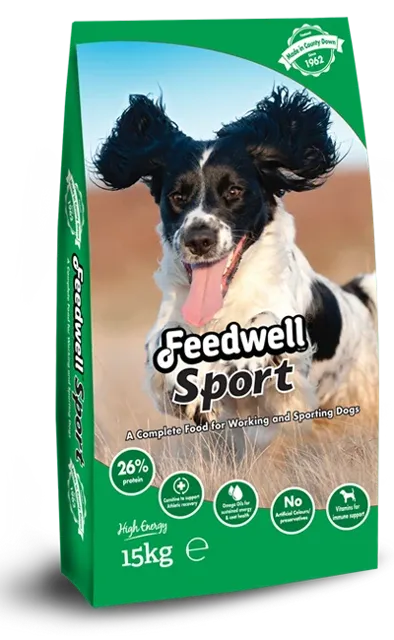
Feedwell Sport is a traditional working dog kibble: whole cereal, meat meal, soya oil, vitamins and minerals, and nothing else on the list. Protein is declared at 26% and fat at 9%, so it is put together to carry a dog through a busy day. It sits in our Average band, held there by a label that names neither the grain nor the animal, while the analysis on the pack reads perfectly respectably for an active adult.
Our view
Likely to suit
For a dog that lives outdoors and eats like it, this is the sort of no nonsense bag that has kept working kennels going for generations.
- Working and sporting adult dogs, with protein declared at 26% to feed the muscle they use
- Owners with a mixed pack to feed, because a single recipe covers toy dogs and giants alike
- The dog who has eaten cereal and meat meal all its life and sees no reason to change
- Households avoiding fish, as no marine ingredient is declared anywhere on this label
Worth watching
A list this short has its honest limits, and they are better known up front.
- Whole cereal names no grain in particular, so a dog with a wheat or maize problem cannot be steered clear with any confidence
- Meat meal names no species either, which rules the food out as the base of an elimination trial
- Soya oil is declared, so a household keeping soya out in every form will want to know it is in the bag
- Ash and moisture are left off the pack, so the analysis has to stand as fed, with no dry matter basis available
- Fat at 9% is moderate for a genuinely hard running dog, so a heavy week of work may call for bigger portions
Written by our editorial team. Independent guidance, not veterinary advice.
How this scores
How we scoreThe Details
Dog fit
For a dog that lives outdoors and eats like it, this is the sort of no nonsense bag that has kept working kennels going for generations. A list this short has its honest limits, and they are better known up front.
Dry
Adult
Toy, Small, Medium, Large, Giant
The score, in context
Our Average band is where the reading finishes, a step under the Good band that the typical adult dry food occupies. The pillars separate the story neatly. Protein and processing comes out Poor because nothing on the list is named, while the printed 26% protein and 9% fat make for a perfectly workmanlike analysis. In other words the recipe is unspecific, and there is nothing thin about it. A dog in regular work will eat it happily and do well on it, and the band is describing the label rather than the bowl.
What's in it
Ingredients, as declared: Whole Cereal, Meat Meal, Soya Oil, Vitamins and Minerals
Named ingredients
Nutritional additives
Nutritional Additives: Vitamin A: 10,000|U/Kg, Vitamin D:1,500|U/kgVitamin E:80mg/kg, Ferrous Sulphate, Monohydrate: 333mg/kg, Cupric sulphateMonohydrates 16mg/kg, Manganous Oxide: 80.64mg/kg, Zinc Oxide: 14mg/kg, Sodium Selenite: 2.2mg/kg.
Ingredient notes
Meat meal is the backbone of this recipe and of a great many British dry foods. It is a dried, rendered concentrate of animal material, and because the water has already gone it carries far more protein per kilo than fresh meat manages once a kibble has been through the oven. That is how a four line list still declares 26% protein. The frustration is the missing species, since meat meal from chicken and meat meal from lamb look identical in print.
Whole cereal sits first, which tells you grain does most of the carrying and not a great deal more. The term stretches from excellent whole grains down to the plainest of them, and it leaves the mill free to follow the harvest between them. Whole is at least a useful word, since it suggests the grain goes in intact.
The fat comes from soya oil. It is a plant oil rich in omega 6, pressed rather than rendered, and it is not the soya protein or soya meal that gets debated as a stand in for meat. Worth being straight about it all the same, because a diet being kept free of soya in every form has soya in this bag.
The panel reads 26% protein, 9% fat and 3.5% fibre, with energy estimated at 328 kcal per 100 grams where the typical adult dry food runs at 357. Ash and moisture go undeclared, so a dry matter conversion is off the table. The supplement side is fully dosed in print. There is a declared vitamin A figure and vitamin D at 1,500 IU per kilo, then vitamin E at 80 mg, iron at 333 mg, manganese at 80.64 mg and copper at 16 mg. Zinc oxide comes in at 14 mg and sodium selenite at 2.2 mg.
Price and value
£1.27 a kilo, sold in a 15kg bag.
Feeding a 15kg adult in moderate condition means roughly 256 grams daily, taking the usual maintenance estimate of around 840 kcal (110 × bodyweight^0.75), and that lands at about £0.32 a day. The pack asks 250 to 350 grams for dogs between 12kg and 25kg, close enough that the waistline can settle it.
Nutritional analysis
Declared analysis
Estimated using Modified Atwater factors*
26%
9%
3.5%
Dry weight
28.3%
9.8%
3.8%
As-fed composition
Estimated breakdown of the finished product by ingredient category, from the declared ingredient list and ingoing weights. These are estimates, not measurements.
32.5%
50%
10.6%
6.9%
Pricing & size
- Pack size
- 15kg (£18.99)
- Retailer pricing
- Coming soon
Live retailer pricing is not yet available for this food. Prices, cost per day and where to buy will appear here once retailer data is live.
Ingredients and nutrition are taken from manufacturer data. Retailer pricing is not yet live for this food.
Related dog food guides
Ranked shortlists that include foods like this one.