



Europa
Europa Extra Sensitive Care: Skin & Coat Care review
Europa Extra Sensitive Care is a three recipe shelf built around hydrolysed protein. The meat or fish is broken into pieces small enough that a touchy immune system often fails to spot them. Each recipe then takes a different job: digestion, skin and coat, or weight alongside joints. All three keep the animal side narrow and quantify their functional extras, with two of them landing in our Good band and the weight recipe a step behind in Average.
Our view
Likely to suit
When a dog reacts to almost everything you put down, the useful move is to make the protein itself harder to recognise, and that is what this shelf is doing.
- Dogs with an itchy or unsettled history, since the animal protein in all three recipes is hydrolysed
- Owners working through an intolerance with their vet, with one turkey recipe and two fish recipes to move between
- A dog whose digestion needs steadying, with dried yeast and lignocellulose added to the turkey recipe for exactly that
- Dogs carrying extra weight and stiff joints at the same time, which the white fish recipe answers with 9% fat, 9.2% fibre and green lipped mussel
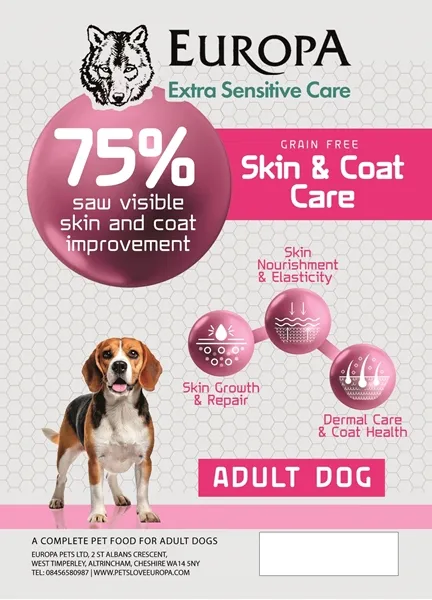
- Owners feeding for coat condition, with salmon oil, borage oil and marine algae in the skin and coat bag
Worth watching
A few label details matter more than usual on a shelf built for sensitive dogs.
- Hydrolysed protein is only as useful as the narrowness around it, and the skin and coat recipe pairs salmon with an unnamed white fish while the weight recipe leaves its white fish unnamed too
- Soya oil appears in the skin and coat recipe, which puts soya on its allergen reading, worth noting if soya is off the list for your dog
- Pea protein carries part of the protein figure in two of the three recipes, so not all of it is animal in origin
- Lignocellulose is purified plant fibre and not the sort that comes with a whole vegetable, doing a bulking job in the digestive and the weight recipes
Written by our editorial team. Independent guidance, not veterinary advice.
How this scores
How we scoreThe Details
Dog fit
When a dog reacts to almost everything you put down, the useful move is to make the protein itself harder to recognise, and that is what this shelf is doing. A few label details matter more than usual on a shelf built for sensitive dogs.
Dry
Adult
Toy, Small, Medium, Large, Giant
Salmon
The score, in context
The digestive and the skin and coat recipes finish in our Good band, level with where adult dry food typically settles, and the weight recipe stops a step behind in Average. The scoring rewards what a careful reader would reward: named animal shares at the top of every list, a dosed mineral panel and functional extras that are quantified instead of hinted at. The digestive recipe reads Average on protein and processing and on nutritional balance, largely because turkey fat at 9% and pea protein take up room a whole meat would otherwise fill. None of that changes what the shelf is for, which is a dog whose ordinary dinner keeps letting it down.
What's in it
Ingredients, as declared: Freshly Prepared Hydrolysed Salmon (35%), Potato, Sweet Potato, Hydrolysed Dried White Fish (14%), Salmon Oil (4%), Beet Pulp, Soya Oil (3%), Hydrolysed Salmon Gravy (2.5%), Minerals, Dried Algae (Schizochytrium sp.) (0.2%), Borage Oil (0.2%), Marigold (Source of Lutein)
Named ingredients
Nutritional additives
Vitamins: Vitamin A 14,423 IU, Vitamin D3 2,000 IU, Vitamin E 96 IU; Trace Elements: Zinc (Zinc Sulphate Monohydrate) 69mg, Iron (Iron II Sulphate Monohydrate) 48mg, Manganese (Manganese Sulphate Monohydrate) 34mg, Copper (Copper II Sulphate Pentahydrate) 10mg, Iodine (Calcium Iodate Anhydrous & Potassium Iodide) 1.33mg
Ingredient notes
Hydrolysis is the idea holding these three together. Breaking a protein into short fragments makes it far less likely to set off a reaction. That is why hydrolysed recipes are the ones reached for when a dog has already failed on the obvious meats. Europa hydrolyses both the fresh and the dried animal entries and the gravy too, so the treatment runs right through rather than sitting on the headline ingredient alone.
The animal shares are printed properly. The digestive recipe declares 26% freshly prepared hydrolysed turkey and 11.5% hydrolysed dried turkey. The skin and coat recipe declares 35% salmon and 14% dried white fish, and the weight recipe 26% white fish and 11.5% dried white fish. Protein converts to 27.2% of dry matter on the first two and 31.5% on the weight recipe, which is the highest of the three despite being the leanest on fat.
The starch in all three comes from potato and sweet potato, with no cereal on any of the three lists. Estimated carbohydrate lands at 44.1%, 45.6% and 41.9% of dry matter respectively, against 46.2% for the typical adult dry food. None of them leans on the plant side more than a dry food normally does.
The fats are chosen for the job in front of them. The digestive recipe uses 9% turkey fat, keeping the animal source consistent with its protein. The skin and coat recipe builds its case on 4% salmon oil, 3% soya oil, marine algae at 0.2% and borage oil at 0.2%. That combination is well judged. Algae supplies the long-chain omega 3s ready made, with no conversion asked of the dog, and borage oil carries plenty of the gamma-linolenic acid that skin work leans on. The weight recipe carries 5.5% salmon oil.
Fibre is doing deliberate work here, not filling space. Lignocellulose is a purified plant fibre. It comes as a pale powder that looks nothing like a vegetable, and it adds bulk with next to no energy attached. At 2.5% in the digestive recipe it helps stools hold their shape. At 5.5% in the weight recipe, alongside 4% beet pulp and 4% pea fibre, it is what lets a dieting dog finish a full bowl and stop asking. Fibre reaches 9.2% of dry matter there.
The extras are small and specific. Dried yeast at 0.7% supports the gut flora in the digestive recipe, and marigold appears on all three as a lutein source. Green lipped mussel at 0.3% brings the joint side of the weight recipe, and L-carnitine is dosed at 1,442 mg/kg to help fat metabolism along. Trace minerals are printed in full on every label, with zinc running from 48 to 69 mg/kg and iron steady at 48 mg/kg.
How this variety differs
Salmon leads at 35% freshly prepared and hydrolysed, the largest single animal entry on the shelf, and behind it sits 14% hydrolysed dried white fish. The coat case rests on 4% salmon oil, 3% soya oil, algae at 0.2% for ready-made omega 3 and borage oil at 0.2%, which together make this the most directly targeted recipe of the three.
Price and value
£8.50 a kilo across all three recipes, each sold in a 10kg bag.
Start from a 15kg adult dog in moderate condition eating about 840 kcal a day (110 × bodyweight^0.75, the standard maintenance estimate). That comes to £1.91 a day on the digestive recipe, £1.87 on the skin and coat and £2.27 on the weight and joint one. The last of those has a lower energy density, so the same calories need a bigger bowl. The labels ask 140 to 255 grams a day for a dog between 10kg and 20kg.
Nutritional analysis
Declared analysis
25%
15%
2.5%
7.5%
8%
Dry weight
27.2%
16.3%
2.7%
8.2%
45.6%
As-fed composition
Estimated breakdown of the finished product by ingredient category, from the declared ingredient list and ingoing weights. These are estimates, not measurements.
51.5%
37%
0.2%
7.2%
4.1%
Pricing & size
- Pack size
- 10kg
- Retailer pricing
- Coming soon
Live retailer pricing is not yet available for this food. Prices, cost per day and where to buy will appear here once retailer data is live.
Ingredients and nutrition are taken from manufacturer data. Retailer pricing is not yet live for this food.
Related dog food guides
Ranked shortlists that include foods like this one.