



Edgard & Cooper
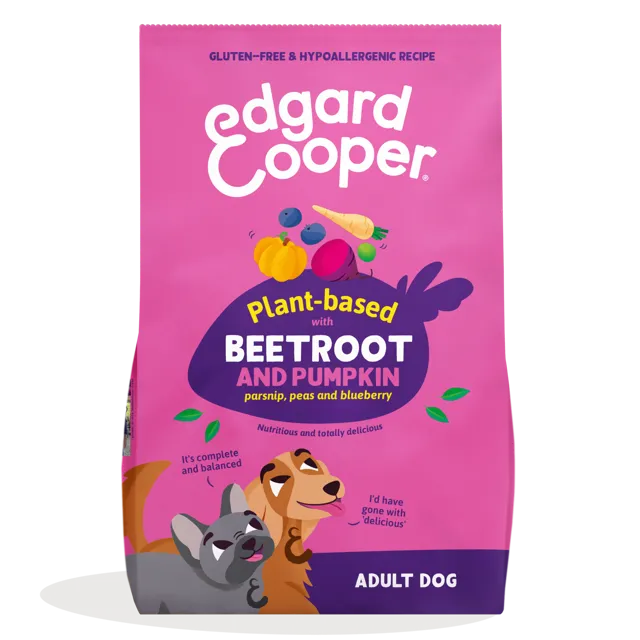
Edgard & Cooper Adult Plant-Based Dry: Beetroot & Pumpkin review
Edgard & Cooper's Adult Plant-Based kibble is a complete meat free food for grown dogs, built on a vegetable block declared at 20%, rice, and concentrated proteins drawn from pea, rice and potato. Rapeseed oil and linseed supply the fats, and dried algae stand in for fish as the marine style omega source. The supplement panel is heavier than most, with taurine at 2000 mg and vitamin B12 at 300 mcg per kilo. Both recipes sit in our Average band, which is a statement about a scale built around named animal ingredients rather than a criticism of how carefully this food is put together.
Our view
Likely to suit
For a household that has decided to feed without meat, this is a recipe that takes the job seriously.
- Households feeding a plant based diet by conviction, with a complete food to build the bowl on
- Dogs that have had trouble with several animal proteins, since neither label carries one
- Owners who want the supplement side spelled out, with taurine at 2000 mg and vitamin B12 at 300 mcg per kilo
- Dogs who do well on fibre, with beet pulp, dried chicory and dried yeasts sitting behind the vegetables
- Owners who like to see exactly what is in the block, since the vegetables are itemised down to the last percentage
Worth watching
Feeding a dog without meat is a real decision, so a few things are worth putting plainly.
- The protein comes from rice, pea and potato concentrates, which a dog digests less completely than the animal kind
- A meat free diet is worth planning alongside your vet, particularly for a young, pregnant or hard working dog
- Rice sits high on both lists, so grain free is not on offer here
- Moisture is not declared on either label, so the dry matter figures here rest on the 8% usually assumed for a kibble
Written by our editorial team. Independent guidance, not veterinary advice.
How this scores
How we scoreThe Details
Dog fit
For a household that has decided to feed without meat, this is a recipe that takes the job seriously. Feeding a dog without meat is a real decision, so a few things are worth putting plainly.
Dry
Adult
Toy, Small, Medium, Large, Giant
The score, in context
Both recipes come out in our Average band. The typical adult dry food sits a band above that, in Good, and the reason for the gap deserves stating openly. Our scoring is built around named animal ingredients and the quality of protein they bring, so a recipe that contains none of them cannot collect those points however thoughtfully it is made. On its own terms this is a careful piece of work. The vegetable block is itemised to the last percentage and the protein is declared at 25%. The supplement panel covers the nutrients a meat free bowl has to supply another way. Taurine and vitamin B12 are among them. If meat free is your brief, the band is a fact about our scale rather than a verdict on this food.
What's in it
Ingredients, as declared: vegetables* 20% (pumpkin* 4%, beetroot* 4%, potato* 4%, swede*, parsnip* 2%, kale*, beans*, peas* 1%), rice* 16.5%, rice protein 11%, pea protein* 7%, rapeseed oil* 5.5%, potato protein 4.5%, peas* (dried) 4.2%, pea starch 4%*, minerals*, beet pulp* (dried), vegetarian gravy*, yeasts* (dried) 3.1%, sunflower seed*, lentils* (dried), potatoes* (dried) 2.1%, linseed* 1.8%, lucerne* (dried), algae* (dried) 0.25%, chicory* (dried) 0.12%, apple* (dried), blueberries* (dried) 0.05%, elderberries* (dried), marjoram* (dried)
Named ingredients
Nutritional additives
vitamin A 27 000 IU, vitamin D 1700 IU, vitamin E 600 mg, vitamin B12 300 mcg, vitamin C 175 mg, taurine 2000 mg, copper (copper(II) sulphate pentahydrate) 5.5mg, zinc (zinc sulphate monohydrate) 120mg, manganese (manganous sulphate monohydrate) 12mg, iodine (calcium iodate anhydrous) 3.5mg, iron (iron(II) sulphate monohydrate) 75mg, selenium (sodium selenite) 0.25mg · Technological additives: antioxidants
Ingredient notes
The vegetable block leads both labels at 20% and every part of it is named, which is unusual and welcome. In the Beetroot and Pumpkin recipe that means pumpkin, beetroot and potato at 4% each, then swede, parsnip at 2%, kale, beans and peas. Vegetables listed this way cannot quietly change from batch to batch, and the reader knows exactly what is being counted.
Protein is where a meat free recipe has to work hardest. All three protein entries, from rice, pea and potato, are concentrates. A dog takes up plant protein less well than meat protein, so the declared 25% is not quite the same 25% you would read on a meat led label. What the recipe does in answer is spread the sources, so that between rice, pea and potato the amino acid profile is filled in from several directions.
Rapeseed oil at 5.5% and linseed at 1.8% carry the fats. Linseed is the plant kingdom's best known omega 3 source, though it supplies the shorter chain form that a dog converts slowly into the versions that skin and coat actually use. Dried algae at 0.25% is the interesting addition, since algae is where fish get their marine omegas from in the first place, making it the obvious answer for a bowl with no fish in it.
Dried beet pulp and dried yeasts do the fibre work alongside dried chicory at 0.12%. The chicory root brings inulin, food for the useful bacteria that live in the large intestine. Crude fibre is declared at 4%, a little above what a meat led kibble usually carries. A recipe built on vegetables and pulses will do that.
The supplement panel is the part to read closely on any meat free food, and this one is generous. Taurine is dosed at 2000 mg per kilo, an amino acid ordinarily supplied by meat and fish and one linked to heart health. Vitamin B12 at 300 mcg is another nutrient that normally arrives with animal ingredients. Vitamin E at 600 mg and vitamin C at 175 mg join the minerals. Zinc runs at 120 mg, iron at 75 mg, manganese at 12 mg, copper at 5.5 mg, iodine at 3.5 mg and selenium at 0.25 mg, the last as sodium selenite.
The finished analysis reads much like a mainstream kibble. Protein is 27.2% of dry matter, fat 13.0% and carbohydrate an estimated 46.8%, against 46.2% typical for adult dry food, with energy at 355 kcal per 100g. Because moisture is not declared, those dry matter figures assume the 8% a dry food usually holds.
How this variety differs
Pumpkin and beetroot at 4% each head the vegetable block, alongside potato at 4%, swede, parsnip at 2% and kale. Rice sits at 16.5% and rice protein at 11%, the single largest concentrated protein entry across the two recipes, with dried peas at 4.2% adding more behind it. Lentils, sunflower seed, apple and elderberries close the list.
Price and value
£7.57 a kilo. Beetroot and Pumpkin comes in a two and a half kilo bag and a 7kg, and Carrot and Courgette adds a 1kg.
A 15kg adult dog in moderate condition eats around 237 grams a day, which comes to £1.79. The standard maintenance sum, 110 × bodyweight^0.75, puts a dog that size near 840 kcal a day. The label's guide asks 204 to 253 grams for a dog between 15kg and 20kg.
Nutritional analysis
Declared analysis
25%
12%
4%
8%
Dry weight
27.2%
13%
4.3%
8.7%
46.8%
As-fed composition
Estimated breakdown of the finished product by ingredient category, from the declared ingredient list and ingoing weights. These are estimates, not measurements.
4.1%
57.4%
20.8%
5.5%
12.1%
Pricing & size
- Pack size
- 2,5 kg - £22.99 · 7 kg - £52.99
- Retailer pricing
- Coming soon
Live retailer pricing is not yet available for this food. Prices, cost per day and where to buy will appear here once retailer data is live.
Ingredients and nutrition are taken from manufacturer data. Retailer pricing is not yet live for this food.
Related dog food guides
Ranked shortlists that include foods like this one.