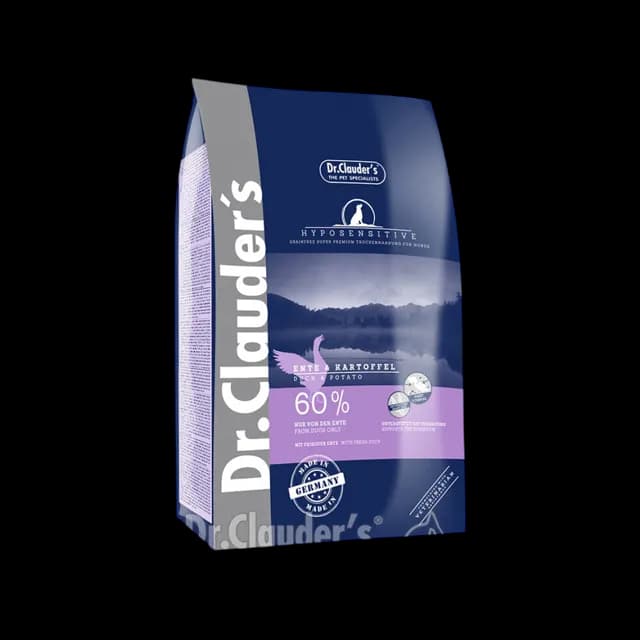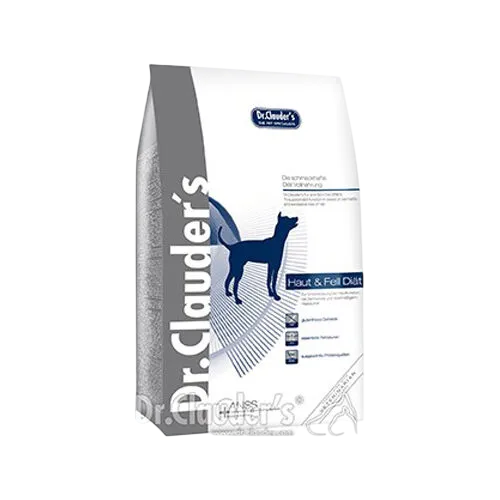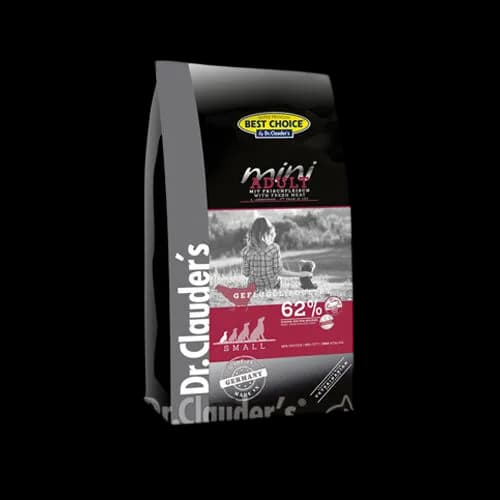


Dr Clauders
Dr Clauders Special Diet: FSD Skin and Coat review
Dr Clauders Special Diet is four condition-shaped recipes sold as everyday complete foods: skin and coat, intestinal, liver and kidney. Each one is cereal-led and each holds something back on purpose, with the restriction being the whole point rather than an oversight. All four sit in our Average band on a general reading. That is what a deliberately low protein or low fat build does, and the job here was never about winning a nutrition contest.
Our view
Likely to suit
If your vet has pointed you towards a diet built around one particular need, this is the sort of food they meant.
- Dogs whose owner and vet have settled on a diet aimed at one organ or one system, since each recipe restricts to a purpose
- Dogs that need fat kept down, with the intestinal recipe declaring 7% fat
- Dogs that eat cereals happily, since rice runs through all four with corn and barley alongside it
- Owners happy to open a fresh bag often, since the range comes only in the smaller sizes
- Dogs whose digestion needs an easier ride, with hydrolysed proteins on every one of these labels
Worth watching
These labels ask for a little more care than an everyday adult food, so a few points are worth having clear.
- A diet aimed at the liver or the kidneys is a decision to make with your vet, since the restriction that helps one dog can be the wrong call for another
- The animal content is written as poultry throughout, so none of these recipes can be tied to a particular bird
- The kidney recipe declares animal fat without naming the animal at all, the vaguest entry in the range
- A calorie figure is missing from all four packs, so the energy here is our own estimate from each analysis
Written by our editorial team. Independent guidance, not veterinary advice.
How this scores
How we scoreThe Details
Dog fit
If your vet has pointed you towards a diet built around one particular need, this is the sort of food they meant. These labels ask for a little more care than an everyday adult food, so a few points are worth having clear.
Dry
Adult
Poultry
The score, in context
All four sit in our Average band, and the reason needs saying plainly rather than being left to look like a verdict on the food. Our scoring reads a bag as a general adult diet, rewarding meat content, protein quality and a modest carbohydrate load. These recipes are built the other way round on purpose. The kidney diet holds protein to 15.5% of dry matter and ash to 4.4%, the liver diet sits at 18.8% protein, and the intestinal diet keeps fat down to 7.7% of dry matter. A general reading marks all of that down, while a vet would recognise it as the design. Against the typical adult dry food in our Good band, these are simply not competing on the same terms.
What's in it
Ingredients, as declared: Corn, poultry meat meal, rice, millet, linseed, poultry fat, protein hydrolysate, egg powder, fish oil, chicory, monocalcium phosphate, thistle oil, sodium chloride sea salt, silica, potassium chloride, yucca shidigera.
Named ingredients
Ingredient notes
Cereals lead every recipe here, and that is a design decision, not a corner cut. Rice, corn and barley are efficient sources of digestible energy that bring very little protein and almost no phosphorus with them. That is exactly what a diet built to hold protein or mineral load down is looking for.
The animal side is written in the general: poultry meat meal, poultry protein, poultry fat and, in the kidney recipe, animal fat with no species at all. Meat meal is the dry rendered powder that has been the backbone of kibble for decades and it is a concentrated protein source, but nothing on these labels tells you which bird it came from.
Each recipe adds something for its own job. Linseed, fish oil and thistle oil run through the skin recipe. Green lipped mussel and yeast beta glucans sit in the intestinal one. The liver diet brings parsley, psyllium and ammonium chloride. The kidney diet swaps in calcium carbonate with the protein held low.
Chicory appears on all four labels as a source of inulin, the prebiotic fibre gut bacteria feed on. Potassium chloride is on all four as a mineral top-up. The pairing is a familiar one on restricted diets.
Two of the recipes use cellulose, the purified plant fibre that is essentially bulk without calories. In a diet meant to fill a dog up while holding something else back that is a defensible choice, though it brings nothing else along with it.
How this variety differs
Corn leads with poultry meat meal behind it, then rice and millet. The coat work is shared between linseed, fish oil and thistle oil, three different routes to the fatty acids that skin condition depends on. Egg powder adds a complete protein and silica appears as an anti-caking mineral. Protein converts to 24.3% of dry matter with fat at 15.5%, the richest reading of the four.
Price and value
£7.78 a kilo across the range, sold in 1 kg and 4 kg bags.
As a guide, take a 15kg adult dog in moderate condition needing about 840 kcal a day (110 × bodyweight^0.75, the standard maintenance estimate). That comes to £1.78 a day on the liver recipe, £1.81 on the skin and coat, £1.88 on the kidney and £2.02 on the intestinal. Those calorie figures are our estimates from each analysis, since the pack prints none.
Nutritional analysis
Declared analysis
Estimated using Modified Atwater factors*
22%
14%
2%
5.6%
9.5%
Dry weight
24.3%
15.5%
2.2%
6.2%
51.8%
As-fed composition
Estimated breakdown of the finished product by ingredient category, from the declared ingredient list and ingoing weights. These are estimates, not measurements.
26.6%
64.6%
0.5%
3%
5.3%
Pricing & size
- Pack size
- 1 kg, 4 kg
- Retailer pricing
- Coming soon
Live retailer pricing is not yet available for this food. Prices, cost per day and where to buy will appear here once retailer data is live.
Ingredients and nutrition are taken from manufacturer data. Retailer pricing is not yet live for this food.
Related dog food guides
Ranked shortlists that include foods like this one.