


Skip to content
Off the Leash
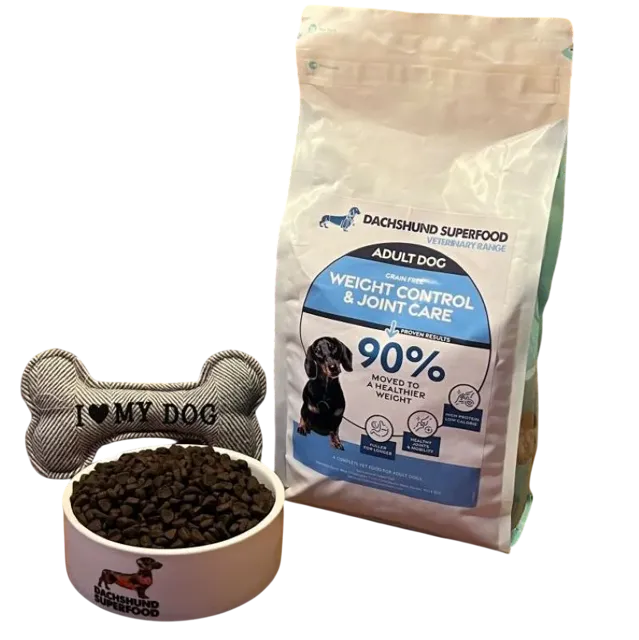
Dachshund Superfood Veterinary Range – Weight Control and Joint Care

Dachshund Superfood

Dachshund Superfood Veterinary Range: Weight Control and Joint Care review

48.4/100Average
DryAdult

The Dachshund Superfood Veterinary Range is four small-breed kibbles, each aimed at one job: dental, digestive, skin and coat, and weight with joint support. What ties them together is hydrolysed animal protein, meaning protein already broken into shorter pieces before it reaches the bowl, sitting on a potato and sweet potato base with no cereal. Three settle in our Good band with the weight and joint recipe a step below in our Average band, so the job on the front of the bag is what should choose between them.

Where to buy: coming soon
Live retailer pricing is coming soon. Once we have prices from UK retailers, the best price, cost per day and where to buy will appear here.

Our view

Likely to suit

Each of these four bags was put together for a particular thing you have noticed about your dog.

  • Small dogs with one issue that needs attention, since every recipe is built around a single named job
  • Dogs whose stomachs turn at ordinary kibble, because the animal protein is hydrolysed in all four recipes
  • Owners avoiding cereal, since the starch across the range comes from potato and sweet potato
  • Households that want a small kibble, as every bag here is made in that size
  • Owners who like knowing what an ingredient is for, since the working entries all come with a declared percentage

Worth watching

The range carries a clinical name, so it helps to know what these labels actually declare.

  • Three of the four recipes carry fish somewhere on the list, so a dog kept away from fish is looking at the digestive recipe
  • Carbohydrate does a fair share of the carrying across the range, converting to between 41.9% and 46.8% of dry matter
  • No separate additives panel is published for any of the four, so vitamin and trace mineral doses are not printed

Written by our editorial team. Independent guidance, not veterinary advice.

How this scores

How we score
48.4/100Average
Protein and processingPoor
Nutritional balanceGood
TransparencyOutstanding
ValueAverage

The Details

Dog fit

Each of these four bags was put together for a particular thing you have noticed about your dog. The range carries a clinical name, so it helps to know what these labels actually declare.

Food type

Dry

Life stage

Adult

Breed size

Small

Main protein

White Fish

The score, in context

Three of the four finish in our Good band, level with the middle of the adult dry shelf, and the weight and joint recipe sits a step below in our Average band. That is a fair result for recipes shaped around a job instead of a headline meat figure. Hydrolysed protein tends to read modestly on paper, and the protein declarations here are moderate by design. The band is earned on how much the labels declare and on the quality of what is in them. Beyond that one step down, the difference between them is the purpose rather than the placing.

What's in it

Ingredients, as declared: Freshly Prepared Hydrolysed White Fish (26%), Potato, Hydrolysed Dried White Fish (11.5%), Pea Protein, Sweet Potato, Salmon Oil (5.5%), Lignocellulose (5.5%), Beet Pulp (4%), Pea Fibre (4%), Hydrolysed Salmon Gravy (2.5%), Minerals, Green Lipped Mussel (0.3%), Marigold (Source of Lutein).

Named ingredients

Freshly Prepared Hydrolysed White Fish (26%), Potato, Hydrolysed Dried White Fish (11.5%), Pea Protein, Sweet Potato, Salmon Oil (5.5%), Lignocellulose (5.5%), Beet Pulp (4%), Pea Fibre (4%), Hydrolysed Salmon Gravy (2.5%), Minerals, Green Lipped Mussel (0.3%), Marigold (Source of Lutein).
Ingredient notes

Hydrolysis is the thread running through the whole range. Breaking protein into shorter fragments before it goes into the kibble makes it easier for a touchy gut to handle. It is also less likely to be spotted by an immune system that has decided it dislikes something. It is a real piece of engineering, not a label word, and it is on every bag here.

The starch and the binding come from potato and sweet potato in all four. Wheat, maize and rice are absent right across the range. Beet pulp handles fibre in three of the recipes, and three also carry a purified plant fibre, cellulose or lignocellulose, which is a white powder that adds bulk and almost no calories. It is a workmanlike inclusion, not a nourishing one, and in a dental or a weight recipe it is doing an obvious job.

Marigold appears on every label as a source of lutein, the pigment that gathers in the eye. It sits at the trace end of each list, so read it as a considered touch and not as the reason to choose the bag.

Only the digestive recipe keeps to one animal from top to bottom. The other three pair their headline species with a second marine source. That matters most on a strict elimination trial. For ordinary sensitive feeding it is a smaller point.

How this variety differs

Built on white fish at 26% freshly prepared and hydrolysed, with 11.5% hydrolysed dried white fish behind it. Then it is leaned out: fat sits at 9% and fibre at 8.5%, the fibre coming from lignocellulose at 5.5%, beet pulp at 4% and pea fibre at 4%. That fibre load fills a dog on 315 kcal per 100 grams, the lightest bowl of the four. Green lipped mussel at 0.3% is the joint entry, a whole food source of the same building blocks that joint supplements isolate.

Price and value

£9.00 a kilo across the range, sold in 1.5kg and 10kg bags of small kibble.

As a guide, feeding a 15kg adult dog in moderate condition comes to between £1.98 and £2.40 a day, assuming about 840 kcal a day (110 × bodyweight^0.75, the standard maintenance estimate). The weight and joint recipe sits at the top of that range because it carries the fewest calories per bowl. These are small-breed bags, so a dachshund-sized dog will eat a fraction of those portions.

Nutritional analysis

Declared analysis

Energy
315 kcal/100g
Protein

29%

Fat

9%

Fibre

8.5%

Ash

7%

Moisture

8%

Dry weight

Protein

31.5%

Fat

9.8%

Fibre

9.2%

Ash

7.6%

Carbs

41.9%

As-fed composition

Estimated breakdown of the finished product by ingredient category, from the declared ingredient list and ingoing weights. These are estimates, not measurements.

Meat

40.3%

Carbs

44.7%

Oils

5.5%

Other

9.5%

Pricing & size
Pack size
1.5kg Small Kibble, 10kg Small Kibble (the description's Product Information block says "Available Sizes: 1.4kg, 10kg" - the on-page variation selector says 1.5kg)
Retailer pricing
Coming soon

Live retailer pricing is not yet available for this food. Prices, cost per day and where to buy will appear here once retailer data is live.

Ingredients and nutrition are taken from manufacturer data. Retailer pricing is not yet live for this food.

Related dog food guides

Ranked shortlists that include foods like this one.
All reviews

Featured feeding accessories

All feeding accessories

Brackenwood

Slow Feeder Maze Bowl

Slows fast eaters and eases gulping at mealtimes.

From £12.99· 4 retailers
View

Tarn & Co

Raised Double Diner

Height-set stand for easier, tidier eating.

From £28.99· 3 retailers
View

Reviewed by Off the Leash Editorial

Last updated 28 August 2026