


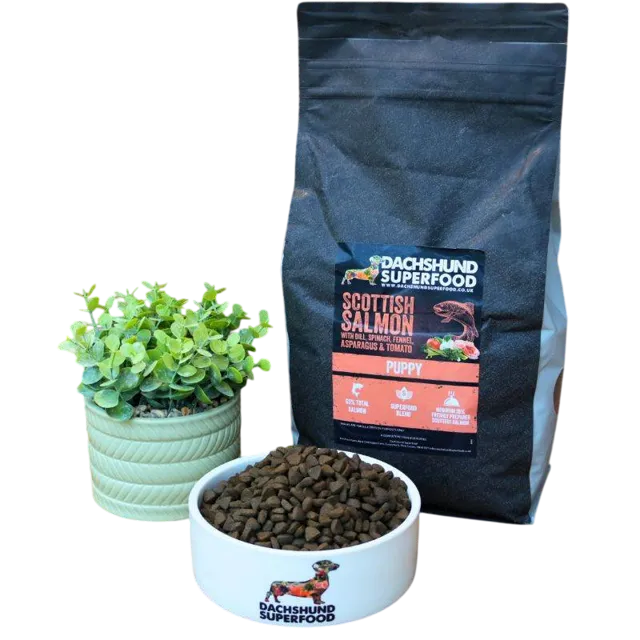

Dachshund Superfood
Dachshund Superfood Puppy: Scottish Salmon review
Dachshund Superfood Puppy is a small breed growth range built around a 65% meat headline, offered as an English free range turkey and pork recipe and a Scottish salmon one. Sweet potato and beans do the starch work here, with no cereal involved. Both recipes declare calcium and both land inside the range growing bone works to, and the joint and prebiotic supplements arrive with milligram doses attached. Both recipes sit in our Excellent band.
Our view
Likely to suit
If your pup is a long backed little dog with a lot of growing to do in a small frame, this range was drawn up with them in mind.
- Dachshund puppies and other small breeds, the size and shape this range is designed around
- Owners who read the calcium line first, since both recipes declare it and both convert inside the range growth asks for
- Pups whose joints deserve attention early, with glucosamine, methylsulfonylmethane and chondroitin sulphate all carrying printed doses
- Grain free households, since beans and sweet potato bind the kibble and no cereal is used
- Puppies who do best on a meat led bowl, both recipes declaring 65% animal ingredients at the front of the list
Worth watching
A few habits of this range's labelling are worth understanding before you commit to a bag.
- The feeding guide is drawn for small breed pups and stops at 12kg of bodyweight, so a bigger pup will run past the end of the chart while still growing
- No separate additive panel is published, with the supplements declared inline in the composition, so the vitamin and trace mineral doses are not there to be checked
- The superfood blend is declared by equivalence, each entry equivalent to 4% fresh ingredients, so it reads as a garnish and not a main event
- Olive extract comes in at 0.01%, a trace inclusion that will not be doing any heavy lifting
Written by our editorial team. Independent guidance, not veterinary advice.
How this scores
How we scoreThe Details
Dog fit
If your pup is a long backed little dog with a lot of growing to do in a small frame, this range was drawn up with them in mind. A few habits of this range's labelling are worth understanding before you commit to a bag.
Dry
Puppy
Small
Salmon
The score, in context
Both recipes come to rest in our Excellent band, and they sit close together inside it. The typical puppy dry food sits a band lower in Good. These two clear the middle of the field on the strength of a high declared meat share, a light starch load and a calcium figure that is actually printed. Transparency reads Outstanding on both labels and protein and processing Good on each. Value keeps step with the Excellent reading of the food itself. Nutritional balance is Excellent on the salmon and Outstanding on the turkey, so neither recipe has a weak side.
What's in it
Ingredients, as declared: 65% Salmon (35% Freshly Prepared Scottish Salmon, 22% Dried Salmon, 5% Salmon Oil, 3% Salmon Gravy), Sweet Potato, Beans, Beet Pulp, Omega 3 Supplement, Dried Superfood Blend* (Including Dill, Spinach, Fennel, Asparagus, Tomato), Minerals, Fructooligosaccharides (FOS, 192 mg/kg), Glucosamine (170 mg/kg), Methylsulfonylmethane (170 mg/kg), Chondroitin Sulphate (125 mg/kg), Mannanoligosaccharides (MOS, 48 mg/kg), Nucleotides, Olive Extract (0.01%), *Each equivalent to 4% Fresh Ingredients
Named ingredients
Nutritional additives
Inline in composition. No separate additives panel is published.
Ingredient notes
Both recipes lead with 65% animal ingredients, and neither leaves that headline as a slogan. The label splits it into freshly prepared meat, dried meat, gravy and fat or oil. The dried portion counts for more than its share suggests. Dried meat has already given up its water, so the protein it declares is roughly the protein that reaches the kibble. Fresh meat is weighed with the water still in it.
The binding comes from beans and sweet potato, with beet pulp behind them for a gentle fibre, and no cereal appears on either list. That keeps the starch load lighter than most kibbles ask for, and both recipes come in below the 39.0% of dry matter that carbohydrate typically reaches in a puppy dry food.
Calcium is declared on both recipes and both figures sit inside the range growing bone needs, at 1.41% of dry matter in the turkey and pork and 1.30% in the salmon. Calcium is the classic thing to get wrong when rearing a puppy, so a printed, in range number is exactly the reassurance you want. Plenty of growth labels never offer it at all.
The joint package is a working one with the milligrams on show. Glucosamine and methylsulfonylmethane run at 180 mg/kg each in the turkey and pork and 170 mg/kg each in the salmon, with chondroitin sulphate at 125 mg/kg in both. Prebiotics are printed too, with fructooligosaccharides at 175 mg/kg in the turkey and pork and 192 mg/kg in the salmon, and mannanoligosaccharides at 50 and 48 mg/kg respectively. Both feed the helpful bacteria that live in a puppy's large bowel. That is worth supporting while a young digestion settles in.
The dried superfood blend closes each list, and the label is candid about its scale, noting each entry as equivalent to 4% fresh ingredients. Read it as seasoning. What holds these recipes up is the meat at the front and the minerals behind it, and the missing additive panel is the one place where the labelling could be more generous than it is.
How this variety differs
The Scottish salmon recipe builds the whole of its 65% from one fish: 35% freshly prepared Scottish salmon, 22% dried salmon, 5% salmon oil and 3% salmon gravy. Salmon is the only animal the label names. For a pup being raised on a single protein, that is a genuinely useful label. One caveat: the omega 3 supplement names no species, so a strict elimination plan is worth confirming with the maker first.
Protein declares at 33.0%, or 35.9% of dry matter, with carbohydrate estimated at 34.0% as fed and 36.9% of dry matter and energy at 380 kcal per 100g. On this label the calcium comes to 1.30% of dry matter. This is also the recipe carrying nucleotides. Its supplement doses run a little differently. Prebiotics are FOS at 192 mg/kg and MOS at 48 mg/kg, while joint support is glucosamine and methylsulfonylmethane at 170 mg/kg each plus chondroitin sulphate at 125 mg/kg.
Price and value
£6.17 a kilo, sold in 2kg, 6kg and 12kg bags.
What a small breed pup needs at three months is not what they need at six, so read the guide printed on the pack and let their waistline confirm the answer. The printed guide runs from 45g a day at the light end to 75g a day at its widest point.
Nutritional analysis
Declared analysis
33%
14.5%
2.5%
8%
8%
Dry weight
35.9%
15.8%
2.7%
8.7%
36.9%
As-fed composition
Estimated breakdown of the finished product by ingredient category, from the declared ingredient list and ingoing weights. These are estimates, not measurements.
62%
3%
26.1%
8.9%
Pricing & size
- Pack size
- 2kg, 6kg, 12kg
- Retailer pricing
- Coming soon
Live retailer pricing is not yet available for this food. Prices, cost per day and where to buy will appear here once retailer data is live.
Ingredients and nutrition are taken from manufacturer data. Retailer pricing is not yet live for this food.
Related dog food guides
Ranked shortlists that include foods like this one.